Among the great deities of Sanathana Dharma, Lord Vishnu stands as the Preserver, the Sustainer, the one who holds the fabric of creation together across vast cycles of cosmic time. Where Brahma creates and Shiva dissolves, Vishnu maintains — intervening at critical moments through his divine avatars to restore dharma and protect the universe from collapse. He is called Sarvavyapi — the all-pervading — because his essence permeates every atom of existence, every breath of every being, every star in every galaxy. To understand Vishnu is to understand the fundamental principle that the universe is not abandoned to chaos, but is held in the compassionate, watchful care of an infinite, conscious Preserver.
This complete guide explores Vishnu in his full depth — from his ancient hymns in the Rig Veda to the rich iconography of his four arms, from the splendour of his transcendental abode Vaikunta to the profound theology of the Vaishnava philosophical schools. We trace his ten avatars (Dashavatara) as a complete revelation of divine wisdom, examine the Vishnu Sahasranama and the Pancharatra Agama, and visit the great temples where his presence is worshipped across millennia.
Etymology: He Who Pervades All Existence
The name Vishnu (विष्णु) is derived from the Sanskrit root vish (विश्), meaning “to pervade”, “to enter”, or “to spread throughout.” The suffix -nu transforms this root into an agent noun: Vishnu thus means literally “he who pervades,” “the all-pervading one,” or “he who has entered into all things.” This etymology is not merely grammatical — it is a complete theological statement. Unlike a deity localised in one realm or one form, Vishnu is understood to be immanent in all matter, in all souls, in all dimensions of existence simultaneously.
The Vishnu Purana declares: “Yad bhutam yaccha bhavyam hi sakalam vishnu-atmakam” — “All that has existed, all that will exist, is pervaded by Vishnu.” This pervasiveness is not passive; it is the active, sustaining presence that keeps creation in ordered motion. Without this pervading consciousness, the cosmos would immediately dissolve into inert matter. Vishnu is therefore not just one deity among many — he is the underlying substratum of conscious existence itself, recognised by different names and in different aspects across the entire range of Vedic and Puranic tradition.
Vishnu in the Vedas: The Three Great Strides
Vishnu’s presence in the oldest stratum of Hindu scripture is unmistakable. In the Rig Veda, one of humanity’s most ancient religious texts, Vishnu appears prominently in hymn 1.154, which opens: “Vishnum stavatha viryam pra vocham” — “I shall proclaim the heroic deeds of Vishnu.” The hymn celebrates Vishnu’s three cosmic strides — the act of Trivikrama — by which he traverses the entire universe in three steps: the first covering the earth, the second the atmosphere, and the third the highest heaven. In doing so, Vishnu measures and encompasses the three planes of existence, asserting his sovereignty over the whole cosmos.
The Rig Veda declares: “Vishnu strode over this (universe); in three places he planted his step.” The third stride — placed in the highest heaven — is described as a place of supreme bliss where the gods feast on immortal amrita (nectar). This celestial summit of Vishnu’s third step is identified in later theology as Vaikunta, the transcendental abode beyond time and matter. Even in the Vedic age, therefore, Vishnu was already associated with the pinnacle of divine realms.
In the Vedic period, Vishnu is also associated with solar symbolism. He is closely allied with Indra in the Rig Veda, helping Indra slay Vritra (the dragon of chaos) by his three strides that illuminate all space. Some scholars note that the Vedic Vishnu represents the solar energy in its three phases — rising (earth), noon (atmosphere), and the celestial zenith (heaven). This solar identity evolves over the Puranic age into Vishnu’s full cosmic sovereignty, but the seed of that sovereignty is already fully present in the Rig Vedic hymns composed thousands of years ago.
The Iconography of Vishnu: Four Arms and Cosmic Symbols
No aspect of Vishnu’s depiction is arbitrary. Every element of his iconography is a carefully encoded theological statement, a visual language of the divine that initiates can read like scripture.
The Four Arms and Their Sacred Objects
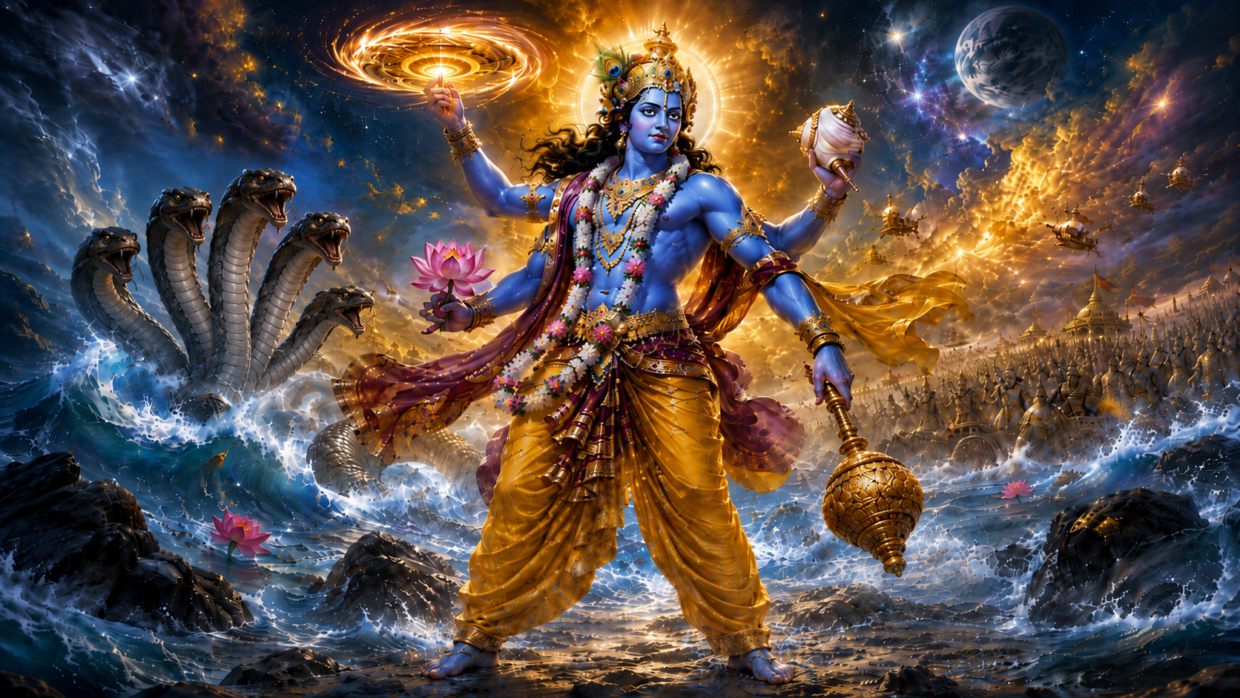
Vishnu is universally depicted with four arms — representing his lordship over the four directions of space, the four Vedas, the four goals of human life (dharma, artha, kama, moksha), and the four aspects of his divine power. Each arm holds one of four sacred objects:
- Shankha (Conch — Panchajanya): The divine conch shell, named Panchajanya, produces the primordial sound of creation — the cosmic Om. Its spiral shape represents the mathematical logarithm of infinite expansion. When Vishnu blows it, the sound penetrates all planes of existence, calling the cosmos to order and dissolving the confusion of ignorance.
- Chakra (Sudarshana — the discus): The spinning discus weapon, called Sudarshana (“beautiful to behold”), is the most potent weapon in creation. It has 108 serrated edges and rotates at the speed of consciousness. It represents the revolving wheel of time, the power of discrimination (viveka), and the divine mind that cuts through all illusion. Sudarshana is so powerful that it is worshipped independently as a deity in some Vaishnava temples.
- Gada (Kaumodaki — the mace): The mace named Kaumodaki represents primal force, the power of knowledge, and the authority of cosmic law. It is the weapon of righteous strength that destroys the ego and the demonic forces of arrogance. The mace also symbolises the power of time itself, which crushes all that is transient.
- Padma (Lotus): The lotus, which rises pristine from muddy water, represents spiritual liberation, purity, and the unfolding of consciousness from material bondage. Vishnu holding the lotus reminds devotees that even in the midst of a turbulent and impure world, the soul can remain untouched, like the lotus floating above the water that nourishes but never stains it.
The Blue Skin, the Garments, and the Sacred Ornaments
Vishnu’s skin is deep blue — the colour of the infinite sky, the deep ocean, and the dark space of the cosmos. Blue is the colour of that which is vast beyond measure, that which has no boundaries. Just as the sky appears blue but has no actual colour of its own — it is the light of consciousness refracted through the medium of existence — Vishnu’s blue form indicates that he is infinite, boundless, and beyond all material definition.
He wears Pitambara — radiant yellow or golden silk garments. Yellow represents the earth, fertility, wisdom, and the golden light of the sun. The contrast of blue skin with golden garments creates a visual metaphor: the infinite (blue) clothed in the finite (gold), spirit embodied in matter.
On his chest gleams the Kaustubha gem — the most precious jewel in all creation, churned up from the cosmic ocean (Kshira Sagara). The Kaustubha represents the pure soul (jiva) in its liberated state, radiant and eternally dwelling at the heart of the Lord. Beside it is the Shrivatsa mark — an auspicious curl of golden hair on his chest — which represents Lakshmi’s eternal dwelling place on Vishnu’s person, signifying that divine grace and prosperity always reside in him.
Vishnu wears the Vaijayanti garland — a magnificent garland of five types of flowers representing the five sense objects (sound, touch, form, taste, smell) and the five great elements. This garland indicates his mastery over all sensory creation. His forehead bears the Tilaka — the Urdhva Pundra mark (vertical lines with a central red dot) — the identifying mark of Vaishnavas, which points upward toward the divine and represents Vishnu’s feet at the crown of the cosmos.
Vaikunta: The Transcendental Divine Abode
Beyond the material universe, beyond the realms of Brahma’s creation and Shiva’s dissolution, exists Vaikunta — the eternal, transcendental abode of Lord Vishnu. The name means “the place without obstruction” or “the realm beyond grief,” from the Sanskrit vai (certainly) and kunta (grief/obstruction). Unlike the celestial heavens within the material cosmos — which are temporary stations for souls who have accumulated merit but not yet achieved moksha — Vaikunta is beyond time, beyond karma, and beyond the cycles of creation and dissolution.
The Bhagavata Purana and Vishnu Purana describe Vaikunta in exquisite detail. It is surrounded by the Viraja river, which marks the boundary between the material and transcendental realms — souls crossing this river shed their material coverings entirely. The realm itself is made of pure chit (consciousness) — every object within it, every flower, every jewel, every building, is conscious and blissful. The residents of Vaikunta are all liberated souls (muktas) in their spiritual forms, eternally engaged in the loving service of Vishnu.
At the entrance of Vaikunta stand the gatekeepers Jaya and Vijaya — two mighty figures who were cursed by the four Kumara sages (Sanaka, Sanandana, Sanathana, Sanatkumara) to take birth in the material world three times as great demons, because they had blocked the sages from entering Vaikunta. Through their three births as demonic pairs (Hiranyakasha-Hiranyakashipu, Ravana-Kumbhakarna, Shishupala-Dantavakra) and their deaths at the hands of Vishnu’s avatars, they accumulated such intense devotion that they were restored to their positions in Vaikunta after each birth. Their story illustrates that even opposition to Vishnu, when intense enough, can function as a form of devotion.
Ananta Shesha: The Cosmic Serpent Bed
In the space between cycles of creation, Vishnu rests in the Anantashayana pose — recumbent upon the great cosmic serpent Ananta Shesha (also called simply Ananta or Adishesha), who floats upon the Kshira Sagara — the ocean of milk, or the causal ocean. The image is one of the most powerful in all of Hindu cosmology: the infinite Lord resting on infinity (Ananta means “without end”), floating on the primal substratum of existence.
Ananta Shesha is described as having a thousand heads — each head crowned with a magnificent jewel whose light illuminates all realms. He is the embodiment of primordial time, of the infinite expansion of cosmic space, and of the foundational tamas energy that supports all creation. He is not a demon or a malefic force — he is among the greatest devotees of Vishnu, serving as his eternal couch, his umbrella, his sandals, and in his human incarnation as Lakshmana (Rama’s devoted brother) and Balarama (Krishna’s elder brother).
From Vishnu’s navel, as he rests in Anantashayana, grows a magnificent lotus. On this lotus sits Brahma, who opens his eyes and begins the work of creation at Vishnu’s will. This image — Vishnu as the source from which creation emerges without effort — encapsulates the Vaishnava understanding that Brahma’s creative act is not independent but entirely dependent on and directed by Vishnu.
Garuda: The Divine Eagle and Sacred Vahana
Vishnu’s vehicle (vahana) is Garuda — a magnificent golden eagle of immense size and power. Garuda is no mere mount; he is a divine being of extraordinary spiritual standing, and the flag of Vishnu bears Garuda’s image. His story is told in the Mahabharata and Puranas: born to the sage Kashyapa and Vinata, Garuda is the eternal enemy of serpents (nagas), because his mother Vinata was enslaved by her sister Kadru (mother of the nagas) through a trick. To free his mother, Garuda stole the amrita (nectar of immortality) from the gods — a feat that even Indra could not prevent — demonstrating his supreme power.
When Vishnu appeared before him, Garuda chose to become his devotee and vahana rather than drink the amrita himself, achieving immortality through devotion rather than the nectar. This choice is deeply instructive: devotion to Vishnu is superior even to physical immortality. Theologically, Garuda represents the Vedas — he carries Vishnu (the Supreme Truth) just as the Vedas carry and convey the Supreme Reality. His wings are the two great sections of the Vedas (karma-kanda and jnana-kanda). He rises above the nagas (representing lower desires and the binding force of material nature) to soar in the clear sky of pure knowledge. Garuda also represents the discriminating intellect (buddhi) that, when purified, rises above the lower nature and carries the devotee directly to the highest truth.
The Dashavatara: Ten Divine Avatars of Vishnu
The doctrine of the Dashavatara — Vishnu’s ten principal avatars — is one of the most remarkable theological constructions in the history of religion. The word avatar (अवतार) means “descent” — the divine descending into the material world to accomplish specific cosmic purposes. The Bhagavad Gita (4.7-8) gives the theological rationale in Krishna’s own words: “Whenever dharma declines and adharma rises, I manifest myself. For the protection of the good, the destruction of the wicked, and the firm establishment of righteousness, I take birth in age after age.”
The ten avatars, presented in their traditional order, trace a remarkable arc from the simplest forms of life to the prophesied future — a sequence that modern scholars have noted parallels the broad stages of biological evolution in striking ways.
1. Matsya — The Great Fish
At the dawn of the current cosmic cycle, a great deluge threatened to submerge all creation and allow the demon Shankhasura to steal the Vedas from Brahma. Vishnu incarnated as a massive fish (Matsya), warning the first man Manu of the coming flood and instructing him to build a boat loaded with the seeds of all species. Matsya then towed the boat through the cosmic flood by means of Shesha’s body used as a rope, and recovered the Vedas by slaying Shankhasura. This avatar marks life’s first emergence in aquatic form — the ocean as the womb of all evolution.
2. Kurma — The Cosmic Tortoise
When the gods and demons agreed to churn the cosmic ocean (Kshira Sagara) to produce amrita using Mount Mandara as the churning rod and the great serpent Vasuki as the rope, the mountain began to sink into the ocean floor. Vishnu descended as a great tortoise (Kurma) and supported Mount Mandara on his back, providing the stable foundation for the great cosmic churning. From this churning emerged the divine physician Dhanvantari with amrita, the goddess Lakshmi, the sacred cow Kamadhenu, the horse Ucchaihshravas, and the terrible poison Halahala which Shiva consumed to protect creation. The Kurma avatar represents the amphibious transition of life from water to land.
3. Varaha — The Cosmic Boar
The demon Hiranyaksha seized the Earth goddess (Bhudevi) and dragged her to the bottom of the cosmic ocean. Vishnu descended as a magnificent boar (Varaha) of immense size — so large that his body filled the space between earth and sky — and dove to the deepest depths of the primordial ocean. After a fierce battle of a thousand divine years, he slew Hiranyaksha and carried Bhudevi back to her rightful place on the surface of the cosmic waters, balanced on his tusks. The Varaha avatar represents the fully terrestrial mammal — the great tusked animal — and the principle that the earth (as divine mother) is always under the protection of the Supreme.
4. Narasimha — The Man-Lion
The demon king Hiranyakashipu — the brother of Hiranyaksha, burning with vengeance — performed terrible austerities to obtain from Brahma a boon that made him virtually indestructible: he could not be killed by man or beast, by day or night, indoors or outdoors, on earth or in the sky, by any weapon. His own devoted son Prahlada refused to abandon his worship of Vishnu despite horrific torture. When Hiranyakashipu challenged Prahlada — asking where his Lord was, even in this pillar — Vishnu burst forth from the pillar as Narasimha (half-man, half-lion). At the precise threshold of dusk (neither day nor night), at the entrance of the palace (neither indoors nor outdoors), placing Hiranyakashipu on his lap (neither earth nor sky), and using his own claws (not weapons), Narasimha disembowelled the demon. This avatar — the boundary between beast and human consciousness — illustrates that the divine observes the precise letter of cosmic law even while transcending it.
5. Vamana — The Dwarf Brahmin
The virtuous demon king Mahabali had through his generosity and righteousness conquered all three worlds, displacing the gods from heaven. Vishnu, to restore cosmic balance and to bless Mahabali himself with liberation, incarnated as a tiny dwarf brahmin (Vamana). Approaching Mahabali during a great yajna, Vamana asked only for three paces of land — as much as his small foot could cover three times. Mahabali agreed, despite warnings from his guru Shukracharya. Vamana then expanded to cosmic proportions — the Trivikrama form — covering the earth with one step, the entire sky and atmosphere with the second, and with the third step (there being no more space) gently placing it on Mahabali’s head, pushing him to the netherworld (Patala) — where he rules in honour and bliss, with the promise of Vishnu himself as his gatekeeper. This avatar marks the complete emergence of fully human form from the transitional dwarf stage.
6. Parashurama — The Warrior Sage
Parashurama (“Rama with the axe”) was born as a brahmin — the son of the sage Jamadagni and the noble Renuka — but carried within him the full fury of the warrior class. When the arrogant Kshatriya king Kartavirya Arjuna (Sahasrarjuna) had his father Jamadagni killed and stole the divine cow Kamadhenu, Parashurama’s wrath became a cosmic force. He circumambulated the earth twenty-one times, systematically destroying the entire Kshatriya order that had become corrupt and oppressive. He is said to have filled five lakes with their blood at Kurukshetra. Parashurama represents the principle that when the ruling class (Kshatriyas) itself becomes adharmic and tyrannical, a higher power must arise to reset the balance — even at tremendous cost.
7. Rama — Maryada Purushottama
Rama is Vishnu’s avatar as the ideal human being — Maryada Purushottama, “the supreme person of perfect conduct.” Born as the crown prince of Ayodhya, Rama lived a life of impeccable dharma: the perfect son who accepted exile without complaint, the perfect husband who crossed oceans to rescue Sita, the perfect king whose reign (Rama Rajya) became the eternal standard of just governance. Through his defeat of the demon king Ravana, Rama demonstrated that dharma, however hard-pressed, ultimately prevails. The Ramayana of Valmiki — humanity’s first poem (Adi Kavya) — is devoted to his story, which has shaped the moral imagination of South and Southeast Asia for millennia.
8. Krishna — Yogeshvara, the Complete Avatar
Krishna is considered by many Vaishnavas to be not merely an avatar but the Svayam Bhagavan — the Supreme Godhead himself in human form. Where Rama embodied one aspect of the divine (ideal humanity), Krishna embodied all aspects simultaneously: the playful child (Bal Gopala), the passionate lover (Raseshvara of the Vrindavana rasa-lila), the wise statesman (the Pandavas’ counsellor), and the supreme cosmic teacher (the speaker of the Bhagavad Gita on the battlefield of Kurukshetra). As Yogeshvara — the lord of all yoga — Krishna revealed in the Gita the complete science of self-realisation through karma yoga, bhakti yoga, jnana yoga, and raja yoga. His life story, told in the Bhagavata Purana’s tenth skandha, remains the most beloved and most detailed of all avatar narratives.
9. Buddha — The Compassionate Teacher
In the Vaishnava interpretation, Gautama Buddha is included as the ninth avatar of Vishnu — though the theological rationale varies among schools. One interpretation holds that Vishnu incarnated as Buddha to stop the cruel misuse of Vedic rituals (particularly excessive animal sacrifices) and to teach compassion (ahimsa) as the foundation of dharmic life. Another interpretation, found in the Bhagavata Purana, suggests that Buddha appeared to delude the demons into abandoning Vedic sacrifices so that they would lose divine protection — a form of divine maya (illusion). Whatever the interpretation, the inclusion of Buddha in the Dashavatara reflects the remarkable assimilative capacity of the Vaishnava tradition and the universal reverence for the historical Buddha across the Indian subcontinent.
10. Kalki — The Awaited Future Avatar
Kalki is the avatar yet to come — prophesied to appear at the end of the current Kali Yuga, when dharma has reached its absolute nadir and human society has completely collapsed into violence, falsehood, and spiritual ignorance. He will appear as a mighty warrior on a white horse, carrying a blazing sword, to sweep away the accumulated darkness of the age and restore the world to the golden Satya Yuga. Kalki’s coming marks not destruction but renewal — the cosmic reset that begins the next great cycle of creation. He is the eschatological promise at the heart of Vaishnava cosmology: however dark the age, the Preserver will come.
The Evolutionary Interpretation of the Dashavatara
It is a remarkable fact that the sequence of Vishnu’s ten avatars mirrors — in broad strokes — the stages of biological evolution as understood by modern science. The progression moves from aquatic life (Matsya — fish), to the amphibious transition (Kurma — tortoise), to fully terrestrial mammals (Varaha — boar), to the boundary between animal and human (Narasimha — man-lion), to a primitive human form (Vamana — dwarf), to early fully-formed humans with primitive technology (Parashurama — the axe-wielder), to civilised ideal humanity (Rama), to the complete realisation of human potential (Krishna), and finally to the prophesied transformation of the human condition (Kalki). Bal Gangadhar Tilak and subsequent scholars noted this parallel in the 19th and 20th centuries, suggesting that the ancient sages had embedded within the mythological narrative a deep intuition about the progression of consciousness through evolutionary forms.
Vaishnavism: The Great Philosophical Schools
The worship of Vishnu and his avatars gave rise to Vaishnavism — one of the four major traditions of Hinduism, and one that has produced some of the most sophisticated philosophical and devotional literature in human history. Two schools in particular stand as philosophical giants.
Ramanuja and Vishishtadvaita (Qualified Non-Dualism)
Ramanuja (1017–1137 CE), the great South Indian philosopher-saint and head of the Sri Vaishnava tradition, propounded Vishishtadvaita — “non-dualism with qualifications” or “qualified oneness.” His system holds that Brahman (the Absolute) is identical with Vishnu/Narayana, and that individual souls (jivas) and material nature (prakriti) are real but constitute the body of Vishnu — they are not separate from him, nor are they identical with him in the simple sense proposed by Advaita Vedanta. Just as a person’s body is part of the person but not identical to the self that animates it, so all souls and all matter are part of Vishnu, animated by him, dependent on him, yet distinct in their individuality.
Ramanuja’s system had profound practical implications: because every soul is part of Vishnu’s body, caste distinctions are secondary to the spiritual reality, and sincere devotion (bhakti) is open to all. He challenged caste-based exclusivity in temple worship and championed the Tamil Vaishnava saints (the Alvars) whose devotional hymns in the Divya Prabandha he placed on par with Sanskrit scripture.
Madhvacharya and Dvaita (Pure Dualism)
Madhvacharya (1238–1317 CE), born in coastal Karnataka, founded the Dvaita Vedanta school, which holds that the distinction between Vishnu (Brahman), individual souls, and matter is real, eternal, and absolute — not merely apparent or qualified. Vishnu is infinitely greater than all souls; the relationship between Lord and devotee is eternal dependence (parataantrya), never identity. Souls are not parts of Vishnu but his entirely distinct servants. Even in liberation (moksha), the soul retains its individuality and eternally worships Vishnu in full blissful awareness.
Madhvacharya also introduced the doctrine of eternal damnation into Hindu philosophy — the idea that some souls are permanently excluded from liberation. This highly unusual position within Dharmic thought reflects the absolute sovereignty of Vishnu in Madhva’s system.
The Four Vaishnava Sampradayas
Vaishnava tradition recognises four authoritative sampradayas (lineages of initiation and teaching), each originating from a divine source:
- Sri Sampradaya: Founded by Lakshmi (Sri); acharya Ramanuja; the Vishishtadvaita school of South India
- Brahma Sampradaya: Founded by Brahma; acharya Madhvacharya; the Dvaita school; also the lineage from which the Gaudiya Vaishnavism of Chaitanya Mahaprabhu descends
- Rudra Sampradaya: Founded by Shiva (Rudra); acharya Vishnuswami and later Vallabhacharya; the Shuddhadvaita (pure non-dualism) school
- Kumara Sampradaya: Founded by the four Kumara sages (Sanaka etc.); acharya Nimbarka; the Dvaitadvaita (dualistic non-dualism) school
The Bhagavata Purana: The Scripture of Divine Love
Of the eighteen Mahapuranas, the Bhagavata Purana (also called the Srimad Bhagavatam) is considered by Vaishnavas to be the crown jewel — nigama-kalpa-taror galitam phalam, “the ripened fruit of the wish-fulfilling tree of Vedic knowledge.” Composed in twelve books (skandhas) and approximately 18,000 verses, it is dedicated entirely to the glory of Vishnu and his avatars, with its magnificent tenth skandha (comprising a full third of the text) devoted to the life of Krishna.
The Bhagavata Purana is framed by one of the most poignant narrative situations in world literature: the sage Shuka recites it to King Parikshit — the grandson of Arjuna — who has been cursed to die in seven days from a serpent’s bite. Parikshit, facing death, asks what a human being should hear, remember, and do in his final days. Shuka’s answer — the entire Bhagavata Purana — suggests that the highest use of one’s remaining consciousness, at any moment, is to hear the glories of Vishnu. The Bhagavata identifies ten characteristics (dashalakshana) of a true Mahapurana, including discussions of primary creation, secondary creation, the genealogy of the gods, the reigns of the Manus, and the nature of liberation.
Vishnu Sahasranama: The Thousand Sacred Names
The Vishnu Sahasranama — the “thousand names of Vishnu” — is one of the most sacred texts in Vaishnavism and in all of Hinduism. It appears in the Anushasana Parva (Book of Instructions) of the Mahabharata, spoken by the dying patriarch Bhishma to the Pandavas. As Bhishma lay on his bed of arrows at Kurukshetra, with Krishna present, Yudhishthira asked him the most important question: what is the highest path to liberation? Bhishma’s answer was the thousand names of Vishnu — a complete theological summary of Vishnu’s nature, attributes, and cosmic functions encoded within 108 shlokas.
Each of the thousand names is a complete meditation in itself. Names like Vishvam (the universe), Vishnuh (the all-pervading), Vashatkara (lord of all oblations), Bhutabhavyabhavatprabhuh (lord of past, present, and future), Purushottamah (the supreme person), and Sarveshvara (lord of all) encode the entire Vaishnava theology. The names are traditionally recited daily — the daily recitation of the Vishnu Sahasranama is considered one of the most powerful spiritual practices, capable of producing liberation itself. Adi Shankaracharya — himself a devoted Shaiva — wrote a celebrated commentary on the Vishnu Sahasranama, demonstrating its authority and relevance across sectarian boundaries.
The Pancharatra Agama: Five Forms of the Divine
The theological and ritual system of the major Vaishnava temples is governed by the Pancharatra Agama — a vast body of texts (over 200 samhitas) that detail the theology, iconography, temple construction, ritual worship, and philosophy of Vishnu worship. The Pancharatra teaches that Vishnu manifests in five successive forms (pancha vyuhas) of increasing accessibility to the devotee:
- Para: The supreme, transcendental form — Vishnu as he is in Vaikunta, the highest manifestation beyond all material contact, accessible only through liberation
- Vyuha: The four emanations — Vasudeva, Sankarshana, Pradyumna, and Aniruddha — who govern the processes of creation and are the presiding deities over the four functions of the inner life (consciousness, ego, mind, intellect)
- Vibhava: The avatar forms — the ten avatars and all other divine descents into the material world
- Antaryami: The Indwelling Witness — Vishnu as the Paramatma present within every heart, the inner controller who witnesses but does not interfere with the freedom of the individual soul
- Archa: The deity in the temple — the consecrated image in which Vishnu, by his own will, agrees to be present in a localised, accessible form for the benefit of devotees who cannot yet perceive his subtler manifestations. This form is considered by Vaishnavas to be the most merciful of all, as the Supreme makes himself literally touchable, bathable, adornable, and feedable for the sake of human devotion.
The Great Temples of Vishnu
Vishnu’s presence on earth is most powerfully experienced in the great temples dedicated to him — structures that have served as centres of spiritual, cultural, and philosophical life for thousands of years.
Srirangam — The Greatest Living Temple
Srirangam (Thiruvarangam) in Tamil Nadu, on an island in the river Kaveri, is the largest functioning Hindu temple complex in the world — covering 156 acres with 21 towers (gopurams) and seven concentric prakaras (enclosure walls). The presiding deity is Ranganatha (Vishnu) in the Anantashayana pose — reclining on Adi Shesha — a form of extraordinary beauty and grace. Srirangam is the first and most important of the 108 Divya Desams (the most sacred Vishnu temples enumerated by the Tamil Alvars). It was the seat of Ramanuja’s ministry and remains the headquarters of Sri Vaishnavism.
Guruvayur — The Dwarka of the South
Guruvayur in Kerala is dedicated to Guruvayurappan — a form of Krishna/Vishnu said to be identical to the four-armed Mahavishnu as described in the Bhagavata Purana’s tenth skandha. The deity image is believed to be among the most ancient in India, carved from a specific sacred stone (Patala Anjanasila) and originally worshipped by Brahma, then Kashyapa, then Vasudeva (Krishna’s father), before being installed at Guruvayur by the sage Brihaspati (Guru) and the wind god Vayu. Non-Hindus are not permitted inside, and the temple maintains strict traditional protocols of worship in the Kerala Tantric tradition.
Badrinath, Dwarka, Mathura, and Puri
Badrinath in the Himalayas — one of the four Char Dham pilgrimage sites — is dedicated to Badrinarayana (Vishnu), who is said to sit in meditation there even now, covered by the cold and ice, performing tapas for the benefit of all creation. Dwarka in Gujarat was Krishna’s capital city — now submerged beneath the Arabian Sea, its ruins discoverable by marine archaeologists — with the Dwarkadhish temple marking its sacred location. Mathura in Uttar Pradesh is the birthplace of Krishna. Puri in Odisha houses the magnificent Jagannath temple — where Vishnu/Krishna appears as Jagannath (Lord of the Universe) in a distinctive, ancient wooden form, accompanied by his siblings Balabhadra and Subhadra, and where the famous Rath Yatra (chariot procession) draws millions of devotees annually.
Vishnu and Lakshmi: The Eternal Divine Couple
No discussion of Vishnu is complete without Lakshmi — the goddess of prosperity, grace, and divine beauty who is his eternal consort. In Vaishnava theology, Vishnu and Lakshmi are Divya Dampati — the divine couple — who are never truly separate. Lakshmi dwells eternally at Vishnu’s chest (at the Shrivatsa mark), at his feet (which she massages as a supreme act of devoted service), and in his heart. The scriptures state: “Vishnu cannot act without Lakshmi’s Shakti.”
In the Sri Vaishnava tradition founded by Ramanuja, Lakshmi (Sri) plays the role of the divine mediator (Purushakara) — she intercedes between the devotee and Vishnu, recommending the devotee’s cause with love and assuring Vishnu that the devotee’s imperfections are not barriers to grace. This makes Sri Vaishnavism distinctively Ubhayavedantic — embracing both Sanskrit (the Vedas and Puranas) and Tamil (the Divya Prabandha of the Alvars) as equally valid scripture, and placing the divine feminine at the centre of the path to liberation.
In each of Vishnu’s major avatars, Lakshmi accompanies him: as Sita with Rama, as Rukmini (and Radha, in some traditions) with Krishna. Their relationship models the ideal union of consciousness and creative power, of the infinite and the beautiful, of transcendence and grace. To worship Vishnu without Lakshmi is considered incomplete in the Sri Vaishnava tradition — one always approaches the divine couple together.
The Living Tradition of Vishnu Worship
The worship of Vishnu today spans hundreds of millions of devotees across India and the world. Daily puja in millions of homes involves the recitation of the Vishnu Sahasranama, the Purusha Sukta, and the Vishnu Ashtottara (108 names). Major festivals like Vaikuntha Ekadashi (the most sacred of the 24 Ekadashis each year, when the gates of Vaikunta are believed to open) draw enormous crowds to Vishnu temples. Ekadashi fasting — on the eleventh day of each lunar fortnight — is the primary Vaishnava fasting observance, dedicated to Vishnu’s satisfaction. The Rath Yatra of Puri, the Brahmotsavam of Tirupati, and the Arudra Darshan (Vaikunta celebrations) at Srirangam are among the largest religious gatherings on earth.
ISKCON — the International Society for Krishna Consciousness, founded by Srila Prabhupada in 1966 — has carried Gaudiya Vaishnavism (worship of Vishnu/Krishna in the Brahma-Madhva-Gaudiya lineage) to every country on earth, making the chanting of the Hare Krishna maha-mantra one of the most recognisable sounds of devotional practice globally. The depth and vitality of Vishnu worship across millennia and across cultures testifies to the profound truth at the heart of the Vaishnava vision: that the universe is held in love, that consciousness underlies all existence, and that the Preserver is always present — in the temple, in the heart, in the depths of every atom.
Key Takeaways
- Vishnu as Preserver: In the Trimurti (Brahma–Vishnu–Shiva), Vishnu sustains and maintains the cosmos — intervening through avatars whenever dharma declines.
- Vedic Roots: Vishnu’s three cosmic strides (Trivikrama) appear in Rig Veda 1.154, establishing him as a solar deity of cosmic sovereignty from humanity’s earliest scripture.
- Iconography as theology: Every element of Vishnu’s four-armed form — Panchajanya, Sudarshana, Kaumodaki, lotus, blue skin, Pitambara, Kaustubha gem, Shrivatsa, Vaijayanti garland — encodes a complete theological statement.
- The Dashavatara: Vishnu’s ten avatars (fish → tortoise → boar → man-lion → dwarf → warrior-sage → Rama → Krishna → Buddha → Kalki) trace an arc from primordial life to the future renewal of dharma, with a striking parallel to biological evolutionary stages.
- Philosophical depth: Vaishnavism produced two of India’s greatest philosophical systems — Ramanuja’s Vishishtadvaita (souls and matter as Vishnu’s body) and Madhvacharya’s Dvaita (eternal distinction between God and souls).
- Vishnu Sahasranama: The 1,000 names spoken by Bhishma in the Mahabharata constitute a complete theological summary of Vishnu’s nature, traditionally recited daily for liberation.
- Pancharatra: The five forms of Vishnu (Para, Vyuha, Vibhava, Antaryami, Archa) represent a complete theology of divine accessibility — from the transcendent to the temple image.
- Vishnu and Lakshmi: The divine couple are inseparable — Vishnu cannot act without Lakshmi’s Shakti; she is the mediator of grace between the devotee and the Lord in the Sri Vaishnava tradition.
Frequently Asked Questions About Lord Vishnu
What is the difference between Vishnu, Narayana, and Krishna?
These names refer to the same Supreme Being understood through different aspects and theological perspectives. Vishnu is the cosmic name — the all-pervading Preserver of the Trimurti. Narayana is the transcendental name — “he who rests upon the cosmic waters (Nara)” and “the abode of all beings” — emphasising his role as the cosmic substratum and the personal God of liberation. Krishna is understood by Vaishnavas (particularly in the Gaudiya tradition following the Bhagavata Purana) as the fullest, most complete expression of the divine personality — Svayam Bhagavan — of whom all other forms, including Vishnu and Narayana, are considered expansions or aspects. In common devotional usage, all three names refer to the same supreme Vaishnava deity.
Why is Vishnu depicted with blue skin?
Vishnu’s deep blue skin (often described as the colour of a dark rain cloud or deep ocean) is a theological metaphor for infinitude. Blue is the colour of that which has no boundaries — the sky extends infinitely above, the ocean extends infinitely in all directions. Just as we call the sky blue even though it has no colour of its own — the appearance of blue results from the infinite expanse of atmosphere — Vishnu appears blue to indicate that he is infinite, borderless, and beyond all limiting definitions. His blue form also evokes the deep, unfathomable quality of pure consciousness — present everywhere, visible in everything, yet impossible to grasp or contain.
What is the significance of Ekadashi in Vishnu worship?
Ekadashi — the eleventh day of each lunar fortnight — is the primary fasting and devotional day in the Vaishnava calendar. There are 24 Ekadashis in a year (25 in a leap year), each with a specific name, associated story, and specific benefits. The fast on Ekadashi is not merely physical — it involves abstaining from grains and beans (which are considered especially tamasic on this day) and dedicating the extra energy of fasting to prayer, scripture study, and meditation. The most sacred of all Ekadashis is Vaikuntha Ekadashi (occurring in the Tamil month of Margazhi), when the gates of Vaikunta are believed to open and devotees who observe this Ekadashi are assured of entrance into Vishnu’s eternal abode. The theological basis is that fasting subdues the material senses, allowing the mind to rise toward the divine.
How does Vishnu relate to Shiva — are they rivals?
While sectarian rivalry between Vaishnavas and Shaivas has historically existed at a popular level, the highest theological understanding within Sanathana Dharma holds that Vishnu and Shiva are not rivals but complementary aspects of one Supreme Reality. The Skanda Purana states that Vishnu and Shiva are one — those who see them as different are in illusion. Vishnu himself, in numerous Puranic passages, declares Shiva to be his greatest devotee, and Shiva reciprocally declares Vishnu to be the highest truth. The compound deity Harihara (half Vishnu, half Shiva) and Shankaranarayana embody this unity. The great temples of India typically have shrines to both, and sophisticated devotees worship both as faces of the one infinite divine. The true rivalry is not between the deities but between the limited human mind and the infinite divine it struggles to comprehend.
What is the Vishnu Sahasranama and how should it be recited?
The Vishnu Sahasranama is a sacred hymn from the Mahabharata (Anushasana Parva, chapters 149-150) consisting of 108 shlokas that encode 1,000 names of Vishnu. It was spoken by Bhishma in the presence of Krishna to answer Yudhishthira’s question about the highest path to liberation. The traditional daily recitation practice involves: bathing and performing basic puja, sitting in a clean, quiet place facing east or north, reciting the preliminary invocations (vishvam vishnu vashatkaaro… the first names), proceeding through all 108 shlokas, and concluding with the phala-sruti (the verses describing the benefits of recitation). Adi Shankaracharya’s commentary is the most widely studied exposition. The Vishnu Sahasranama is recited in Vaishnava households daily, at temples during abhisheka (ritual bathing of the deity), and at important life events. The tradition holds that one recitation equals the giving of a great gift, and regular practice leads to the progressive purification of consciousness and ultimately to liberation.
Which is the most sacred Vishnu temple and why?
Different Vaishnava traditions accord primacy to different temples based on their specific scriptural authority and sampradaya. In the Sri Vaishnava tradition, Srirangam (Thiruvarangam) is supreme — it is the first of the 108 Divya Desams, the seat of Ramanuja, and the temple where the deity rests in the Anantashayana pose most perfectly described in the Bhagavata Purana. Tirupati (Tirumala Venkateswara) has the highest footfall of any Hindu temple on earth — over 50,000 pilgrims daily — and is considered a Kaliyuga Vaikunta where Vishnu has personally chosen to be specially accessible in this dark age. Guruvayur is supreme for many Kerala devotees as the temple where the original image said to have been worshipped by Krishna’s own parents is installed. Ultimately, the “most sacred” temple is the one where the devotee’s heart is most fully opened in love — for Vishnu, as the all-pervading Antaryami, is equally present in every shrine and in every sincere heart.