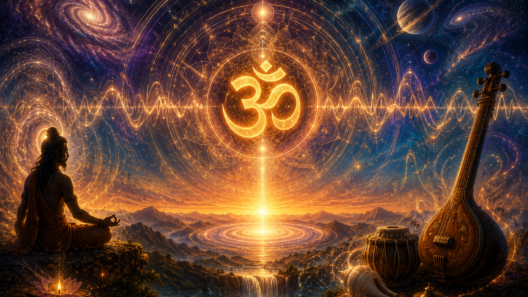
Among the many philosophical systems that have emerged from the Indian subcontinent across five thousand years of sustained intellectual inquiry, Advaita Vedanta stands apart. It is arguably the most coherent, the most radical, and the most consequential philosophical achievement in Indian history — a system of thought so complete and so internally consistent that it has absorbed and outlasted virtually every rival tradition it has encountered.
The name itself carries the teaching: a-dvaita means “not-two.” Advaita Vedanta is the school of Vedantic philosophy that asserts the fundamental non-duality of all existence. Its central and revolutionary claim is breathtakingly simple — there is only one reality (Brahman), the individual self (Atman) is identical to that one reality, and the entire appearance of multiplicity — the world of names and forms, of you and me, of stars and stones — is due to Maya, the cosmic power of apparent illusion.
This is not mere speculation or poetic metaphor. Advaita Vedanta is a rigorous philosophical system, complete with epistemology, metaphysics, ethics, and a detailed practical path to liberation. It was systematised in its definitive form by one of the most extraordinary minds ever produced by the subcontinent: Adi Shankaracharya, the philosopher-saint who lived in the 8th century CE and transformed Indian thought forever in a life of barely thirty-two years.
The system has captivated not only Hindu seekers but thinkers from across the world. Arthur Schopenhauer declared the Upanishads — the source texts of Advaita — “the most elevating reading in the world.” Ralph Waldo Emerson drew directly from Vedantic non-dualism in his Transcendentalist philosophy. Aldous Huxley identified Advaita as the clearest expression of what he called the “Perennial Philosophy,” the common mystical core underlying all the world’s great spiritual traditions. And in the twenty-first century, neuroscientists and philosophers of mind have found themselves returning to Advaita’s account of consciousness with growing interest, recognising that its analysis of awareness, selfhood, and experience anticipates questions that Western philosophy of mind has only recently begun to formulate.
This complete guide traces Advaita Vedanta from its roots through its full flowering — its founder, its core doctrines, its texts, its path to liberation, and its enduring global significance.
Adi Shankaracharya — The Founder of Advaita Vedanta
Birth, Childhood, and the Call of Renunciation
Adi Shankaracharya was born, according to tradition, in 788 CE in the village of Kaladi in what is now Kerala, in the far south of India. His parents, Shivaguru and Aryamba, were devout Brahmin householders who had prayed long for a son. According to tradition, the child Shankara displayed signs of extraordinary intellectual gifts from his earliest years.
By the age of eight, he had mastered all four Vedas — a feat that typically takes a scholar decades. The legend of his renunciation is one of the most celebrated in Indian hagiography. While bathing in the Purna river near his home, the young Shankara’s foot was seized by a crocodile. He called out to his mother, who stood helpless on the bank, that he wished to die as a sannyasi (renunciant) rather than as a householder. In the Hindu tradition, dying in the act of taking sannyasa (even symbolically, by mentally declaring it) was considered auspicious. His mother, faced with her son’s imminent death, gave her reluctant blessing. The crocodile released him.
Whether taken literally or symbolically, this story captures something essential about Shankara: his renunciation was absolute, early, and driven by an intensity that overrode even the deepest familial bonds. He left home, found his teacher Govindapada at Omkareshwar on the Narmada river (who was himself a disciple of Gaudapada, the first systematic Advaita philosopher), received complete instruction in Advaita, and then began his extraordinary journey across the length and breadth of India.
The Debates and the Consolidation of Advaita
Shankara’s method was debate. He travelled from one intellectual centre to another, engaging the leading thinkers of every school — Buddhists, Jains, Mimamsakas, Vaishnavas, Shaivas — in open philosophical disputation, and by all accounts he prevailed in each encounter. The most celebrated of these debates was his encounter with Mandana Mishra, the great Mimamsa scholar, at the city of Mahishmati.
Mandana Mishra was one of the most eminent scholars of his age, a champion of Purva Mimamsa — the philosophical school that held the Vedic rituals and their injunctions to be the supreme authority, with liberation achievable only through proper ritual action. His wife, Ubhaya Bharati, herself a scholar of the first rank, agreed to serve as judge. The debate lasted days. According to tradition, Ubhaya Bharati then challenged Shankara on the subject of Kama Shastra (the science of erotic love) — a subject about which a lifelong celibate renunciant could know nothing. Shankara famously left his body, temporarily entered (through yogic power) the body of a recently deceased king, lived in that body long enough to gain the required knowledge, returned to his own body, and resumed the debate. Mandana Mishra was convinced, took the name Sureshvara, became one of Shankara’s chief disciples, and went on to write major Advaita commentaries.
These debates were not mere intellectual sport. Shankara’s deepest mission was to counter the profound fragmentation that had overtaken Hindu intellectual and spiritual life through the influence of Buddhism, Jainism, and dozens of competing Hindu sub-schools. He sought to demonstrate that the Upanishads, the Bhagavad Gita, and the Brahma Sutras — the Prasthanatrayi or “triple canon” of Vedanta — all pointed, when properly interpreted, to a single, coherent, non-dual philosophy.
The Four Mathas — Institutionalising Advaita
One of Shankara’s most lasting practical achievements was the establishment of four monastic centres (mathas) at the four cardinal points of India, each entrusted to one of his chief disciples:
- Sringeri Sharada Peetham (South — Karnataka): Entrusted to Sureshvara (Mandana Mishra); the deity is Sharada (Saraswati); represents the Rig Veda
- Dwarka Sharada Peetham (West — Gujarat): Entrusted to Hastamalakacharya; the deity is Siddheshwara; represents the Sama Veda
- Govardhan Peetham, Puri (East — Odisha): Entrusted to Padmapadacharya; the deity is Jagannath; represents the Atharva Veda
- Jyotir Math, Badrinath (North — Uttarakhand): Entrusted to Totakacharya; the deity is Narayana; represents the Yajur Veda
These four mathas still function today as the living seats of the Shankaracharya lineage, each headed by a Jagadguru Shankaracharya who represents an unbroken line of succession going back to Shankara himself. They are among the oldest living institutional traditions in the world.
The Literary Legacy — Works of Extraordinary Scope
To appreciate the full scale of Shankara’s achievement, one must consider that he accomplished everything he did in approximately thirty-two years of life. His literary output alone — commentaries, independent philosophical works, and devotional hymns — would take most scholars several lifetimes to produce.
His commentaries (Bhashyas) form the foundation of his philosophical system:
- Commentaries on the ten principal Upanishads (Dashopanishad Bhashyas): Isha, Kena, Katha, Prashna, Mundaka, Mandukya (with Gaudapada’s Karika), Taittiriya, Aitareya, Chandogya, and Brihadaranyaka
- The Bhagavad Gita Bhashya: His commentary on all 700 verses of the Gita, demonstrating that the Gita’s teaching is ultimately non-dual
- The Brahma Sutra Bhashya (also called the Sharirakabhashya): His magnum opus commentary on the 555 aphorisms of the Brahma Sutras — considered the most rigorous and comprehensive defence of Advaita philosophy against all rival schools
His independent philosophical works include:
- Vivekachudamani (“The Crest Jewel of Discrimination”): 512 verses in the form of a dialogue between a student and a Guru; the most accessible and beloved introduction to Advaita practice
- Upadesasahasri (“A Thousand Teachings”): A systematic pedagogical text presenting the Advaita method of instruction
- Mandukyakarika Bhashya: His commentary on Gaudapada’s commentary on the Mandukya Upanishad — the most philosophically dense of all his works
- Aparokshanubhuti (“Direct Experience of Reality”): A shorter practical guide to Jnana Yoga
His devotional hymns reveal a dimension often overlooked in accounts of Shankara the philosopher:
- Bhaja Govindam (“Worship Govinda”): A short, passionate poem rebuking the futility of worldly learning without devotion; composed, tradition says, in a burst of inspiration upon seeing an elderly scholar memorising Sanskrit grammar
- Soundarya Lahari (“Wave of Beauty”): 100 verses of extraordinarily refined devotional poetry addressed to the Goddess, affirming Shankara’s Shakta dimension
- Nirvana Shatakam (“Six Verses on Liberation”): Six verses beginning “Manobuddhi ahankara chittani naham” (“I am not the mind, intellect, ego, or memory…”) — a direct, compressed statement of Advaita Self-enquiry
The Core Doctrine — Brahman, Atman, and Maya
Brahman: The One Absolute Reality
Brahman — from the Sanskrit root brih, “to expand” or “to be great” — is the Advaita term for the one absolute reality. It is not a deity in the conventional sense. It has no form, no personality, no attributes, no location. It is Nirguna Brahman — Brahman without qualities — pure, self-luminous, infinite, non-dual consciousness.
The Upanishads describe Brahman with three terms that are not attributes but rather point to its essential nature: Sat-Chit-Ananda:
- Sat (Being/Existence): Brahman alone truly exists — it is that whose existence never ceases, never changes, never becomes non-existent. Everything else has a contingent, borrowed, or apparent existence.
- Chit (Consciousness/Awareness): Brahman is not an unconscious substance — it is pure, self-luminous consciousness. It does not become conscious of something external; consciousness is its very nature. All awareness in all beings is nothing other than this one consciousness appearing through different instruments.
- Ananda (Bliss): The natural condition of Brahman is bliss — not the bliss of pleasure (which depends on an object) but the intrinsic fullness (purna) of a reality that lacks nothing and needs nothing.
Because Brahman transcends all categories of thought and language, the Upanishads also approach it via the method of Neti, Neti — “not this, not this” — systematically negating every quality, every attribute, every description until what remains is the bare, undeniable fact of pure being-awareness-bliss itself.
Atman: The True Self
Atman is the individual self — but not the self as ordinarily understood. In Advaita, the Atman is emphatically not the body, not the mind, not the intellect, not the ego, not the collection of memories and habits that constitutes the psychological personality. All of these are anatman — “not-self” — objects that arise and pass away within experience.
The Atman is the pure witness-consciousness — the unchanging awareness in which all experiences (waking, dreaming, deep sleep) arise and subside. It is that which is present in all three states of consciousness, which is never absent, which illumines the mind and senses without itself being illumined by anything else. It is self-luminous (svaprakasha) — just as a lamp illumines all objects in a room without itself requiring a further lamp to be seen, the Atman illumines all mental and sensory experience without requiring any additional light of awareness.
The fundamental claim of Advaita is: this Atman is identical to Brahman. The individual consciousness and the universal consciousness are not two separate realities — they are the same one reality appearing differently due to the superimposition of limiting adjuncts (upadhis). Just as the space inside a pot and the space outside the pot are not two different spaces — the pot merely creates the appearance of a boundary — the individual self and the universal Self are not two different consciousnesses.
Maya: The Cosmic Power of Apparent Illusion
If Brahman alone is real and Atman is identical to Brahman, how does the appearance of a world of multiplicity arise? How do billions of apparently separate individuals, objects, and events appear? The Advaita answer is Maya.
Maya is one of the most misunderstood concepts in Indian philosophy. It is frequently translated as “illusion,” which is misleading. Shankara is careful to say that Maya does not mean the world is non-existent or that our experience is like a hallucination. Rather, the world is mithya — it has an apparent or dependent reality at the empirical level, but it is not the ultimate, unconditional reality. It is real in the way that a dream is real during the dream — vivid, consequential, emotionally compelling — but which is seen, upon waking, to have had no independent existence apart from the dreamer’s consciousness.
Shankara’s most celebrated illustration is the rope-snake analogy: In dim light, a person sees a coiled rope on the ground and mistakes it for a snake. The “snake” has empirical reality — the fear is real, the racing pulse is real, the avoidance behaviour is real. But when light is brought, only the rope is seen. There was never a snake. The snake had apparent reality (pratibhasika satta) but not the rope’s empirical reality (vyavaharika satta), and neither has the ultimate reality of pure consciousness (paramarthika satta).
Similarly, the world of names and forms has empirical reality — it is real at the level of practical life and experience — but it is not ultimately real in the sense that Brahman is ultimately real. When the light of Brahma-jnana (knowledge of Brahman) dawns, the world of multiplicity is not destroyed — it continues to appear — but it is no longer mistaken for an independent, self-subsisting reality separate from Brahman.
Maya operates through two powers: Avarana-shakti (the power of veiling — concealing the true nature of Brahman) and Vikshepa-shakti (the power of projection — projecting the appearance of the world onto the screen of Brahman). Like a magician’s trick, Maya conceals the truth and projects a substitute in its place.
Avidya: Ignorance as the Root of Bondage
The proximate cause of bondage and suffering is not sin, not karma, not God’s will — it is Avidya, ignorance of one’s true nature. This ignorance is not ordinary not-knowing. It is not the ignorance of someone who has never been taught a fact. It is the fundamental mis-identification of the Self with the not-Self — taking the body-mind-ego complex to be what one essentially is.
Shankara calls this process Adhyasa — superimposition. Just as one might see a rope in dim light and superimpose the qualities of a snake upon it, Avidya causes us to superimpose the qualities of the body (birth, death, hunger, pain), the mind (desire, fear, memory), and the ego (“I am so-and-so, from such-and-such place, with such-and-such desires”) onto the pure Atman. The result is bondage — the endless cycle of desire, action, and rebirth driven by the mistaken belief that we are limited, mortal individuals in need of something we do not yet possess.
The remedy is not action, not ritual, not even devotion (at the ultimate level) — it is Jnana (knowledge): the direct, experiential recognition of one’s identity with Brahman. This is why Advaita is called a Jnana Marga — a path of knowledge.
The Two Levels of Reality — Vyavaharika and Paramarthika
One of Shankara’s most philosophically sophisticated contributions is his detailed analysis of three levels of reality (tri-vidha satta), which allows Advaita to make its absolute claims without dismissing the world of ordinary experience:
Paramarthika Satta — Absolute Reality
This is the highest level — the level at which only Brahman exists, undivided, self-luminous, without a second. At this level, there are no individual selves, no world, no God as a separate person, no karma, no birth, no death. There is only the one, infinite, self-aware reality. This is what the Upanishads mean when they say “Ekam evadvitiyam” — “One only, without a second” (Chandogya Upanishad 6.2.1).
Vyavaharika Satta — Empirical/Transactional Reality
This is the level of practical life — the world as we encounter it in waking experience. At this level, the world is fully real, individual selves are real, God (as Ishvara or Saguna Brahman — Brahman with attributes) is real, karma and rebirth are real, and the entire apparatus of ethical life, devotional practice, and ritual observance is meaningful and binding.
Shankara insists on taking this level with complete seriousness. Critics who accuse Advaita of making ethics meaningless misunderstand this distinction. Ethics, compassion, and right action are fully real and fully obligatory at the empirical level. The teaching that “all is Brahman” does not give licence to harm others — it is a truth to be realised through dedicated practice, not a justification for selfishness or nihilism.
Pratibhasika Satta — Apparent/Illusory Reality
This is the level of pure error — the snake seen in the rope, the oasis seen in the desert, the objects seen in a dream. These have neither the absolute reality of Brahman nor even the empirical reality of the waking world. They exist only in the moment of error and vanish completely when the error is corrected.
This three-level analysis is one of Advaita’s most powerful philosophical tools. It explains how Advaita can simultaneously assert that “Brahman alone is real” (paramarthika standpoint) and that “the world and all its distinctions are real and matter” (vyavaharika standpoint) without contradiction. As Shankara famously states: “From the absolute standpoint, there is no bondage and no liberation — but from the empirical standpoint, both are real, and the path of liberation is necessary and valid.”
The Mahavakyas — The Four Great Sayings
The heart of the Advaita teaching is crystallised in four short statements drawn from the four Vedas, known as the Mahavakyas — the Great Sayings. Each is a direct statement of the identity of Atman and Brahman:
1. Prajnanam Brahma — “Consciousness is Brahman”
Source: Aitareya Upanishad 3.3 (Rig Veda). This Mahavakya identifies Brahman with the principle of Prajna — consciousness or intelligence. It points to the fact that the ultimate reality is not an inert substance but pure, self-aware consciousness. This is the Lakshana Vakya — the “definition sentence” that tells us what Brahman is.
2. Aham Brahmasmi — “I am Brahman”
Source: Brihadaranyaka Upanishad 1.4.10 (Yajur Veda). Spoken by the sage Yajnavalkya, this is the Anubhava Vakya — the “experiential sentence” in which the individual Self directly declares its identity with the absolute. The “I” here is not the ego — it is the pure witness-consciousness, the Atman, recognising its own nature as none other than Brahman.
3. Tat Tvam Asi — “Thou art That”
Source: Chandogya Upanishad 6.8.7 (Sama Veda). This is the most famous of the four Mahavakyas — the Upadesha Vakya or “instructional sentence” spoken by a Guru to a disciple. The sage Uddalaka Aruni speaks it nine times to his son Shvetaketu, each time after a different illustration of how the one reality (Tat — “That,” Brahman) is the inner essence of everything, including the young man himself (Tvam — “Thou,” Atman). The illustrations include the salt dissolved invisibly in water, the single seed from which a whole fig tree grows, and the deep sleep in which individual consciousness merges back into the universal. Each time Uddalaka concludes: Tat tvam asi, Shvetaketo — “That thou art, Shvetaketu.”
4. Ayam Atma Brahma — “This Self is Brahman”
Source: Mandukya Upanishad 1.2 (Atharva Veda). This is the Sakshat Vakya — the “direct pointing sentence.” The word Ayam (“this” — the immediately present, directly known Self) is identified with Brahman. It is the most direct of the four: not a definition, not a teaching, not a declaration — simply a pointing to what is immediately present and self-evident as the ultimate reality.
Each of these four Mahavakyas is traditionally assigned to one of the four Vedas, one of Shankara’s four mathas, and one of the four stages of the Advaita path. Together they constitute a complete statement of the Advaita teaching: Brahman is consciousness; I am Brahman; you (the student) are That; and this directly present Self — here, now, undeniably aware — is Brahman.
The Path to Liberation — Jnana Yoga in Advaita Vedanta
The Sadhana Chatustaya — The Four-Fold Qualification
Advaita does not teach that liberation is available to anyone at any moment regardless of preparation. The direct investigation of one’s own nature requires a specific quality of mind — clear, calm, discriminating, and intensely motivated. Shankara prescribes a rigorous Sadhana Chatustaya (four-fold qualification) as the essential prerequisite for the path of Jnana:
- Viveka (Discrimination): The ability to discriminate clearly between the eternal (nitya) and the non-eternal (anitya) — between what is real and what is merely apparent. This is not an intellectual exercise but a lived recognition of the impermanence of all conditioned phenomena.
- Vairagya (Dispassion): Genuine dispassion toward the fruits of action, both in this life and in future lives. This is not depression or nihilism — it is the recognition that no finite object or experience can provide the infinite satisfaction the heart seeks.
- Shatsampat (Six virtues): Shama (tranquility of mind), Dama (control of the senses), Uparama (withdrawal from compulsive ritual action), Titiksha (endurance of the pairs of opposites — heat and cold, pleasure and pain, praise and blame), Shraddha (genuine faith in the teacher and the teaching), and Samadhana (one-pointed concentration of mind).
- Mumukshutva (Burning desire for liberation): Not a mild intellectual preference, but an intense, uncompromising longing for liberation from the cycle of birth, death, and rebirth — as urgent as the desire of a man whose hair is on fire to find water, in the Upanishadic phrase.
Shravana, Manana, Nididhyasana — The Three-fold Path
For the qualified student, the path of Jnana Yoga proceeds through three stages, described in the Brihadaranyaka Upanishad and developed systematically by Shankara:
Shravana (Hearing/Listening): The first stage is receiving the teaching of non-duality from a qualified teacher (Guru) who speaks from direct realisation. This is not merely reading books — it is receiving the living transmission of the teaching through systematic study of the Upanishads, particularly the great statements like Tat Tvam Asi. The purpose of Shravana is to bring the intellectual understanding to the point where the student knows what the teaching says and has no fundamental confusion about its content.
Manana (Reflection/Contemplation): The second stage is rigorous intellectual reflection — taking every doubt, every objection, every apparent contradiction in the teaching and working through it systematically with the tools of logic and reasoning until no doubt remains. Shankara places great emphasis on this stage: the Advaita teaching must be able to withstand the most penetrating rational scrutiny. Manana converts intellectual understanding into conviction.
Nididhyasana (Deep Meditative Contemplation): The third and most subtle stage is the continuous, direct, lived recognition of one’s identity with Brahman — not as a thought about reality, but as the immediate, non-conceptual recognition of what is already and always the case. This is the stage where the gap between “knowing about Brahman” and “being Brahman” collapses. Nididhyasana is not a technique of concentration — it is the ongoing practice of “abiding as the Self,” recognising in every experience the one consciousness that is looking through every pair of eyes.
Jivanmukti — Liberation While Living
One of Advaita Vedanta’s most distinctive and remarkable teachings is that liberation (Moksha) is available in this very life — not only after death, not only after many future lifetimes, but here and now, in the living body. This is called Jivanmukti — liberation while living.
The Jivanmukta (liberated-while-living being) has fully realised the identity of Atman and Brahman. The Avidya (ignorance) that gave rise to the sense of separate individuality has been dissolved by direct knowledge. Yet the body continues to live — carried forward by the momentum of Prarabdha karma (the portion of accumulated karma that has already begun to bear fruit in this life, like an arrow already released from a bow that must complete its flight).
From the outside, the Jivanmukta appears to live and act like anyone else — they eat, sleep, speak, and move about in the world. But inwardly, they are completely free. They act without ego, without the sense of personal doership, without accumulating new binding karma. Their actions arise spontaneously from the situation, like a mirror reflecting whatever is placed before it without holding any reflection.
Shankara offers a vivid image: the Jivanmukta is like a burnt rope. A rope of rope still has the form and appearance of a rope — it looks like a rope and lies on the ground like a rope — but it has completely lost the capacity to bind anything. It cannot tie a bundle; it crumbles at the touch. Similarly, the Jivanmukta appears to be a person living in the world, but they no longer have the capacity to be bound by worldly experience.
Key Texts of Advaita Vedanta
The Mandukya Upanishad
At only twelve verses, the Mandukya Upanishad is the shortest of the principal Upanishads — yet it is considered by many Advaita teachers, including Shankara’s teacher Gaudapada, to be the most direct and complete statement of the non-dual teaching. Shankara himself declared that the Mandukya alone, properly understood, is sufficient to lead to liberation.
The Mandukya takes the sacred syllable Om as its subject and demonstrates that Om, understood in its full depth, is nothing other than Brahman — and that the four elements of Om (A, U, M, and the silence that underlies and pervades them) correspond to the four states of consciousness: waking (jagrat), dreaming (svapna), deep sleep (sushupti), and the “fourth” (Turiya) — the pure, non-dual awareness that underlies and pervades all three ordinary states.
Gaudapada’s Karika
Gaudapada (6th–7th century CE), the teacher of Shankara’s teacher, wrote the Mandukya Karika — a verse commentary on the Mandukya Upanishad in four chapters. This is the first fully systematic Advaita philosophical text, and it introduces some of Advaita’s most radical ideas, including Ajativada — the doctrine that there is no real creation at all, that nothing has ever truly been born, that the appearance of birth, change, and multiplicity is entirely illusory. Shankara drew heavily on Gaudapada’s work but also moderated some of its most extreme formulations.
Shankaracharya’s Vivekachudamani
The Vivekachudamani (“Crest Jewel of Discrimination”), 512 verses, is the most beloved and accessible of all Advaita texts. Written as a dialogue between a sincere spiritual seeker and his Guru, it guides the student step by step from initial inquiry through all the stages of Advaita practice to the final recognition of the Self. Its literary quality is outstanding — the verse is lucid, warm, and occasionally of real poetic beauty — and its philosophical depth rewards repeated study throughout a lifetime.
Vidyaranya’s Panchadashi
The Panchadashi (“Fifteen Chapters”), composed by Vidyaranya Swami (14th century CE), the revered head of the Sringeri Matha, is the most comprehensive Advaita textbook. Arranged in three groups of five chapters (covering consciousness, bliss, and liberation), the Panchadashi is the standard advanced study text in traditional Advaita schools. Its fifteenth and final chapter, Jivanmukti Viveka, contains one of the most beautiful accounts of the liberated state in all Indian literature.
The Ashtavakra Gita
The Ashtavakra Gita (date uncertain — possibly 1st millennium CE) is the most radical non-dual text in the Indian tradition. A dialogue between the sage Ashtavakra and King Janaka, it presents Advaita in its most uncompromising form, with no concession to progressive stages or preparatory practices. Its opening instruction is startling in its directness: “If you desire liberation, my child, abandon the objects of the senses as poison, seek forgiveness, contentment, uprightness, compassion, and truth as nectar — and know yourself as consciousness, free, the one witness, and be happy.” The Ashtavakra Gita was a favourite text of Ramana Maharshi.
Major Objections and Advaita’s Responses
Ramanuja’s Vishishtadvaita Critique
Ramanuja (11th–12th century CE), the founder of Vishishtadvaita (Qualified Non-Dualism), mounted the most philosophically sophisticated challenge to Shankara’s Advaita. His primary objection: If Brahman is pure, quality-less consciousness (Nirguna Brahman), it cannot serve as the cause of the world. A cause must have the capacity to produce an effect; pure, quality-less consciousness without any power of action cannot account for the rich, varied, complex world of experience. Furthermore, Ramanuja objected that the concept of Maya is itself incoherent: Maya is either real (in which case there are two realities — Brahman and Maya) or it is unreal (in which case it cannot produce the world).
Shankara’s response: Brahman’s causal power is precisely what Maya is — it is not separate from Brahman but is Brahman’s own inscrutable, beginningless power (shakti). Maya is neither fully real nor fully unreal — it is anirvachaniya (indescribable), belonging to neither category. This is not a evasion but a recognition that the ultimate nature of Maya cannot be captured in dualistic logical categories, which are themselves products of Maya. At the absolute level, the question “why does Maya exist?” does not arise, because at the absolute level only Brahman exists.
Madhva’s Dvaita Critique
Madhva (13th century CE), the founder of Dvaita Vedanta (Dualism), argued that the identity of the individual self (jiva) with Brahman contradicts direct experience. We never experience ourselves as infinite, unlimited, and all-knowing. We experience ourselves as ignorant, finite, and dependent. If jiva and Brahman were truly identical, either all jivas would be omniscient (but they are not) or Brahman would be ignorant (which Shankara himself denies). Furthermore, Madhva argued, the relationship between Guru and student, devotee and God, would be rendered meaningless if they were ultimately identical.
Shankara’s response: The experience of limitation and ignorance is itself a product of Avidya — it is not a direct experience of the Atman but an experience of the body-mind-ego complex mistaken for the Atman. The Atman itself is never actually limited. Just as a dreamer appears to be a separate, limited person within the dream — subject to hunger, fear, and ignorance — while actually being the unlimited dreaming mind, so the jiva appears limited within the dream of Maya while actually being unlimited Brahman. When the dream ends (Avidya is dissolved by Jnana), the apparent limitation vanishes and only the unlimited is seen to have ever existed.
The “Practical Ethics” Objection
A common popular objection: If everything is Brahman — if there is only one Self — then there is no basis for ethics. Why not harm others, steal, or lie, if ultimately there is no “other” to harm?
Shankara’s response operates on two levels. First, at the empirical (vyavaharika) level, ethics is fully real, binding, and non-negotiable. The fact that water is ultimately H₂O does not mean thirst is unreal or that drinking is unnecessary. At the empirical level where experience occurs, the distinction between self and other, the reality of suffering, and the binding force of ethical obligation are all fully present and fully valid.
Second, the deeper logic of Advaita actually strengthens the ethical imperative. If all selves are one Self, then harming another is harming oneself. Compassion is not a moral rule imposed from outside but the spontaneous natural expression of the recognition that the suffering being before me is not different from me. The Jivanmukta — the fully liberated being — does not need ethical rules because compassion, generosity, and non-harming arise spontaneously and effortlessly from the recognition of unity. As Shankara puts it in the Vivekachudamani: “The knower of Brahman becomes Brahman” — and Brahman, being all, naturally expresses itself in compassion toward all.
Advaita Vedanta’s Global Influence
Swami Vivekananda and the West
The most pivotal moment in Advaita’s modern global spread was Swami Vivekananda‘s appearance at the Parliament of the World’s Religions in Chicago in September 1893. In a series of addresses that electrified the audience, Vivekananda presented Advaita Vedanta not merely as one Indian philosophical system among many, but as the universal science of consciousness — the philosophical framework within which all religions, all paths, and all genuine spiritual experiences find their coherent explanation.
His presentation was transformative. He demonstrated that Advaita does not negate other religions but contains them — devotion, ritual, service, and meditation are all valid paths, appropriate to different temperaments, all leading toward the one recognition of the Self’s identity with Brahman. He founded the Ramakrishna Mission and Ramakrishna Math, which continue to be the most influential institutional vehicles for Advaita teaching in the modern world.
Ramana Maharshi — The Silent Advaita
Ramana Maharshi (1879–1950) is the most celebrated Advaita teacher of the modern era. Following a sudden, spontaneous experience of death at the age of sixteen — in which he investigated the experience of dying directly and discovered the Self to be deathless — he became permanently established in the state of Sahaja Samadhi (natural, effortless non-dual awareness). He lived at the foot of the sacred mountain Arunachala in Tamil Nadu for the rest of his life.
His teaching was essentially Shankara’s — the identity of Atman and Brahman, the unreality of the ego, the path of Self-enquiry (“Who am I?” — Naan Yaar?) as the most direct route to liberation. But his manner was entirely his own: simple, immediate, and grounded in direct experience rather than textual scholarship. He attracted seekers from across the world, and his influence on modern non-dual teaching (through teachers like Nisargadatta Maharaj, Papaji, Mooji, and Rupert Spira) has been enormous.
Western Philosophy and Literature
The German philosopher Arthur Schopenhauer (1788–1860) was one of the first major Western philosophers to engage deeply with the Upanishads. He wrote famously: “In the whole world there is no study so beneficial and so elevating as that of the Upanishads. It has been the solace of my life — it will be the solace of my death.” His own philosophy of the “Will” as the underlying reality of the world, and his teaching that individual identity is an illusion (the “veil of Maya” as he called it), shows clear and acknowledged affinities with Advaita.
Ralph Waldo Emerson and the American Transcendentalists drew directly from Vedantic sources, and the influence of Advaita ideas can be found throughout Emerson’s essays on the “Oversoul” and the self-reliance of the individual who recognises his or her identity with the infinite. Aldous Huxley‘s The Perennial Philosophy (1945) identified Advaita as the clearest expression of the universal mystical core that he found in Sufism, Christian mysticism, Buddhist philosophy, and Taoism.
Contemporary Relevance — Neuroscience and Non-Duality
In the twenty-first century, Advaita Vedanta has found an unexpected resonance with researchers in neuroscience, philosophy of mind, and consciousness studies. The “hard problem of consciousness” — the question of how and why physical processes in the brain give rise to subjective experience — has led a growing number of researchers to take seriously the possibility that consciousness is fundamental, not derivative.
Neuroscientist and author Sam Harris has acknowledged, in his book Waking Up and in his subsequent work, that the non-dual investigation of consciousness — particularly the Self-enquiry practice associated with Ramana Maharshi and Advaita — offers genuine insights into the nature of selfhood and awareness that Western science and philosophy are only beginning to approach. He writes that the sense of being a self located inside the head is itself a cognitive construction that can be seen through, and that when it is seen through, what remains is something that Advaita would recognise as the Atman — open, boundless awareness.
Contemporary teachers like Rupert Spira and Mooji, both deeply rooted in the Advaita tradition via the Ramana Maharshi lineage, have made the non-dual teaching accessible to a new global audience through books, retreats, and online platforms, demonstrating that the ancient teaching of Shankara continues to speak directly and powerfully to the deepest questions of human existence.
Key Takeaways
- Advaita Vedanta means “not-two” — it is the non-dual philosophical school that teaches there is only one reality: Brahman, pure self-luminous consciousness.
- Adi Shankaracharya (788–820 CE) systematised Advaita in a life of approximately 32 years, leaving commentaries on the Upanishads, Bhagavad Gita, and Brahma Sutras, plus independent works including the Vivekachudamani, and devotional hymns including Bhaja Govindam and Nirvana Shatakam.
- The core doctrine: Brahman (the one absolute reality, Sat-Chit-Ananda) is identical to Atman (the true Self), and the appearance of multiplicity is due to Maya (cosmic apparent illusion) operating through Avidya (ignorance).
- Three levels of reality: Paramarthika (absolute — only Brahman), Vyavaharika (empirical — the world, karma, ethics are fully real), and Pratibhasika (illusory — pure error like the rope-snake).
- The four Mahavakyas — great sayings of the Upanishads — directly state the identity of Atman and Brahman: “Consciousness is Brahman,” “I am Brahman,” “Thou art That,” and “This Self is Brahman.”
- The path of liberation is Jnana Yoga via Shravana (hearing the teaching), Manana (reflection), and Nididhyasana (deep contemplation), requiring the four-fold qualification of Viveka, Vairagya, Shatsampat, and Mumukshutva.
- Jivanmukti — liberation while living — is Advaita’s unique teaching that full realisation of one’s identity with Brahman is available in this very life, not only after death.
- Advaita’s global influence spans from Schopenhauer and Emerson to Vivekananda’s 1893 Chicago Parliament address, Ramana Maharshi’s Self-enquiry, and contemporary non-dual teachers and neuroscientists.
Frequently Asked Questions
What is the difference between Advaita Vedanta and Buddhism?
While Advaita Vedanta and Buddhism (particularly Madhyamaka Buddhism) share several surface similarities — including the critique of a permanent individual ego, the teaching of universal impermanence at the phenomenal level, and the emphasis on direct investigation of experience — they differ fundamentally on the question of the Self. Buddhism teaches Anatman (no-self) — there is no eternal, unchanging Self or Atman. Advaita Vedanta teaches the opposite: there is an eternal, unchanging Self — the Atman — but it is not the personal ego; it is pure, unlimited consciousness identical to Brahman. Shankara explicitly engaged and rejected Buddhist positions in his commentaries, arguing that the Buddhist doctrine of universal momentariness (everything is changing all the time) is internally incoherent because the recognition of change itself requires a non-changing witness.
Does Advaita Vedanta deny the existence of God?
No — but it reframes the concept of God. Advaita distinguishes between Nirguna Brahman (Brahman without qualities — the ultimate, absolute reality) and Saguna Brahman or Ishvara (Brahman with qualities — the personal God who creates, sustains, and dissolves the universe). Ishvara is fully real and fully to be worshipped at the empirical level — Shankara himself composed deeply devotional hymns to Shiva, Vishnu, and the Goddess. But at the absolute level, Ishvara is Brahman appearing through the limiting adjunct of Maya — the Lord in relation to the creation. When the veil of Maya is dissolved in Brahman-knowledge, the distinction between Ishvara and Brahman itself dissolves. This is Advaita’s famous formula: the world, the individual self, and God are ultimately one — Brahman.
Is Maya the same as saying the world does not exist?
This is the most common misunderstanding of Advaita. Maya does not mean the world is non-existent or that our experiences are mere hallucinations. The Advaita term for the world’s ontological status is mithya — not unreal, but “apparently real” or “dependently real.” The world exists and is fully real at the empirical level of experience. It is built, maintained, and experienced by real people with real bodies and real consequences. What Advaita denies is that the world has ultimate, unconditional, independent reality — the kind of absolute, self-subsisting reality that belongs to Brahman alone. The rope-snake analogy is helpful: the fear you feel when you see what you think is a snake is real — the racing heart is real — but the snake itself is not ultimately what you took it to be. Similarly, the world is real as experience but not ultimately real as a self-subsisting reality independent of Brahman-consciousness.
What is the significance of the “Tat Tvam Asi” teaching?
“Tat Tvam Asi” — “Thou art That” — is arguably the single most important statement in all of Indian philosophy. It appears nine times in the sixth chapter of the Chandogya Upanishad, spoken by the sage Uddalaka to his son Shvetaketu after a series of illustrations showing that the one subtle essence underlying all creation is the same reality that is the inner Self of the listener. The word “Tat” (That) refers to Brahman — the infinite, formless, absolute reality. The word “Tvam” (Thou) refers to the individual Atman — you, the one reading these words. The word “Asi” (art/are) is the verb of identity. Together they say: the apparently separate, limited individual self that you take yourself to be is, at the most fundamental level of your being, identical with the infinite, formless absolute reality underlying the entire universe. This is not a metaphor or a pious aspiration — it is, in Advaita, a direct, literally true statement of the present reality, requiring not belief but direct investigation to verify.
How does Advaita Vedanta understand karma and rebirth?
Advaita accepts karma and rebirth as fully real at the empirical (vyavaharika) level — they are not dismissed or denied. The cycle of birth, death, and rebirth (Samsara) driven by accumulated karma is a fundamental feature of the empirical world, and it is the very condition from which liberation (Moksha) is sought. However, Advaita makes a crucial distinction regarding karma: only Sanchita karma (accumulated karma from all past lives) and Agami karma (karma accumulated in future actions) are dissolved by Brahman-knowledge. Prarabdha karma — the portion of karma already in the process of bearing fruit in this current life — continues even after liberation. This is why the Jivanmukta (liberated-while-living being) continues to live in the body after realisation. The body lives out its natural span; when Prarabdha is exhausted and the body dies, the Jivanmukta does not take another birth. This final liberation at the death of the body is called Videhamukti — disembodied liberation.
Can Advaita Vedanta be practised alongside devotional traditions like Vaishnavism or Shaivism?
Not only can it be — in the Indian tradition, it always has been. Shankara himself is the supreme example: the philosopher who wrote the most rigorous technical defence of Nirguna Brahman also composed some of the most passionate devotional hymns in Sanskrit literature — to Shiva, to Vishnu, to the Goddess, to Ganesha and Subrahmanya. In the Advaita framework, devotion to a personal God (Bhakti) is fully valid and fully effective at the empirical level. It purifies the mind, cultivates the qualities required for Jnana, and in some cases — as in the tradition of Bhakti Vedanta represented by teachers like Ramakrishna — itself becomes the direct vehicle of non-dual realisation. Advaita does not require the abandonment of devotional practice; rather, it provides the philosophical framework within which devotion finds its ultimate meaning. As Ramakrishna expressed it: first there is “I and Thou” (the devotee and the God); then “I am Thine” (surrender); and finally the sweetness of “I am That” (non-dual recognition) — each stage real and sacred in its own right.