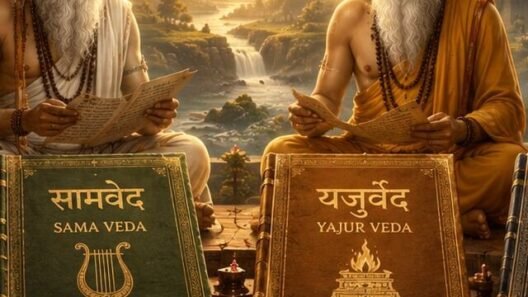
In Part 1 of this series, we explored the divine nature and mission of Lord Veda Vyasa Munihi — the incarnation of Lord Vishnu who took human form exclusively to serve as the Supreme Guru of humanity. We examined Lord Krishna’s declaration in the Bhagavad Gita (“Among the Munis, I am Veda Vyasa”), the eternal Guru Pitha that Vyasa occupies, his codification of the four Vedas, his composition of 108 Puranas, and the philosophical masterpiece of the Brahma Sutras. In this second part, we turn to the equally extraordinary story of his divine birth, his central role in the founding of the Kuru dynasty, and the epic drama of the Mahabharata — the greatest battle ever fought on this earth — that emerged from his lineage and was ultimately recorded by his pen.
The life of Krishna Dwaipayana Veda Vyasa is not merely a biographical narrative. It is a cosmic story — a story in which the Supreme Being took birth, shaped the royal lineage of an entire civilisation, ensured the playing out of the great war between Dharma and Adharma, and then recorded the entire epic for the benefit of humanity across all time. Every detail of this story carries spiritual meaning, from the miraculous circumstances of his birth to the profound manner in which he blessed the mothers of the Kuru heirs. Understanding this story is essential for understanding the Mahabharata, the Bhagavad Gita and the Bhagavata Purana — three of the most sacred texts of Sanathana Dharma.
The Birth of Krishna Dwaipayana — Sage Parashara, Satyavathi and the Divine Plan
The story of Veda Vyasa’s birth begins with the great Maharshi Parashara — one of the most celebrated sages of the Vedic tradition and the father of the sage lineage. One day, Sage Parashara wished to cross a river and approached the riverbank where the local fishermen community operated a ferry service. On that particular afternoon, the chief of the fishermen had gone for his noon meal and had asked his young daughter Satyavathi to inform any travellers to wait until his return. But when the sage arrived, Satyavathi agreed to ferry him across herself.
Satyavathi was a young maiden, radiant and full of life, with a natural luminosity about her. As the boat moved across the water, the divine sight of Sage Parashara — his inner vision heightened by decades of intense tapasya — opened out to reveal the extraordinary destiny of this young woman. He saw in the subtle realms of time that Satyavathi was not an ordinary fisherman’s daughter. She was destined to become a queen, the consort of a great emperor who would rule all of Bharat. She would be the mother of a royal lineage — a great clan that would wield sovereign power over the land for generations.
But more than this, Sage Parashara also perceived something even more momentous in the cosmic scheme: the Divine Will itself was present in that very moment, signalling that the time had come for a supremely important soul to enter the world. The divinity wished to manifest as a child — a child who would become the greatest Guru in human history, a being who would be more than human, who would in truth be God Himself in the form of the Eternal Teacher. And this divine child was to be born through Sage Parashara and this very maiden, Satyavathi, at this very point in time.
The sage also intuited that this divine child would be the forefather of the great Kuru clan — the lineage that would produce the Pandavas and Kauravas, stage the greatest conflict ever witnessed on earth, and serve as the vehicle through which the Bhagavad Gita would be spoken. The entire cosmic drama was arranged around this single event: the birth of the Divine Guru.
The Consent of Satyavathi — Dharma Even in Cosmic Events
Recognising the divine call, Sage Parashara turned to the young maiden and said gently: “O maiden, if you are willing, a divine child will be born to you and me at this very moment.”
Satyavathi was immediately alarmed. She responded with great dignity and moral clarity, pointing out that such a request was entirely improper from a great sage to an unmarried maiden who was yet to be wed. She feared that a refusal might bring the sage’s displeasure and perhaps his curse — yet she did not abandon her dharmic position. This moment reveals the deeply ethical foundation of the Vedic tradition: even when the cosmic plan involves extraordinary events, individual consent and dignity are not bypassed. The divine must work through the willing cooperation of the human, not against it.
Sage Parashara, understanding her concern, reassured her: “O maiden, your maidenhood will remain completely intact. The child will be born through the power of my Ojas — the sublimated, purified life-force — and your feminine shakti. This conception will take place in Aakasha (the subtle space or ether), not through physical union in the ordinary sense. Therefore, your maidenhood will remain as it is. Do not be afraid.”
The tradition is explicit about why the sage sought her consent so carefully. Taking the consent of the woman was not merely a formality — it was a moral necessity. Had Sage Parashara used his spiritual powers to impose his will upon Satyavathi without her willing agreement, the act would have been one of Adharma (unrighteousness), and the child born from such an act could not have been divine. A child born through Adharma carries the imprint of that transgression and cannot fulfil a divine purpose. The cosmic plan required that Satyavathi consent freely, out of understanding and willingness, so that the child born of this union would be truly born in Dharma and carry the full power of the divine purpose.
Satyavathi, reassured and understanding the divine nature of what was being proposed, gave her consent.
The Island Birth and the Cosmic Significance of the Name Krishna Dwaipayana
Following Satyavathi’s consent, Sage Parashara guided the boat to a small island that had formed in the middle of the river — created by the river dividing into two channels and then rejoining, enclosing a small patch of land between them. Satyavathi steered the boat to this island and both of them rested there. The sage entered into deep meditation.
As the meditation deepened, a remarkable phenomenon occurred: a dense mist arose around the island, completely enveloping both figures in a luminous, concealing veil. This mist was not an ordinary atmospheric occurrence but a manifestation of the divine energy at work — a sacred covering drawn around the moment of a cosmic event. By the time the mist lifted and dissipated, a beautiful child had emerged and lay on the land of the island — a complete, living child, born through the power of meditation and subtle energy, not through physical birth in the conventional sense.
The child was of a remarkable deep blue complexion — the colour of the infinite sky at dusk, the colour traditionally associated with Lord Vishnu and Lord Krishna, symbolising the boundlessness of divine consciousness. Because of this colouring, Sage Parashara named the child Krishna. And because the child was born on the island (Dvipa) formed by the division (ayana) of the river, he was also called Dwaipayana — giving him his full birth name of Krishna Dwaipayana.
What happened next was no less extraordinary. The child, instead of behaving like a newborn infant, immediately grew to young adulthood before their eyes. He stood upright, folded his hands in reverence, and bowed to both Sage Parashara and to his mother Satyavathi, seeking their blessings. He then turned to his mother with a profound and compassionate declaration:
“O mother, whenever you remember me, I will appear before you, and whatever service you need of me, I will perform it willingly.”
Having given this assurance, the child Krishna Dwaipayana turned away from the river and walked into the forest — heading toward a life of intense Tapasya, the deep meditative penance through which divine knowledge is unfolded from within. This was not an abandonment of his mother but a statement about his nature: he was not a child who needed to be raised, but a divine being who had appeared in the world with a fully formed purpose and was already setting about fulfilling it.
Veda Vyasa’s Return — Blessing the Daughters-in-Law of the Kuru Throne
Years passed. True to the vision Sage Parashara had seen, Satyavathi went on to become the queen of Bharat by marrying the great emperor Shantanu. The Kuru dynasty’s story now unfolded with Satyavathi at its centre.
Shantanu had an elder son from an earlier marriage — the incomparable Bhishma, born as Devavrata, who was the very embodiment of dharmic valour and principle. In order to secure Satyavathi’s hand in marriage (her father insisted that only her children should inherit the throne), Bhishma took the most extraordinary oath in the history of the tradition: he vowed never to marry and never to ascend the throne, surrendering his own royal rights so that Satyavathi’s future children could rule. This terrible and selfless vow earned him the name Bhishma — one who has taken a terrible oath.
Satyavathi bore Shantanu two sons: Chitrangada and Vichitraveerya. Chitrangada, who was brave and powerful, died young in battle against the Gandharvas. Vichitraveerya became king but also died early, before he could father any children — leaving behind two wives: Ambika and Ambalika. The Kuru throne was now without a male heir, and Bhishma — bound by his oath — could not fill the vacancy himself.
Satyavathi, facing the extinction of her royal lineage, remembered the promise made to her on that island so many years before. She called out in her heart to her celestial son Krishna Dwaipayana. And, true to his word, he appeared before her.
By now, Krishna Dwaipayana had already accomplished his great spiritual works. He had divided and codified the Vedas into their four collections and thereby earned the title by which he would be known forever: Veda Vyasa — the one who arranged the Vedas. He had already composed the 108 Puranas. He was no longer the child who had walked into the forest; he was the Supreme Guru, radiating the light of concentrated divine consciousness, his form aged and matted-haired from decades of intense penance, his eyes blazing with the inner fire of awakened awareness.
Satyavathi recounted to him the tragedy of her lineage — both sons dead, no heirs, the throne at risk. Understanding the full situation — and knowing with divine insight how critical this dynastic continuation was to the unfolding of the cosmic plan — Lord Veda Vyasa agreed to help. He said to his mother: “O mother, I will sit in deep meditation in a private chamber. Send your daughters-in-law, one by one, to receive my blessings.”
The Mahanaarayana Upanishad (Chapter 79, Verse 12) illuminates the mechanism of what followed:
“The great seers turn their Mind INWARD through right Meditation and unfold the creative potential of their inner Mind, and even create their own progeny through this creative power of the Mind.”
This is not a metaphor but a direct description of the spiritual mechanism at work. Lord Veda Vyasa, in deep meditation, channelled the divine creative energy (Ojas) and transmitted it through his gaze — just as his own father Sage Parashara had transmitted it at his birth. The power of concentrated, purified spiritual consciousness can function as the creative force of life itself, and the great rishis understood this and worked with it consciously.
The Birth of Dhritarashtra, Pandu and Vidura — and Their Fates
Lord Veda Vyasa entered the chamber and sat in deep meditation. Ambika, the first daughter-in-law, was sent in. She sat before the blazing sage, who opened his eyes and turned his luminous gaze upon her. The light was overpowering — his eyes held the concentrated energy of decades of spiritual practice, and the radiance was more than Ambika could bear. She closed her eyes in fear.
When the second daughter-in-law Ambalika entered the chamber, the same overpowering radiance met her. Ambalika, though she kept her eyes open, was seized with terror and turned completely pale.
When both daughters-in-law reported back to Satyavathi, neither wished to return to the chamber. They arranged for a servant maid to be sent in their place for a third session. This servant maid entered the chamber with a composed and open bearing. Where the royal daughters-in-law had been overcome by fear, the maid sat steadily and received the sage’s luminous gaze with calm equanimity and humble openness.
After the sessions were complete, Lord Veda Vyasa reported the results to his mother with the directness of one who sees the inevitable consequences of every action:
- Ambika (who closed her eyes): Her son would be born strong and physically powerful, but blind — because she had closed her eyes during the transmission of divine light. This son was Dhritarashtra, who would grow to be a man of great physical strength but whose blindness — both physical and metaphorical — would make him unable to see the truth of Dharma and lead to the catastrophic favouritism toward his son Duryodhana.
- Ambalika (who turned pale with fear): Her son would be born brave and capable, but with a condition of anaemia (pallor) that would weaken him throughout his life — because she had turned pale with fear. This son was Pandu, the “pale one,” who would become king and father the five Pandavas, but whose health would be forever compromised.
- The servant maid (who received the blessing with composure and openness): Her son would be born without physical defect and with extraordinary wisdom and righteousness. This son was Vidura, who became the wisest counsellor of the Kuru court, a man of unimpeachable integrity, whose Vidura Niti (the ethics of Vidura) is celebrated to this day as one of the finest statements of moral and practical wisdom in all of Indian literature. The tradition identifies Vidura as a partial incarnation of Lord Yama (the deity of righteousness and death), which explains both his extraordinary virtue and the equanimity with which he navigated the tragic events that unfolded around him.
This episode illustrates a profound principle: the quality of one’s inner state at the moment of receiving divine grace directly shapes the quality and character of what is received. Fear closes the door; composure and openness allow the divine energy to flow in its fullness. The three sons born from these three very different inner responses to the same divine transmission became the three pillars around which the entire Mahabharata narrative rotates.
The Rise of the Kuru Clan — Pandavas vs Kauravas
From these three births, the mightiest royal clan of ancient Bharat grew and divided. Dhritarashtra, despite his blindness, was married to the princess Gandhari, who in an act of supreme devotion and solidarity chose to blindfold herself for life, vowing never to see what her husband could not see. Together they had a hundred sons — the Kauravas — headed by the eldest, Duryodhana.
Pandu became king and married two wives: Kunti and Madri. Through a celestial boon given to Kunti — the ability to invoke any deity and receive a child through that invocation — Pandu fathered five sons despite a curse that prevented him from fathering children in the ordinary way. These five sons were the Pandavas:
- Yudhishthira — son of Yama (Dharma), the embodiment of righteousness
- Bhima — son of Vayu (the wind deity), of incomparable physical power
- Arjuna — son of Indra (king of the devas), the supreme warrior and archer
- Nakula and Sahadeva — twin sons of the Ashvini Kumaras (divine physicians), gifted with beauty, skill and knowledge
The Pandavas, from their earliest years, were the embodiment of dharmic excellence. They were guided by the great Bhishma and by Dronacharya in the martial arts, and they grew to become warriors without equal. The eldest, Yudhishthira, was so committed to truth that he was called Dharmaraja — the king of Dharma.
Duryodhana and his brothers, by contrast, grew in the shadow of envy and resentment. From childhood, Duryodhana could not bear the superior abilities and dharmic character of the Pandavas. The court of Hastinapura became a court divided — between the Kauravas who sought every means to undermine the Pandavas, and the Pandavas who, despite every provocation, continued to uphold righteousness. Vidura, the wise half-brother, repeatedly counselled Dhritarashtra to act with justice and protect the Pandavas, but Dhritarashtra — blinded not only physically but by his partiality for his own son — repeatedly failed to act rightly.
The tension built over decades through a series of incidents: an assassination attempt by fire at Varanavata, the game of dice in which the Pandavas lost their kingdom and were sent into exile for thirteen years, the humiliation of Draupadi in the Kuru court. Each of these incidents deepened the fracture between the two branches of the Kuru family, until war became inevitable.
The Mahabharata War — Dharma Against Adharma
The great war of Kurukshetra was fought on the Kurukshetra plain (in present-day Haryana, North India) and lasted eighteen days. It was not merely a territorial dispute between cousins, though it had that surface appearance. At its deepest level, it was the decisive confrontation between Dharma (righteousness) and Adharma (unrighteousness) — a cosmic battle that had been building since the beginning of the Dvapara Yuga and which, by its conclusion, would mark the transition into the Kali Yuga.
Lord Krishna — the most significant among the divine incarnations of Lord Vishnu and a contemporary of Veda Vyasa (both being manifestations of the same divine consciousness) — had aligned Himself unequivocally with the Pandavas. He did not join the battle as a warrior; instead, He served as the charioteer of Arjuna, the greatest warrior among the Pandavas. In this role — guiding, counselling and inspiring — He embodied the role of Guru on the battlefield. His presence on the side of the Pandavas was itself the statement of the divine order: where Dharma stands, the Divine stands with it.
The armies arrayed against each other were the largest ever assembled in human history according to the Mahabharata account. On the Kaurava side stood eleven Akshauhinis (military divisions), and on the Pandava side stood seven Akshauhinis. Great warriors such as Bhishma, Drona, Karna, Ashvatthama and Kripacharya fought on the side of the Kauravas — some because of obligation and loyalty rather than agreement with Duryodhana’s cause. Great warriors such as Arjuna, Bhima and Abhimanyu fought on the side of the Pandavas.
The battle resulted in the near-total destruction of both armies. Duryodhana and all his brothers perished. The Kaurava side was left with almost no survivors. On the Pandava side, the five brothers survived along with Lord Krishna, but their entire army was also largely destroyed. The aftermath saw the earth soaked in the blood of countless warriors from across Bharat.
One of the most devastating episodes of the war came from the Brahmastra wielded by Ashvatthama — the son of Drona — in a final act of desperation and vengeance after the Kaurava defeat. The Brahmastra is described in the tradition as a weapon of such incomprehensible destructive power that its use was said to have tilted the earth itself by half a degree on its axis. Lord Krishna intervened to neutralise the worst effects of this weapon, but its impact left lasting consequences upon the world — a statement the tradition makes about the irreversible nature of adharmic destruction, even when the final victory goes to Dharma.
The Bhagavad Gita and Anugita — Lord Krishna as Divine Teacher
Of all the events of the Mahabharata, the episode that has most profoundly shaped human spiritual history is the conversation between Lord Krishna and Arjuna on the battlefield of Kurukshetra, just before the beginning of the eighteen-day war. Arjuna, faced with the sight of his beloved teachers, kinsmen and friends arrayed on the opposing side, was overcome with grief and moral paralysis. He lowered his bow and told Krishna he could not fight — that no kingdom was worth the destruction of his own family and the violation of the bonds of relationship.
Lord Krishna’s response to Arjuna’s crisis constitutes the Bhagavad Gita — 700 verses across 18 chapters that represent the most comprehensive and profound statement of spiritual wisdom ever delivered by God directly to a human being in the midst of a life crisis. The Gita addresses every fundamental question of human existence: the nature of the Self (Atman), the nature of God (Brahman), the relationship between the individual and the Divine, the three paths of liberation (Jnana Yoga — the path of knowledge, Bhakti Yoga — the path of devotion, and Karma Yoga — the path of action), the nature of death and rebirth, the qualities of the liberated person, and the supreme secret of surrender to God.
After the war ended, Arjuna at some point confessed to Krishna that he had forgotten many of the teachings of the Gita in the heat of the subsequent battles and events. Lord Krishna graciously repeated the essential teachings in a condensed form — this second discourse is known as the Anu-Gita (the follow-on Gita), found in the Ashvamedha Parva of the Mahabharata. While the Anu-Gita is less widely studied than the Bhagavad Gita itself, it contains important additional insights and represents Lord Krishna’s final direct teaching to Arjuna.
It was Lord Veda Vyasa who recorded and preserved both the Bhagavad Gita and the Anu-Gita within the vast body of the Mahabharata, ensuring that these supreme teachings would be available to humanity across all of time. Without Vyasa, the Gita — the very words spoken by God on the battlefield — would not have been preserved. The Guru who gave us the Vedas also gave us the greatest teaching within the epic he composed.
The Bhagavata Purana and Uddhava Gita — The Last Message of Lord Krishna
Following the conclusion of the Mahabharata war, as the Dvapara Yuga gave way to the Kali Yuga, Lord Veda Vyasa turned to what many consider his greatest and most personally heartfelt work: the Bhagavata Purana (also known as the Srimad Bhagavatam). The Bhagavata is a text of twelve books (Skandhas) and approximately 18,000 verses, and it stands apart from all other Puranas in its tone of ecstatic devotion and its supreme focus on the nature and glory of Lord Vishnu-Krishna.
The Bhagavata Purana is, at its heart, the complete life story of Lord Krishna — from the divine circumstances preceding his birth, through his childhood miracles in Vrindavan (the Govinda stories that have captured the hearts of devotees across the world), his youth in Mathura and Dwarka, and the events of the Mahabharata era. It is through the Bhagavata that the world received the full and luminous narrative of Krishna’s life in all its dimensions: as the divine child (Bala Krishna), as the enchanting cowherd boy (Gopa Krishna), as the loving husband and king (Dwarkadhish), and as the supreme Guru and God (the Gita’s speaker).
Within the Bhagavata Purana, Lord Veda Vyasa incorporated the Uddhava Gita — also called the Hamsa Gita — the final spiritual discourse given by Lord Krishna before his departure from the earth. Uddhava was Krishna’s closest and most beloved devotee and companion, and Krishna chose him as the recipient of his last great teaching. The Uddhava Gita (found in the Eleventh Skanda of the Bhagavata) is considered by many scholars and saints to be even more advanced in its philosophical depth than the Bhagavad Gita itself, as it was spoken in a context of complete intimacy and spiritual equality rather than in the urgency of a battlefield.
In the Uddhava Gita, Lord Krishna covers the highest teachings of the Vedantic and devotional traditions, speaks of the paths of knowledge, devotion and renunciation, addresses the nature of the Gunas (the three qualities of Nature), the path of liberation, and the supreme nature of pure Bhakti (devotion). It represents the final transmission of the Divine Teacher — the last words of the Lord before He returned to His transcendental abode.
By incorporating the Uddhava Gita within the Bhagavata Purana, Lord Veda Vyasa ensured that not only the Bhagavad Gita (the teaching given in the urgency of war) but also this final and most intimate teaching of Krishna would be preserved and transmitted. Once again, the Supreme Guru served as the vessel through which the Supreme Lord’s final words reached humanity.
“What Is Found Here Can Be Found Anywhere” — The Eternal Completeness of Veda Vyasa
Lord Veda Vyasa’s declaration echoes with renewed depth when viewed through the lens of his life and works as described in this two-part series: “What is found here can be found anywhere, but what is NOT found here can never be found anywhere.”
Looking at the full scope of what “here” encompasses — the four Vedas, 108 Puranas, the Mahabharata with the Bhagavad Gita and Anu-Gita, the Brahma Sutras, the Upanishads, the Bhagavata Purana with the Uddhava Gita, and the Shaanthi Mantras — the declaration ceases to seem like hyperbole and reveals itself as a sober statement of fact. Wherever in the universe true knowledge is to be found, it will be found in some form within the body of Veda Vyasa’s works. And whatever cannot be found within this body of knowledge — whether in its explicit statement or in its implicit depths — cannot be found anywhere in the universe.
This declaration also contains a teaching about the nature of Veda Vyasa himself. Only the omniscient can speak of completeness with such certainty. Only the one who has direct access to the totality of divine knowledge — not merely learned knowledge but the living, immediate awareness of Truth in all its dimensions — can make such a claim. This is not the boast of a scholar; it is the statement of the all-knowing, speaking through the mouth of the divine Guru.
The story of Veda Vyasa’s divine birth, his role in the Kuru dynasty, his recording of the Mahabharata and the Gita, his composition of the Bhagavata Purana and the Uddhava Gita — all of these point to a single truth: that the Supreme Being took form as the Supreme Guru, arranged the great cosmic drama of the Kuru clan and the Mahabharata war, and then with incomparable grace turned the entire experience into sacred literature — the foundation of Sanathana Dharma for all of Kali Yuga.
As long as the Vedas are chanted, as long as the Gita is read, as long as the Bhagavata is sung, as long as a single devotee sits at the feet of a Guru — in all of these, Lord Veda Vyasa Munihi is present. He is not a figure of the past but the living Guru principle, eternally accessible to those who seek with sincerity and love.
FAQs
1. Who were the parents of Veda Vyasa and how was he born?
Veda Vyasa was born to Sage Parashara (father) and Satyavathi (mother), a young fisherman’s daughter. The birth was not an ordinary physical birth but occurred through the transmission of Sage Parashara’s Ojas (concentrated spiritual energy) through deep meditation, while both sat on a small river island enveloped in a divine mist. The tradition emphasises that Satyavathi’s full and willing consent was obtained before the event, and that her maidenhood remained intact, as the sage promised. The child — Krishna Dwaipayana — was born fully formed, grew instantly to young adulthood, and immediately left for forest meditation.
2. What is the connection between Veda Vyasa and the Kuru dynasty?
Veda Vyasa was the half-brother of Chitrangada and Vichitraveerya (Satyavathi’s sons by Emperor Shantanu). When both these sons died without heirs, Satyavathi called upon Vyasa, and through his blessing she transmitted divine creative energy (Ojas) to her daughters-in-law, who conceived and bore three sons: Dhritarashtra (born blind), Pandu (born anaemic) and Vidura (born wise and virtuous). Dhritarashtra and Pandu became the fathers of the Kauravas and Pandavas respectively — making Veda Vyasa the paternal grandfather of both warring clans of the Mahabharata.
3. Why was Vidura wiser than Dhritarashtra and Pandu?
Vidura was born to a servant maid who entered Veda Vyasa’s presence with complete composure and open receptivity, unlike the royal daughters-in-law who were overcome by fear. The tradition teaches that the quality of the mother’s inner state at the time of receiving the divine blessing directly shaped the quality of the child. Because the maid received the divine energy without fear or resistance, Vidura was born without physical defect and with extraordinary wisdom and righteousness. He is identified in the tradition as a partial incarnation of Yama (the deity of dharma), which further explains his exceptional moral clarity.
4. What is the Uddhava Gita and how is it different from the Bhagavad Gita?
The Uddhava Gita (also called Hamsa Gita) is the final spiritual discourse given by Lord Krishna to his closest devotee and companion Uddhava, just before Krishna’s departure from the world. It is found in the Eleventh Skanda of the Bhagavata Purana, composed by Veda Vyasa. While the Bhagavad Gita was spoken on a battlefield to rouse a warrior to his duty, the Uddhava Gita was spoken in complete intimacy and contemplative calm, and is considered to explore even deeper dimensions of Vedantic and devotional philosophy. It represents Krishna’s final teaching — the culmination of all His wisdom distilled for His most beloved devotee.
5. Why did Lord Krishna side with the Pandavas in the Mahabharata war?
Lord Krishna aligned with the Pandavas because they were wholly committed to Dharma (righteousness), while the Kauravas under Duryodhana had repeatedly violated Dharma through treachery, attempted assassination, deceit at the dice game, and the public humiliation of Draupadi. The Mahabharata war was not merely a territorial conflict between cousins but a cosmic confrontation between Dharma and Adharma. Lord Krishna — as an incarnation of Lord Vishnu whose cosmic purpose is the preservation of Dharma — could only stand on the side of righteousness. His declaration in the Bhagavad Gita (Chapter 4, Verse 8) makes this explicit: “For the protection of the righteous, for the destruction of the wicked, and for the establishment of Dharma, I come into being age after age.”