In the vast expanse of the Indian spiritual tradition, God Himself has taken human form time and again to protect Dharma and guide humanity toward liberation. Among all such divine manifestations, one stands apart in its singular purpose and incomparable scope: the incarnation of Lord Vishnu as Sage Veda Vyasa Dwaipayana — the Supreme Guru of mankind, the architect of Sanathana Dharma as it is known and practised today. To call him merely a sage or scholar would be to miss the profundity of what he represents. He is the very embodiment of the Guru principle itself, occupying the seat of Jagad Guru — the World Teacher — for all time.
What Lord Veda Vyasa Munihi accomplished surpasses anything achievable by a single human lifetime, or even many lifetimes. He codified the four Vedas, composed the epic Mahabharata (within which the immortal Bhagavad Gita is enshrined), authored 108 Puranas, wrote the Brahma Sutras, composed multiple Upanishads, and gave humanity the Bhagavata Purana containing the Uddhava Gita — the final message of Lord Krishna. His declaration rings with the confidence of completeness: “What is found here can be found anywhere, but what is NOT found here can never be found anywhere.” This post is the first in a two-part series exploring the life, mission and eternal legacy of this supreme divine Guru.
Who Is Lord Veda Vyasa? — The Divine Incarnation as Supreme Guru
Lord Veda Vyasa, also known as Krishna Dwaipayana Vyasa, is revered in the Indian tradition not merely as a great sage but as an avatara — a direct descent of Lord Vishnu into human form. While other avataras of Lord Vishnu such as Rama, Narasimha or Vamana came with specific missions to vanquish evil and restore cosmic order, the incarnation as Veda Vyasa was of a different and uniquely elevated character. It was exclusively for the purpose of being the Eternal Guru — to gather, codify, preserve and transmit the entire body of spiritual, cultural and scientific knowledge for all of humanity, across all of time.
In the Indian tradition, the three great deities — Lord Brahma (the Creator), Lord Vishnu (the Preserver) and Lord Shiva (the Transformer) — form the first tier of the Guru lineage. These three are the primordial teachers from whom all spiritual knowledge flows. The Supreme Being Himself, the Absolute Reality, is both God and the Ultimate Guru. Veda Vyasa, as an incarnation of Lord Vishnu, is thus embedded within this highest Guru lineage. He was not a human being who attained Guruhood through sadhana alone; he was the divine principle of Guruhood itself, made manifest in human form.
The extraordinary nature of his contributions makes this divine origin self-evident. If one were to consider Veda Vyasa as merely a human being, it becomes impossible to explain how a single individual could have produced such a staggering volume of profound knowledge spanning every dimension of existence — spiritual, philosophical, cosmological, historical, ethical, medical, astronomical and beyond. The scope defies human capacity. It is precisely this impossibility that the tradition points to when it affirms: Veda Vyasa is God Himself, incarnate as the Guru of all gurus.
His full name, Krishna Dwaipayana, carries meaning in every syllable: Krishna refers to his dark complexion at birth, and Dwaipayana means “one born on an island” — a reference to the circumstances of his miraculous birth, which is described in detail in Part 2 of this series. The name Vyasa — meaning “one who divides or arranges” — was given to him because of his monumental act of codifying the Vedas into four distinct collections, making the vast ocean of Vedic knowledge accessible to humanity.
Lord Krishna’s Declaration in the Bhagavad Gita — “Among the Munis, I Am Veda Vyasa”
Perhaps the most powerful endorsement of Veda Vyasa’s divine status comes from none other than Lord Krishna Himself, in the Bhagavad Gita. In Chapter 10, which is titled Vibhuti Yoga — the Yoga of Divine Manifestations — Lord Krishna enumerates the highest expressions of His own glory across all planes of existence. He declares Himself to be the best, the greatest, the most excellent in every category of being. And it is in this exalted context that He makes the declaration:
“Among the Munis (great sages), I am Veda Vyasa.”
— Bhagavad Gita, Chapter 10, Verse 37
This verse is of immense significance. Lord Krishna does not say “Veda Vyasa is like Me” or “Veda Vyasa represents Me.” He says, in direct and unambiguous terms, “I am Veda Vyasa.” In the Vibhuti Yoga, this phrasing is consistently used for the very highest and most luminous expression of divine power in each domain. Just as He says “I am the Himalayas among mountains” and “I am the ocean among water bodies,” He says “I am Veda Vyasa among the Munis.” This places Veda Vyasa at the absolute pinnacle of the sage tradition — as the very presence of God among the great seers.
This declaration also illuminates a profound dimension of the divine play (lila). Lord Krishna and Sage Veda Vyasa were contemporaries — both lived in the same era, the Dvapara Yuga transitioning into Kali Yuga. Lord Krishna was the direct disciple of Sage Sandipani, but He Himself served as the great Guru on the battlefield of Kurukshetra. Veda Vyasa was the one who recorded the Mahabharata, including the Bhagavad Gita itself. Thus two incarnations of the same divine consciousness — Krishna and Vyasa — played out their respective roles in the same cosmic drama, one as the all-powerful Lord who acts, and the other as the all-knowing Guru who records, preserves and transmits the eternal knowledge.
When Krishna declares “I am Veda Vyasa,” He is also pointing to the essential unity of these two manifestations. The Guru who speaks (Krishna in the Gita) and the Guru who records and preserves (Vyasa) are ultimately one and the same divine consciousness, functioning in complementary roles for the benefit of humanity across time.
The Seat of the Eternal Guru — Why Veda Vyasa Occupies the Guru Pitha for All Time
In the Guru tradition of Sanathana Dharma, the Guru Pitha (the seat of the Guru) is not merely a physical or ceremonial seat but a cosmic principle — the living channel through which divine knowledge flows into the world. While there have been and will continue to be countless great Gurus, saints, acharyas and teachers in every era, the tradition holds that one occupies the supreme Guru Pitha for all time: Lord Veda Vyasa Munihi.
This is why the auspicious day of Guru Purnima is celebrated as Vyasa Purnima — the full moon day that honours Veda Vyasa as the supreme Guru of all Gurus. On this day, disciples across the Hindu tradition offer gratitude not only to their personal Guru but to the source of all Gurujnana — to Vyasa himself, who made the entire treasure of spiritual wisdom available for all of humanity. This is the day traditionally observed as the birthday of Veda Vyasa, and it has been honoured for thousands of years without interruption.
His occupancy of the Guru Pitha is not time-limited. The tradition teaches that so long as Sanathana Dharma remains alive in the universe — whether in this Manvantara or beyond — Sage Veda Vyasa occupies the seat of the Supreme Guru. This is because his works, the Vedas, the Puranas, the Brahma Sutras, the Mahabharata and the Bhagavata, form the living backbone of Hinduism itself. Every mantra recited, every Purana heard, every verse of the Gita contemplated, every formula of the Brahma Sutras explored — all of it traces back to Veda Vyasa. In a very real sense, every sincere seeker who follows the Dharmic path is, at every moment, receiving the transmission of Veda Vyasa’s Guruhood.
Furthermore, the tradition holds that Veda Vyasa is one of the seven Chiranjeevis — the immortals who persist through the ages, maintaining their subtle presence to guide and protect Dharma. He is not merely a historical figure but a living presence in the subtle realms, accessible to sincere seekers who approach with genuine surrender and devotion.
The Codification of the Four Vedas — Rig, Yajur, Sama and Atharva
Among all the contributions of Veda Vyasa, the most foundational — and the one that gave him his very name — was the monumental task of codifying the Vedas. Before Vyasa’s intervention, the vast body of Vedic knowledge that had been received by the ancient rishis through direct revelation (shruti) existed as a single, undivided whole. It was transmitted orally from Guru to disciple across generations in this undivided form. But as the Dvapara Yuga drew to a close and the darker energies of Kali Yuga began to make their presence felt, it became apparent that humanity’s capacity to hold and transmit this vast body of knowledge in its undivided form was diminishing.
Veda Vyasa, endowed with divine foresight, perceived what was coming. The lifespan of human beings would shorten, their intellect would contract, their ability for sustained memorisation and contemplation would decline, and the unity of the Vedic tradition would risk fracturing irreparably. Acting with the compassion of the Supreme Guru, he undertook the systematic reorganisation of the entire Vedic corpus into four distinct collections — each suited to a specific purpose and transmitted through a specific lineage of disciples.
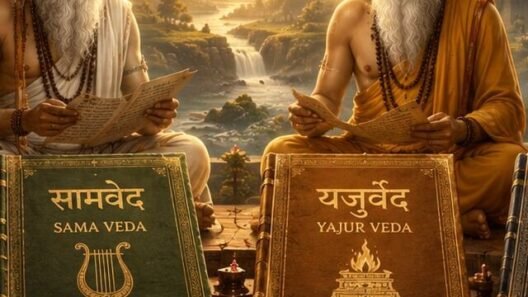
The four Vedas as organised by Veda Vyasa are:
- Rigveda — The Veda of hymns and praises. It contains 1,028 suktas (hymns) addressed to the various devas (cosmic forces), dealing with cosmology, creation, the nature of reality and the paths of knowledge and devotion. It was transmitted to Veda Vyasa’s disciple Paila.
- Yajurveda — The Veda of ritual and sacrifice. It contains the prose mantras used in Vedic yajnas and rituals. It was transmitted to the disciple Vaishampayana.
- Samaveda — The Veda of melody and chant. It is essentially a musical rendering of hymns from the Rigveda, forming the scriptural basis of Indian classical music. It was transmitted to the disciple Jaimini.
- Atharvaveda — The Veda of practical and applied knowledge, including healing, protection, and the understanding of subtle forces. It was transmitted to the disciple Sumantu.
By dividing and distributing the Vedas in this manner, Veda Vyasa ensured that the transmission would survive even as human capacity diminished in Kali Yuga. Each division was entrusted to a specific lineage of teachers, creating multiple parallel channels through which the Vedic knowledge could flow forward through time. This act of codification is precisely why he is called Vyasa — one who divides and arranges — and why this name has become his most enduring title, overshadowing even his birth name of Krishna Dwaipayana.
The 108 Puranas — A Complete Listing
If the codification of the Vedas represents Veda Vyasa’s preservation of the revealed knowledge (shruti), his composition of the Puranas represents his gift of that knowledge made accessible and alive for the common person. The Puranas — literally “ancient narratives” — are vast compilations of mythology, cosmology, genealogy, history, ethics, yoga, bhakti and practical spirituality. They take the abstract truths of the Vedas and Upanishads and give them form through story, symbol and dramatic narrative, making the deepest spiritual truths accessible to people of all backgrounds, not just the learned few.
Lord Veda Vyasa composed not merely 18 Puranas (as is commonly cited) but a total of 108 Puranas, organised into four groups of 18. This completeness — 108 being the most sacred number in the Hindu tradition, representing the fullness of cosmic reality — reflects the all-encompassing nature of Vyasa’s mission. He left nothing uncovered. Every aspect of dharmic life, every level of spiritual understanding, every tradition and lineage within Sanathana Dharma, finds its Puranic foundation in one or more of these 108 texts.
The 18 Maha Puranas
The 18 Maha Puranas (Great Puranas) are the most celebrated and widely studied. Each of them is massive in scope, dealing with the full range of Hindu cosmology, theology and dharmic living:
- Padma Purana
- Matsya Purana
- Markandeya Purana
- Bhagavatha Purana
- Brahma Purana
- Brahmanda Purana
- Brahma Vaivatha Purana
- Vaayu Purana
- Vaamana Purana
- Varaha Purana
- Vishnu Purana
- Agni Purana
- Linga Purana
- Koorma Purana
- Skanda Purana
- Garuda Purana
- Naarasimha Purana
- Bhavishya Purana
Among these, the Bhagavatha Purana is widely regarded as the crown of all Puranas. It is the text in which Veda Vyasa poured out the most direct and ecstatic expression of his devotion to Lord Vishnu-Krishna, and it is the text in which the full life of Lord Krishna is narrated in incomparable detail. The Vishnu Purana is considered the next most important, providing the most systematic account of Vaishnava cosmology and theology. The Skanda Purana is the largest of all Puranas in terms of verses, covering an enormous range of topics including the stories of Lord Murugan (Skanda/Kartikeya), the Shiva tradition and the sacred geography of India.
The 18 Upa Puranas
The 18 Upa Puranas (Secondary Puranas) supplement the Maha Puranas with further narratives, traditions and teachings, often focusing on specific deities, sages or philosophical themes:
- Sanath Kumara
- Naarasimha
- Vaayuveeya
- Shiva Dharma
- Doorvasa
- Naaradiya
- Nandikeshwara
- Oushinasa
- Kapila
- Varuna
- Shmya
- Kaalika
- Maheshwara
- Kalki
- Devi
- Paraashara
- Marichi
- Bhaskara
The 18 Ati Puranas
The 18 Ati Puranas (Extended or Superior Puranas) form a further layer of Puranic literature, containing elaborations and extensions of themes found in the Maha Puranas:
- Bruhan Naaradiya
- Bruhad Vishnu
- Bruhad Vaamana
- Bruhan Matsya
- Bruhad Swayambhu
- Bruhad Dharma
- Ganesha
- Kurma
- Brahma
- Bruhad Vishnu Dharma
- Bruhan Naarasimha
- Bruhath Oushinasa
- Bruhad Devi
- Bhavishyottara
- Bruhan Nandikeshwara
- Vaasita
- Yuga
- Maanava Purana
The 18 Lagu Puranas
The 18 Lagu Puranas (Smaller or Condensed Puranas) present more concise treatments of Puranic themes, often serving as accessible introductions to the larger bodies of teaching:
- Lagu Naaradiya
- Lagu Vaamana
- Lagu Bharmavaivarta
- Swalpa Matsya
- Aatma
- Shiva Uttara Kanda
- Vruddha Padma
- Ruju
- Pashupathi
- Paraananda
- Chandi
- Angirasa
- Maagha
- Vishnu Dharmottara
- Garga
- Kaarthava
- Soura
- Laghu Bhaghavatha Purana
Together, these 72 Puranas (the four groups of 18) — along with the 18 Maha Puranas — constitute the full body of 108 Puranas attributed to Veda Vyasa. They cover the traditions of Shaivism, Vaishnavism, Shaktism, the Ganapatya tradition, the solar tradition and many more, demonstrating the catholic, all-encompassing vision of Veda Vyasa who saw all of Sanathana Dharma as one living whole.
The Brahma Sutras, Upanishads and Shaanthi Mantras
Beyond the Vedas, the Puranas and the Mahabharata, Lord Veda Vyasa made several other contributions of the highest philosophical importance. Chief among these are the Brahma Sutras — also known as the Vedanta Sutras or Uttara Mimamsa Sutras.
The Brahma Sutras are a collection of 555 aphorisms (sutras) that systematically present the teachings of the Upanishads in a logical, structured form. The Upanishads themselves, though supremely profound, are arranged thematically rather than systematically — different Upanishads approach the nature of Brahman (the Absolute) from different angles, using different examples and metaphors. The Brahma Sutras reconcile apparent contradictions across the Upanishadic teachings and present a coherent, unified vision of the nature of Brahman, the nature of the individual soul (Atman), and the relationship between the two.
The central teaching of the Brahma Sutras can be encapsulated in the very first sutra: “Athatho Brahma Jijnyasa” — “Now, therefore, inquiry into Brahman.” This points to the supreme purpose of human life: the direct inquiry into the nature of the Absolute Reality. The Brahma Sutras became the foundational text for all schools of Vedanta philosophy. Adi Shankaracharya, Ramanujacharya, Madhvacharya and all the great Vedantic teachers of later periods each wrote their own commentary (bhashya) on the Brahma Sutras, demonstrating their centrality to the ongoing philosophical tradition.
In addition to the Brahma Sutras, Veda Vyasa is credited with the composition of several Upanishads, giving direct access to the highest Vedantic truths. He also composed Shaanthi Mantras — peace invocations designed to appease the nine planets (Navagrahas) and invoke cosmic harmony at the beginning of Vedic study sessions. These mantras continue to be recited at the beginning of Vedic and Upanishadic study across India to this day, creating an unbroken chain of practice stretching back to Veda Vyasa himself.
The Mahabharata itself — at approximately 100,000 shlokas the longest poem ever composed — represents another apex of Veda Vyasa’s creation. Within it, the Bhagavad Gita (comprising 700 verses across 18 chapters) stands as perhaps the most concentrated and profound spiritual teaching ever given, with Lord Krishna as the divine teacher. The Mahabharata also contains the Anu-Gita (the post-war repetition of the Gita’s teachings by Krishna to Arjuna), vast sections on statecraft, ethics, cosmology and the dharma of various stages of life, as well as detailed accounts of the great Kuru clan and the decisive battle of Kurukshetra.
“What Is Found Here Can Be Found Anywhere” — The Completeness of Veda Vyasa’s Knowledge
Lord Veda Vyasa made a declaration of extraordinary confidence and vision that has echoed through the ages: “What is found here can be found anywhere, but what is NOT found here can never be found anywhere.” This statement, far from being an expression of personal pride, is a declaration about the completeness and universality of the knowledge he made available.
What does this completeness mean? It means that every dimension of knowledge relevant to human evolution and liberation — spiritual, philosophical, ethical, cosmological, historical, social, medical, astronomical, poetic, musical, architectural and more — has been addressed within the body of texts attributed to Veda Vyasa. If you wish to understand the nature of God, the Upanishads and Brahma Sutras address it. If you wish to understand the path of devotion, the Bhagavata Purana and the Bhagavad Gita address it. If you wish to understand the laws of righteous conduct and statecraft, the Mahabharata addresses it. If you wish to understand the cosmic cycles of creation, maintenance and dissolution, the Puranas address it. If you wish to understand the path of action, knowledge or surrender, the Gita addresses all three.
This universal completeness is only possible because Veda Vyasa was not drawing merely on his individual knowledge, however vast, but on the infinite knowledge of the Divine Consciousness itself, of which he was a direct manifestation. He was, in this sense, the conduit through which the totality of the Vedic revelation was passed into a form that humanity could receive, study, contemplate and live by — across the long night of Kali Yuga, without losing the essential thread of truth.
This is why the tradition does not merely remember Veda Vyasa with gratitude but worships him — honours him as the Supreme Guru whose gracious gift is the very foundation of every sincere seeker’s spiritual journey. Whether one follows the path of Advaita Vedanta, Vishishtadvaita, Dvaita, Shaiva Siddhanta, Shaktism, Vaishnavism, the Smarta tradition or any other branch of Sanathana Dharma, one is standing on the ground that Veda Vyasa prepared. He is the common root from which all the branches of the great dharmic tree grow.
In Part 2 of this series, we explore the miraculous birth of Veda Vyasa as Krishna Dwaipayana, his role in the birth of the Kuru dynasty, his relationship with the Pandavas and Kauravas, the Mahabharata war, the Bhagavad Gita and the crowning work of his life — the Bhagavata Purana.
FAQs
1. Why is Veda Vyasa considered an incarnation of Lord Vishnu?
Veda Vyasa is considered an incarnation of Lord Vishnu because the sheer magnitude and profundity of his contributions — codifying the Vedas, composing the Mahabharata, 108 Puranas, the Brahma Sutras and numerous Upanishads — surpasses anything achievable by a single human being. This superhuman scope of knowledge and output is seen as evidence of divine presence. Lord Krishna Himself confirmed this by declaring in the Bhagavad Gita (Chapter 10, Verse 37): “Among the Munis, I am Veda Vyasa,” directly identifying Vyasa as His own manifestation.
2. What is the significance of the name Krishna Dwaipayana?
The name Krishna Dwaipayana is Veda Vyasa’s birth name. Krishna refers to his dark blue complexion at birth, and Dwaipayana means “born on an island” — referring to the small island formed by the bifurcation of a river, where his birth occurred. Later, his act of dividing the Vedas into four collections earned him the additional name Vyasa (meaning “one who arranges or divides”), and the combined form Veda Vyasa became his most enduring title.
3. Why does Guru Purnima celebrate Veda Vyasa?
Guru Purnima, the full moon day in the month of Ashadha, is also called Vyasa Purnima because it is traditionally observed as the birthday of Veda Vyasa. Since Veda Vyasa is the Supreme Guru who gave all the foundational texts of Sanathana Dharma to humanity, honouring him on this day is considered equivalent to honouring the principle of the Guru itself — the Guru who transmits the light of knowledge across the darkness of ignorance. Disciples across all traditions within Hinduism offer gratitude to Veda Vyasa on this day, alongside their own personal Guru.
4. What is the difference between the Maha Puranas, Upa Puranas, Ati Puranas and Lagu Puranas?
The 108 Puranas composed by Veda Vyasa are grouped into four tiers. The 18 Maha Puranas (Great Puranas) are the largest and most celebrated, covering the full range of Hindu cosmology, theology and dharmic living. The 18 Upa Puranas (Secondary Puranas) supplement the Maha Puranas with additional narratives and teachings. The 18 Ati Puranas (Extended Puranas) contain elaborations and deeper explorations of themes from the Maha Puranas. The 18 Lagu Puranas (Smaller Puranas) offer more condensed treatments, serving as accessible introductions to the larger bodies of Puranic teaching.
5. What are the Brahma Sutras and why are they important?
The Brahma Sutras (also called Vedanta Sutras) are a collection of 555 aphorisms composed by Veda Vyasa that systematically present the philosophical teachings of the Upanishads. While the Upanishads present the nature of Brahman (the Absolute) through varied approaches and examples, the Brahma Sutras reconcile all of these into a coherent, logical framework. They form the third of the three foundational texts of Vedanta (Prasthanatrayi) — alongside the Upanishads and the Bhagavad Gita — and every major Vedantic school (Advaita, Vishishtadvaita, Dvaita and others) has composed authoritative commentaries on them.