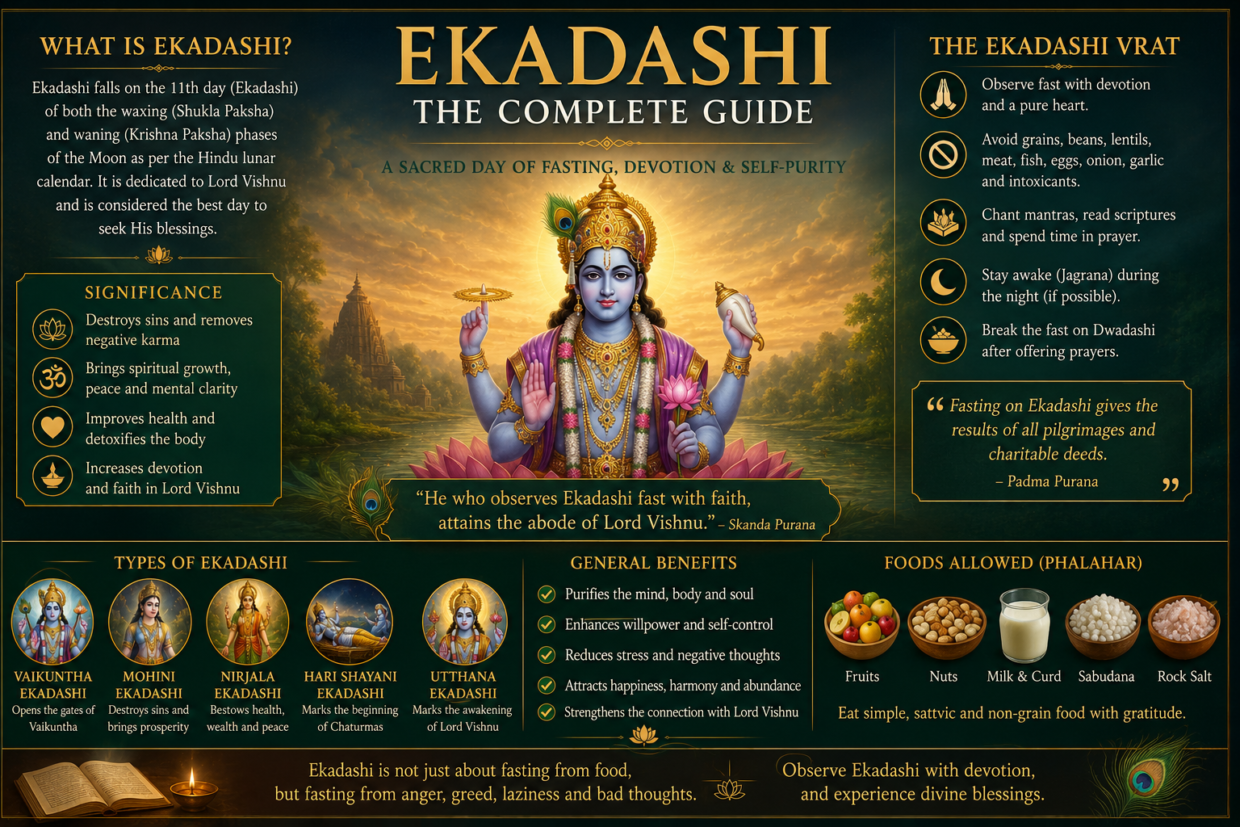
Ekadashi — the eleventh day of the lunar fortnight — stands as the most sacred fasting day in the Vaishnava calendar and one of the most widely observed ritual fasts across all of Hinduism. Occurring twice every lunar month, once in the bright fortnight (Shukla Paksha) and once in the dark fortnight (Krishna Paksha), Ekadashi comes around 24 times each year (occasionally 26 in certain leap years of the Hindu calendar). No other tithi carries the concentrated spiritual potency that tradition ascribes to the eleventh day.
The word Ekadashi derives from the Sanskrit eka (one) and dasha (ten) — “the eleventh.” But behind this simple numerical name lies a theology of liberation, a goddess born from the divine body of Vishnu, a fast that yogis, kings, merchants, and ordinary householders have observed for thousands of years, and a body of lore so vast that the Padma Purana devotes an entire section — the Uttara Khanda — to the stories and merits of each named Ekadashi.
This complete guide covers everything: the mythological origin of Ekadashi as a living goddess, the astronomical and Ayurvedic logic underpinning the fast, the names and stories of the most important Ekadashis in the annual cycle, the precise ritual protocol from the day before to the day after, the Tulsi connection, and the scriptural theology of liberation through fasting on the eleventh day.
The Origin of Ekadashi: The Padma Purana Account
The origin of Ekadashi as a goddess is narrated in vivid detail in the Padma Purana. In the ancient time before time was counted, a demon named Mura — also called Murasura — had grown so powerful that he terrorised the three worlds. The gods, unable to withstand his onslaught, fled to Vaikuntha and appealed to Lord Vishnu for protection. Vishnu took up arms and battled Mura and his armies for thousands of years in the celestial realm. Even Vishnu, the supreme sustainer, found himself exhausted by this seemingly endless war.
Vishnu withdrew to a cave in Badarikashrama — the sacred Himalayan valley — and lay down to rest in a state of deep yogic sleep. Mura, seizing the opportunity, followed him into the cave with the intention of killing the sleeping deity. But as Vishnu slept, a radiant female energy — a Shakti — emerged from his body. She was luminous, armed with weapons, and filled with a divine fury. This goddess, born from the concentrated spiritual power dwelling within Vishnu’s own form, stood between the demon and the sleeping Lord.
The battle was fierce but brief. The Shakti who had emerged from Vishnu slew Mura single-handedly while Vishnu rested undisturbed. When Vishnu awoke and saw the demon slain and the radiant goddess standing victorious, he was filled with delight. He asked her who she was and what boon she desired. The goddess replied that she was the energy born from his own divine body, and she made a remarkable request: she asked to be known throughout all the worlds as Ekadashi, because she had been born on the eleventh lunar day. And she asked that all those who fasted on her day — observing the eleventh tithi with devotion — would receive liberation from the cycle of birth and death.
Vishnu granted the boon unreservedly. In doing so, he transformed Ekadashi from a mere point in the lunar calendar into a living goddess of liberation — a deity whose very day carries the power to free souls from the accumulated weight of karma. This is why the Ekadashi fast is not merely a health practice or an ascetic discipline; it is, in the Vaishnava understanding, a meeting with a goddess who was born to destroy obstacles to liberation.
The Astronomical and Physiological Basis of Ekadashi Fasting
The Lunar Calendar Connection
The Shukla (bright fortnight) Ekadashi falls approximately three days before the full moon, and the Krishna (dark fortnight) Ekadashi falls approximately three days before the new moon. These are the two points in the lunar month when the moon’s gravitational influence on earth’s water bodies — and on the water content of the human body — is at a particular intensity of transition. The moon governs the tides of the ocean; it also, according to both ancient Indian science and contemporary research into lunar biology, influences the fluid balance within living organisms.
The human body is approximately 60-70% water. Traditional Indian thought holds that the gravitational pull of the moon on the approach to full moon and new moon creates conditions in which the digestive system is under increased hydraulic pressure, making it less efficient at processing heavy foods — especially grain-based foods that require prolonged digestive effort. Fasting on these days is therefore not an arbitrary imposition but a response to the body’s own lunar rhythms.
The Ayurvedic Rationale
Ayurveda, the ancient Indian science of life and health, offers a specific physiological explanation for the Ekadashi fast. On the eleventh lunar day, the digestive fire (Agni) is said to operate at a heightened intensity that can produce excess heat in the digestive tract. Grains — especially rice and wheat — are understood in Ayurveda as foods that require significant digestive effort and, when incompletely digested, produce toxins (Ama) that accumulate in the body. The tradition specifically holds that grain consumed on Ekadashi undergoes a fermentation process in the intestine rather than clean digestion, producing harmful byproducts.
Fasting from grain on Ekadashi thus serves a dual purpose: it allows the overworked digestive fire to rest and reset, and it prevents the accumulation of grain-derived toxins that would be produced under the specific lunar-digestive conditions of the eleventh day. The permitted Ekadashi foods — fruits, milk, nuts, root vegetables, tapioca — are all foods that Ayurveda classifies as easy to digest and less likely to produce Ama. This is not arbitrary; it reflects a sophisticated understanding of food categories and their digestive properties.
Contemporary nutritional science offers a parallel perspective. The category of “grain-free” fasting that Ekadashi mandates is remarkably close to what modern research calls time-restricted feeding combined with carbohydrate restriction. The 24-48 hour cycle of reduced caloric and carbohydrate intake triggers autophagy — the body’s cellular self-cleaning process — and allows the gut microbiome to reset. The ancient Ayurvedic insight about grain avoidance maps, in important ways, onto modern understanding of how periodic restriction of complex carbohydrates benefits metabolic health.
The Meditation and Yogic Connection
Beyond physiology, the yogic tradition offers a direct experiential rationale for Ekadashi fasting. The process of digesting a heavy meal — particularly grain-based foods — draws significant pranic (vital energy) resources toward the digestive system, away from the higher faculties of mind and consciousness. Anyone who has attempted deep meditation immediately after a full meal will recognise the phenomenon: the mind is dull, the body heavy, concentration elusive.
Fasting, by contrast, frees the prana that would have been consumed by digestion. The mind becomes lighter, clearer, and more responsive to meditation. This is the practical yogic reason why intensive spiritual practices — long meditation retreats, extended mantra japa, devotional vigils — are traditionally undertaken in a fasted state. Ekadashi, by mandating a 24-hour fast twice monthly, creates a built-in rhythm of heightened spiritual receptivity in the practitioner’s life. The eleventh day becomes, twice a month, a day when the conditions for deep meditation and devotion are physiologically supported.
The 24 Named Ekadashis of the Year
Each of the 24 Ekadashis occurring across the twelve months of the Hindu lunar calendar has a specific name, an associated narrative from the Puranas, a presiding form of Vishnu, and specific merits attributed to its observance. The Padma Purana is the primary source for these narratives; the stories are also found distributed across the Vishnu Purana, the Skanda Purana, and the Bhavishya Purana. Below are the most significant Ekadashis in depth, followed by a complete listing.
Nirjala Ekadashi: The Waterless Fast
Of all 24 Ekadashis, Nirjala Ekadashi — occurring on the Shukla Ekadashi of the month of Jyeshtha (May-June) — is universally acknowledged as the most rigorous and the most meritorious. Nirjala means “without water”: observers of this Ekadashi abstain not only from food but from all liquids for a full 24 hours, from sunrise on Ekadashi until after the Dwadashi tithi has begun the following morning.
The Padma Purana tells the story of Bhima, the second of the five Pandava brothers, who was renowned for his enormous appetite and physical strength. Bhima observed all his dharmic duties faithfully — but he found it genuinely impossible to fast on each of the 24 Ekadashis throughout the year. He went to the sage Vyasa (who was also his grandfather through his mother Kunti’s lineage) and confessed that while his brothers Yudhishthira, Arjuna, Nakula, and Sahadeva, and their wife Draupadi, all observed every Ekadashi faithfully, he could not bear the hunger.
Vyasa, in his compassion, prescribed the solution: if Bhima could observe just one Ekadashi — the Nirjala Ekadashi of Jyeshtha — with complete rigour, including the waterless fast, he would accrue the merit of all 24 Ekadashis of the year combined. This is why Nirjala Ekadashi is also called Bhima Ekadashi or Pandava Ekadashi. It represents the tradition’s acknowledgement that the spirit is willing but the flesh is weak — and its compassionate provision of a path to full merit even for those who cannot maintain monthly fasting discipline throughout the year.
Observing Nirjala Ekadashi in the heat of the Indian summer (Jyeshtha is one of the hottest months) without water for 24 hours is a genuine physical ordeal. The tradition regards the intensity of the physical difficulty as commensurate with the extraordinary spiritual merit. On this day, the gift of water — offering pots of water, digging wells, setting up water stations for travellers — is considered among the most meritorious acts one can perform.
Vaikuntha Ekadashi: The Opening of the Celestial Gates
Vaikuntha Ekadashi — occurring on the Shukla Ekadashi of the month of Margashirsha (December-January), which falls in the solar month of Dhanur according to the Tamil/South Indian calendar — is the single most celebrated Ekadashi in the Hindu world, particularly in South India and among Vaishnava communities globally. On this day, tradition holds that the gates of Vaikuntha — Vishnu’s supreme abode — are thrown open, and any soul that passes through them, even symbolically, is assured liberation.
At the great Vaishnava temple complexes — Tirupati (Tirumala Venkateswara), Srirangam (Ranganatha), Melukote, and Udupi — the Vaikuntha Dwara, the northern gate of the temple’s inner sanctum, is opened only on this one day of the year. Hundreds of thousands of devotees queue through the night to pass through this gate, which symbolises entry into Vaikuntha itself. The merit of passing through the Vaikuntha Dwara on this day is said to be equivalent to liberation from the cycle of rebirth.
In Karnataka, Vaikuntha Ekadashi is known as Mukkoti Ekadashi — the Ekadashi of the 33 crore (330 million) gods. According to this tradition, all the devas assemble at Vaikuntha on this day to worship Vishnu, making the celestial realm especially accessible to human prayer and devotion. Temples across Karnataka conduct all-night recitations of the Vishnu Sahasranama and the Divya Prabandham (the 4,000 verses of the Alvars) on this night.
The Dhanur Masa in Tamil Nadu — the entire lunar month in which Vaikuntha Ekadashi falls — is itself a sacred month dedicated to early-morning (pre-dawn) worship of Vishnu. The recitation of Andal’s Thiruppavai, 30 verses sung in the pre-dawn hours, is the characteristic devotional form of this month. Vaikuntha Ekadashi is its climactic day.
Devshayani Ekadashi: When Vishnu Goes to Sleep
Devshayani Ekadashi falls on the Shukla Ekadashi of the month of Ashadha (June-July) and marks one of the most significant transitions in the Vaishnava annual calendar: the beginning of Chaturmasya, the four-month period during which Lord Vishnu is traditionally said to enter Yoga Nidra — divine sleep — resting on the coils of Adishesha, the cosmic serpent, floating on the Kshira Sagara (the Milky Ocean).
Devshayani means “the sleeping of the gods.” During the four months of Chaturmasya — from Ashadha Shukla Ekadashi to Kartika Shukla Ekadashi — no auspicious events are traditionally performed: no weddings, no house-warming ceremonies (Griha Pravesh), no initiation rituals, no new ventures. The world is, in a sense, in the care of Brahma and Shiva while Vishnu rests. This four-month period corresponds roughly to the monsoon season in India — the period when travel was difficult in ancient times, when rivers flooded, and when agricultural communities were most dependent on the rain.
The Chaturmasya vows — four months of intensified spiritual practice — begin on Devshayani Ekadashi. Wandering monks (sannyasis and ascetics) were traditionally expected to remain in one location during this period, giving teachings, rather than travelling. This practice of Chaturmasya pravasa (four-month residence) is still observed by Jain monks and by many Hindu sannyasis.
Prabodhini Ekadashi / Dev Uthani Ekadashi: The Awakening
Four months after Devshayani Ekadashi, on the Shukla Ekadashi of Kartika (October-November), comes Prabodhini Ekadashi — the Ekadashi of awakening. Prabodhini means “the one that awakens”; the alternative name Dev Uthani Ekadashi means “the Ekadashi on which the gods rise.” On this day, Vishnu is said to awaken from his four-month Yoga Nidra, and the world returns to its full active state. All the auspicious activities suspended during Chaturmasya — weddings, house-warmings, new ventures — resume from this day.
Prabodhini Ekadashi is also the occasion for the Tulsi Vivah — the ceremonial marriage of the Tulsi plant (sacred basil, Ocimum tenuiflorum) to Lord Vishnu, represented by the Shaligrama stone (an ammonite fossil from the Gandaki River in Nepal that is Vishnu’s aniconic form). The Tulsi Vivah is a complete wedding ceremony: the Tulsi plant is decorated as a bride with a sari and jewellery, the Shaligrama is dressed as a groom, and the marriage is conducted with full Vedic rites including the Saptapadi (seven steps). Households across North and West India perform this ceremony on Prabodhini Ekadashi, and it is considered as meritorious as the marriage of a daughter. The ceremony marks the resumption of the marriage season after Chaturmasya.
Putrada Ekadashi: The Son-Granting Fast
Putrada Ekadashi — which occurs twice a year, on the Shukla Ekadashi of both Shravana (July-August) and Pausha (December-January) — is specifically recommended for couples who desire children. Putrada means “granting a son” (or, more broadly, granting progeny). The Padma Purana tells the story of King Suketuman of Bhadravati, who was childless and deeply distressed. He and his queen observed the Putrada Ekadashi fast with complete devotion, following all prescribed rites, and were blessed with a son who became a great and righteous king.
The Putrada Ekadashi of Pausha is particularly associated with the birth of children with good qualities and spiritual inclinations — tradition holds that the soul that takes birth in a family after the parents’ observance of this Ekadashi will be a noble, dharmic soul. The fast is also observed by those who seek the welfare and long life of existing children.
Papamochani Ekadashi: The Destroyer of Sin
Papamochani Ekadashi falls on the Krishna Ekadashi of Chaitra (March-April), the month that marks the approach of the new Hindu year. Papamochani means “that which releases from sin” — papa is sin or negative karma, and mochani is the one who liberates or releases. This Ekadashi is said to destroy even the heaviest accumulated sins, including those committed unknowingly or in previous lives.
The Padma Purana’s narrative for Papamochani Ekadashi involves an apsara (celestial nymph) named Medhavi and a sage named Chyavana — a story of spiritual pride, temptation, and ultimately redemption through the grace of Ekadashi observance. The Ekadashi immediately preceding the new year serves as a cosmic reset — a day of expiation and release before the new annual cycle begins.
Kamika Ekadashi: The Shravana Observance
Kamika Ekadashi falls on the Krishna Ekadashi of Shravana (July-August), within the holiest month of the Hindu calendar — a month sacred to both Shiva (whose association with Shravana is well-known through the Kanwar Yatra) and Vishnu. Kamika is said to derive from the granting of desires (kama); this Ekadashi is particularly auspicious for fulfilling legitimate desires through devotional observance.
The Lord Vishnu worshipped on Kamika Ekadashi is specifically the form associated with the Tulsi leaf — this Ekadashi is one on which the offering of Tulsi to Vishnu carries extraordinary merit. The Padma Purana states that a single Tulsi leaf offered to Vishnu on Kamika Ekadashi equals in merit the donation of gold, land, and all material wealth combined. The month of Shravana’s intensified spiritual atmosphere makes this Ekadashi particularly potent for both Shaiva and Vaishnava devotees.
The Complete Annual Cycle
The 24 named Ekadashis in their annual sequence are: Saphala (Pausha Krishna), Putrada (Pausha Shukla), Shattila (Magha Krishna), Jaya (Magha Shukla), Vijaya (Phalguna Krishna), Amalaki (Phalguna Shukla), Papamochani (Chaitra Krishna), Kamada (Chaitra Shukla), Varuthini (Vaishakha Krishna), Mohini (Vaishakha Shukla), Apara (Jyeshtha Krishna), Nirjala (Jyeshtha Shukla), Yogini (Ashadha Krishna), Devshayani (Ashadha Shukla), Kamika (Shravana Krishna), Shravana (Shravana Shukla), Aja (Bhadrapada Krishna), Parivartini/Parsva (Bhadrapada Shukla), Indira (Ashwina Krishna), Papankusha (Ashwina Shukla), Rama (Kartika Krishna), and Prabodhini/Dev Uthani (Kartika Shukla). In leap years of the Adhika Masa (intercalary month), two additional Ekadashis may occur.
How to Observe Ekadashi: The Complete Ritual Protocol
Dashami: The Day of Preparation
The Ekadashi observance actually begins on Dashami — the tenth day, the day before Ekadashi. On Dashami evening, the observant practitioner takes a single meal before sunset, avoiding all meat, fish, onion, garlic, and eggplant (brinjal). These foods are considered Tamasic (dulling to the consciousness) and incompatible with the elevated spiritual state that Ekadashi demands. The evening meal should be simple, light, and Sattvic.
After the evening meal on Dashami, the practitioner sets a clear intention for the following day’s fast — ideally reciting a short sankalpa (vow) naming the specific Ekadashi being observed. Sleeping early on Dashami night is recommended, both to avoid overeating (as hunger returns in the late evening) and to facilitate an early pre-dawn awakening on Ekadashi.
The Ekadashi Fast: Grain Abstention as the Core Practice
The single defining feature of Ekadashi — the one element that is non-negotiable across all traditions and all 24 Ekadashis — is the complete abstention from grain. All cereals (rice, wheat, corn, millet, oats, barley) and all legumes (lentils, chickpeas, kidney beans, peas) are prohibited. This prohibition includes all products derived from these: bread, pasta, rice dishes, dhal, tofu, and crucially, all flours made from grains or legumes.
The degree of strictness varies according to tradition and individual capacity. The three main levels of Ekadashi observance are:
- Nirjala: No food and no water for the full 24-hour period. This is the most austere form, recommended only for robust practitioners and specifically mandated for the Nirjala Ekadashi of Jyeshtha.
- Phalahar: Fruits, milk, and water only. No cooked food of any kind. This is the middle path.
- Upvas with Ekadashi foods: Grain-free but allowing a specific range of permitted foods. This is the most commonly observed form.
Permitted Ekadashi Foods
The cuisine that has developed around Ekadashi fasting is remarkably rich and varied — a testament to the culinary creativity of Hindu households over centuries. Permitted foods include:
- Fruits: All fresh fruits and dried fruits (dates, raisins, figs)
- Dairy: Milk, curd (yogurt), ghee, paneer (fresh cheese), butter
- Nuts and seeds: Almonds, cashews, peanuts (groundnuts — a common exception to legume rules in practice), walnuts
- Root vegetables: Potatoes, sweet potatoes, yams, arbi (taro)
- Sabudana: Tapioca pearls — the basis of the beloved Sabudana Khichdi, one of the most widely eaten Ekadashi dishes in Maharashtra and North India
- Singhara flour: Water chestnut flour, used to make rotis and halwa on Ekadashi
- Rajgira (Amaranth): Amaranth flour, used for Ekadashi rotis and laddoos
- Kuttu (Buckwheat): Despite its name, buckwheat is not a true cereal grain and is permitted on Ekadashi; Kuttu ki puri and paratha are North Indian Ekadashi staples
- Rock salt (Sendha namak): Regular sea salt is avoided; only rock salt (halite) is used in Ekadashi cooking
- Specific vegetables: Bottle gourd, ridge gourd, pumpkin, raw banana; onions and garlic are always prohibited
The Day’s Spiritual Programme
Rising before dawn (Brahma Muhurta, approximately 1.5 hours before sunrise) is the ideal starting point on Ekadashi. After bathing — ideally in a river, lake, or the sea, or at minimum a full home bath — the practitioner visits the Vishnu temple for morning darshan and participates in the morning aarti. The Vishnu Sahasranama (the thousand names of Vishnu) is recited either in the temple or at home — its recitation on Ekadashi is said to carry exceptional merit.
Reading or listening to the specific Ekadashi’s story — as narrated in the Padma Purana — is an important part of the day. Each Ekadashi has its own Mahatmya (glorification narrative), and hearing it on the day of that Ekadashi is itself considered a meritorious act. The stories typically involve a king, a sage, or an ordinary person whose sins are washed away or whose desires are fulfilled through the fast.
The ideal Ekadashi programme includes as much time as possible in devotional activity: japa (mantra repetition) of the Hare Krishna Mahamantra or the Vishnu Ashtakshara (Om Namo Narayanaya), kirtan (devotional singing), reading of Vaishnava scriptures (Bhagavad Gita, Bhagavata Purana), and service in the temple or to Vaishnavas. The tradition holds that Ekadashi is a day when even ordinary activities should be minimised and spiritual activity maximised.
Staying awake through the night — Jaagaran — in devotional activity (kirtan, bhajan, prayer) is the highest form of Ekadashi observance. The Padma Purana states that the merit of a night spent awake in devotion on Ekadashi exceeds the merit of all manner of yajna (sacrifice) and charitable donation. ISKCON temples worldwide conduct all-night kirtans on Ekadashi nights for this reason.
Dwadashi: The Break-Fast
The Ekadashi fast concludes on Dwadashi — the twelfth day — but the protocol for breaking the fast is as precise as the fast itself. One does not simply eat when hungry on the morning after Ekadashi. The fast should be broken only after the Dwadashi tithi has definitively begun — one waits for a specific muhurta (auspicious moment) within Dwadashi. Breaking the fast either too early (while Ekadashi still runs) or too late (after Dwadashi has ended and Trayodashi has begun) both carry spiritual demerits.
The break-fast should begin with a specific item: in the month of Kartika, Amla (Indian gooseberry, Amalaki) is the traditional first food. In other months, the specific Ekadashi’s story often prescribes a particular food — it might be a specific fruit, a Tulsi leaf, or a Sattvic preparation. The Padma Purana specifies break-fast protocols in detail for individual Ekadashis.
Critically, before eating on Dwadashi, the practitioner should first feed Brahmins and distribute food and dakshina (gift) to the needy. The entire merit of the Ekadashi fast is said to be sealed and secured by this act of charitable feeding on Dwadashi. Keeping the fast but neglecting the charitable distribution is considered incomplete observance. On Dwadashi, one also avoids certain activities: sleeping during the day, eating in another’s house (without express invitation), eating multiple times, eating meat or the foods avoided on Dashami.
Ekadashi in the Bhagavata Purana and Scriptural Theology
The Bhagavata Purana — the most beloved of the eighteen Mahapuranas, and the primary scriptural authority for Vaishnava devotion — does not enumerate the 24 Ekadashis in the manner of the Padma Purana, but it repeatedly references Ekadashi fasting as part of the devotional life of Vishnu’s devotees. The Bhagavata’s treatment of Ekadashi is embedded within its broader theology of bhakti — that genuine devotion expressed through service, remembrance, and renunciation (including the renunciation of food) constitutes the highest path to liberation.
The Padma Purana’s Ekadashi narratives contain a remarkable and theologically significant pattern: many of the stories involve liberation through inadvertent or accidental Ekadashi fasting. A hunter, fleeing pursuers, climbed a Bilva tree on Ekadashi and spent the entire day and night in the tree — unable to hunt, eat, or drink, and dropping leaves on a Shivalinga at the base of the tree (which happened to be Shivaratri as well). He was liberated despite having no devotional intent whatsoever. A prostitute inadvertently fasted on Ekadashi because her lover was late and she waited all day without eating — she too received liberation.
These stories establish a striking theological principle: the power of Ekadashi is, in some sense, intrinsic to the tithi itself rather than dependent entirely on the observer’s conscious intention. The day itself carries a liberating force. Deliberate, intentional observance with full devotion produces the highest merit — but even inadvertent observance produces merit, because the day is intrinsically sacred. This position represents a sophisticated middle ground between the view that karma depends entirely on intention (sankalpa) and the view that ritual action carries automatic power regardless of mind-state (karma-kanda).
The Vishnu Purana reinforces this by stating that Vishnu himself is especially present and accessible on Ekadashi — that his grace flows more freely on this day, that prayers offered on Ekadashi reach him directly, and that the remembrance of his name on the eleventh day destroys sins that would otherwise require many lifetimes to exhaust.
Ekadashi and the Vaishnava Tradition
Ekadashi is fundamentally a Vaishnava observance. While it is observed across many Hindu communities, its primary scriptural home is in Vaishnava literature — the Padma Purana, the Vishnu Purana, the Bhagavata Purana — and its mythology is inseparable from Vishnu and his devotion. The goddess Ekadashi was born from Vishnu’s own body; the fast is dedicated to Vishnu or his various forms (Krishna, Rama, Narayana, Venkateswara, Ranganatha); the specific foods permitted and prohibited are calibrated against Vishnu’s preferences and Ayurvedic principles accepted within the Vaishnava tradition.
This contrasts with the Shaiva tradition’s own sacred fast days: Pradosham (the thirteenth tithi of both fortnights) and the monthly Shivaratri (the fourteenth tithi of the dark fortnight) are to Shaivas what Ekadashi is to Vaishnavas. Mondays (Somavara) are sacred to Shiva; Ekadashi days are sacred to Vishnu. The two great devotional traditions of Hinduism each have their own rhythmic pulse of fasting and intensified practice built into the lunar calendar.
The Gaudiya Vaishnava tradition — the lineage of Sri Chaitanya Mahaprabhu (1486-1534) — is the tradition most responsible for the global spread of Ekadashi observance in the modern era. Chaitanya himself observed Ekadashi with exceptional strictness, reportedly weeping in ecstatic devotion through Ekadashi nights in kirtan. His tradition, represented globally today by ISKCON (the International Society for Krishna Consciousness), treats Ekadashi as one of the central organising features of Vaishnava life. ISKCON publishes annual Ekadashi calendars calibrated for each time zone; ISKCON temples worldwide distribute special Ekadashi prasad (grain-free foods); and the Ekadashi fast is one of the four regulative principles’ adjacent practices that initiates are expected to maintain.
For the Gaudiya tradition, the logic of Ekadashi fasting is explicitly theocentric: fasting on Ekadashi is not primarily about health or self-discipline — it is about pleasing Krishna. The entire day is reimagined as a gift to the Lord: the discomfort of the fast is offered to him, the freed energy is directed toward hearing about him, chanting his names, and serving his devotees. This orientation transforms what might otherwise be a health or ascetic practice into a complete devotional act.
Ekadashi Across Traditions
Parallels in Jainism
Jainism, which shares the Indian subcontinent with Hinduism and has deeply influenced its ascetic culture, has its own tradition of periodic fasting keyed to the lunar calendar. The Jain equivalent fasting days are the Ashtami (eighth tithi) and Chaturdashi (fourteenth tithi) of each fortnight — days that are considered particularly auspicious for spiritual practice and particularly inauspicious for new ventures. The annual Paryushana festival (eight days for Shvetambara Jains, ten days for Digambara Jains) is the most intensive fasting period in the Jain year, analogous in some respects to the significance of Nirjala Ekadashi.
The Jain and Vaishnava fasting traditions share the insight that the lunar calendar provides natural thresholds — points in the monthly cycle where the conditions for spiritual intensification are most favourable. The specific days differ between the traditions, but the underlying principle — that certain tithis are inherently charged with spiritual power and that fasting amplifies the practitioner’s access to that power — is shared.
The Shaiva Parallel: Pradosham and Shivaratri
In the Shaiva tradition, Pradosham — which falls on the thirteenth tithi (Trayodashi) of both fortnights, specifically in the evening twilight period (the “pradosha” or dusk interval) — is the equivalent of Ekadashi. Pradosham is believed to be the time when Shiva performs his cosmic dance (Nataraja) at Kailasha, surrounded by all the gods, and when his grace is most freely available. Devotees fast through the day and worship Shiva specifically in the Pradosha Kala (the 3-hour window around sunset).
Monthly Shivaratri (the fourteenth tithi of the dark fortnight) is another Shaiva fasting day, building toward the annual Maha Shivaratri (the most important). The monthly Shivaratri fast is observed by many Shaiva devotees on the fourteenth lunar day — one day after Pradosham. The structural parallel to the Vaishnava Ekadashi cycle is clear: both traditions use the lunar calendar to create a monthly rhythm of intensified devotional practice, each keyed to their primary deity’s particular sacred days.
Modern Science and Lunar Fasting
The past two decades have produced a substantial body of scientific research on the health benefits of intermittent fasting — periodic caloric restriction as a means of improving metabolic health, reducing inflammation, promoting autophagy (cellular self-cleaning), and potentially extending lifespan. This research has lent unexpected scientific credibility to ancient fasting traditions that have long been dismissed as superstition by modernist critics.
The Ekadashi-Dwadashi cycle — 24 to 36 hours of grain-free eating followed by a carefully controlled break-fast — maps remarkably closely onto the 24-hour intermittent fasting protocols that have shown the strongest metabolic benefits in clinical research. The specific prohibition of grains (complex carbohydrates) on Ekadashi aligns with the research on carbohydrate restriction’s role in triggering ketosis and autophagy. The emphasis on fruits, dairy, and roots (all easier to digest than grains) as permitted foods aligns with research showing that certain foods are less metabolically disruptive during fasting windows.
Some researchers have specifically investigated the relationship between lunar cycles and human physiology, finding correlations between lunar phases and sleep patterns, hormone levels, and digestive function. While this research remains preliminary and contested, it provides a scientific context for the ancient intuition that the eleventh lunar day carries specific physiological significance. The tradition’s claim that grain is particularly hard to digest on Ekadashi may well have an empirical basis that ancient practitioners discovered through careful observation of the body’s lunar rhythms over generations.
The Tulsi Plant and Ekadashi
No discussion of Ekadashi is complete without the sacred Tulsi plant (Ocimum tenuiflorum, holy basil). Tulsi holds a unique position in the Vaishnava world as the most beloved of all Vishnu’s devotees — a divine being who chose to manifest as a plant in order to be in constant proximity to her Lord and to serve all his devotees. Her leaves are the single most sacred offering that can be made to Vishnu: the Padma Purana states that a single Tulsi leaf placed on the head of Vishnu’s murti equals in merit all manner of material offerings combined.
Ekadashi has a particular and somewhat paradoxical relationship with Tulsi. On the one hand, Ekadashi is one of the days when Tulsi leaves are most valued as Vishnu’s offering — they are considered especially potent when offered on the eleventh day. On the other hand, Ekadashi is one of the days when Tulsi leaves should not be plucked. The tradition holds that Tulsi deserves a day of rest on Ekadashi — she is not to be disturbed by the plucking of her leaves. Leaves may be offered to Vishnu on Ekadashi, but they should be plucked the day before (on Dashami) and preserved, not plucked on the day itself. The same prohibition applies on Sundays and on full-moon and new-moon days.
The theological rationale is tender: Tulsi is understood as a living devotee of Vishnu, and Ekadashi — Vishnu’s own most sacred day — is a day when she too should be free to worship without the demands of being plucked and used. She is given the same consideration as a devotee who should be left undisturbed in prayer on the most sacred day of the week.
The Tulsi Vivah: The Celestial Wedding
The high point of the Tulsi-Ekadashi connection is the Tulsi Vivah performed on Prabodhini Ekadashi in Kartika. The ceremony is a complete Hindu wedding, with all its ritual complexity, performed between the Tulsi plant (the bride) and either the Shaligrama stone or a murti of Vishnu/Krishna (the groom). In many homes, a small model of a wedding mandap (canopy) is constructed from sugarcane stalks; the Tulsi plant is placed within it, decorated with a red sari, a bangles, sindoor (vermilion), and flowers; and the Shaligrama is brought ceremonially to the mandap as the groom.
The marriage is conducted with Vedic mantras, the Saptapadi (seven steps around the sacred fire), the exchange of flower garlands, and the tying of the mangalsutra (wedding necklace). In many traditions, the entire neighbourhood is invited; the ceremony has the social character of a real wedding, with sweets distributed and blessings exchanged. The Padma Purana states that a householder who performs the Tulsi Vivah with devotion receives the merit of having given his own daughter in marriage — one of the highest meritorious acts in the Hindu dharmic framework.
The Tulsi Vivah also marks the beginning of the wedding season in most of India. Since no marriages could be performed during the four months of Chaturmasya (when Vishnu was sleeping), the first day Vishnu “wakes up” — Prabodhini Ekadashi — is the day when the sacred marriage between Tulsi and Vishnu is first performed, blessing and inaugurating the entire earthly wedding season to follow. Marriages in many Hindu communities are not performed until after the Tulsi Vivah, and the first auspicious muhurta for earthly weddings comes on or after this day.
Ekadashi in Daily and Community Life
The practical impact of Ekadashi on the rhythm of Hindu life, particularly in North India and among Vaishnava communities worldwide, is substantial. Twice a month, the household kitchen undergoes a complete transformation: the usual staples (rice, wheat, dhal, bread) disappear, replaced by tapioca, buckwheat, water chestnut flour, potatoes, and an array of fruit-based preparations. The household’s daily schedule shifts: the morning includes temple-going and Vishnu Sahasranama recitation; the evening is devoted to kirtan and scripture; the night may include a devotional vigil.
In communities where Ekadashi is widely observed, restaurants and food stalls modify their menus on the eleventh day. “Upvas thali” (fasting plate) is available in many North Indian restaurants — a grain-free meal of Sabudana Khichdi, potato preparations, and fruit. Sweet shops prepare Ekadashi-specific sweets: Sabudana kheer, Rajgira laddoo, Singhara halwa. The entire food economy of a devout community briefly reorganises itself around the lunar day.
For ISKCON devotees globally — in Europe, North America, Russia, South America, and Africa — Ekadashi provides a shared devotional calendar that transcends cultural and national differences. An ISKCON devotee in London and one in Mumbai observe the same Ekadashi on the same day (adjusted for time zones), fast on the same foods, read the same Padma Purana narrative, and participate in the same all-night kirtan. The twice-monthly Ekadashi fast is one of the most powerful unifying practices in the global Vaishnava community.
The Liberating Promise of Ekadashi
At its deepest level, Ekadashi is a promise: the promise made by Vishnu to the goddess born from his own body, that those who fast on her day will receive liberation. This is not merely a conditional promise dependent on the perfection of one’s practice — the Padma Purana’s narratives repeatedly demonstrate that even imperfect, partial, or inadvertent fasting on Ekadashi carries liberating power. The grace of the day is generous.
This generosity reflects the Vaishnava theology of divine grace (prasada or anugraha): liberation is ultimately not earned by one’s own effort but bestowed by the Lord’s grace. The fast creates the conditions — the lightened body, the quieted mind, the spirit directed toward devotion — in which that grace can more easily flow. Ekadashi is twice-monthly proof that the Hindu tradition never abandoned its devotees to earn liberation alone; it built the conditions for liberation into the calendar itself.
The eleventh day of the moon remains, after thousands of years, one of the most living, most widely observed, and most deeply felt spiritual practices in the Hindu world. From the banks of the Ganga in Varanasi to the Vaishnava temples of South India, from ISKCON centres in London to Brahmin households in rural Maharashtra, the Ekadashi fast continues to be observed with the same intention it has carried since the goddess was born from Vishnu’s sleeping form: the desire for liberation, offered twice monthly to all who are willing to simply stop eating grain and turn their hearts toward the Lord.
Key Takeaways
- Ekadashi is the 11th lunar tithi, occurring twice monthly (Shukla and Krishna Paksha), totalling 24 fasts per year — the most important fasting day in the Vaishnava calendar.
- The Ekadashi goddess was born from Vishnu’s body and slew the demon Mura while Vishnu rested; Vishnu granted her the boon that fasting on her day confers liberation.
- Grain (all cereals and legumes) is the one non-negotiable prohibition on Ekadashi; fruits, dairy, tapioca, buckwheat, water chestnut flour, and root vegetables are permitted.
- Nirjala Ekadashi (Jyeshtha Shukla) is the most rigorous — a waterless 24-hour fast said to equal the merit of all 24 Ekadashis combined; also called Bhima Ekadashi.
- Vaikuntha Ekadashi (Margashirsha/Dhanur Masa) is the most celebrated — the gates of Vaikuntha are said to open; massive celebrations at Tirupati, Srirangam, and all major Vaishnava temples.
- Devshayani Ekadashi begins Chaturmasya (four months of Vishnu’s Yoga Nidra) when no auspicious events are held; Prabodhini Ekadashi ends it with the Tulsi Vivah and the resumption of the wedding season.
- Tulsi leaves should not be plucked on Ekadashi — she rests on this day; but previously plucked leaves remain the most sacred offering to Vishnu on the eleventh day.
- The fast begins on Dashami (avoiding meat, onion, garlic) and ends on Dwadashi (the 12th day) at a specific auspicious time, after feeding Brahmins and the poor.
- The Ayurvedic and lunar logic: the 11th tithi is a phase of digestive sensitivity; grain avoidance prevents accumulation of toxins and frees pranic energy for deeper meditation.
- Even inadvertent fasting on Ekadashi carries liberating power — the Padma Purana teaches that the tithi’s sanctity is intrinsic, not entirely dependent on the observer’s conscious devotion.
Frequently Asked Questions About Ekadashi
Can I drink water on Ekadashi?
Yes — for the vast majority of Ekadashi observances, water and other non-grain liquids (milk, fruit juice, coconut water) are permitted. The only Ekadashi on which even water is withheld is Nirjala Ekadashi (Jyeshtha Shukla Ekadashi, May-June), which is specifically designated as the waterless fast. On all other Ekadashis, staying well-hydrated is not only permitted but recommended, especially in warm climates. Many practitioners drink milk, fruit juices, coconut water, and plain water throughout the Ekadashi day without any diminishment of the fast’s merit.
Why are onion and garlic avoided on Ekadashi (and on Dashami)?
Onion and garlic are classified in Ayurveda and in Vaishnava food theology as Tamasic foods — foods that dull the consciousness, increase lethargy and agitation, and are incompatible with sattvic (pure, luminous) spiritual states. The Padma Purana specifically prohibits them for Ekadashi observers because the purpose of the fast is to heighten spiritual clarity and devotional focus — qualities that Tamasic foods directly obstruct. Additionally, onion and garlic are considered aphrodisiacs that stimulate the lower passions, which are to be restrained during periods of intensive spiritual practice. The prohibition begins on Dashami (the day before Ekadashi) because these foods take time to be metabolically cleared and their dulling effect persists into the next day.
What is the significance of breaking the Ekadashi fast at a specific time on Dwadashi?
The timing of the Dwadashi break-fast matters because the Ekadashi fast is technically complete only when the Ekadashi tithi has fully ended and the Dwadashi tithi has begun. Breaking the fast while Ekadashi still runs — even if one has been fasting since the previous morning — is considered a violation of the vow. Equally, waiting too long and breaking the fast after the Dwadashi tithi has ended (i.e., on Trayodashi) is also discouraged, as it can produce what the tradition calls Trayodashi-bheda (breaking on the thirteenth) which carries its own demerits. The traditional practice is to check the Panchang (almanac) for the precise Dwadashi parana time for one’s location — the window during which the fast should be broken — and to eat within that window, after the morning worship and the feeding of Brahmins.
Is Ekadashi observed differently in South India compared to North India?
The fundamental practice — grain-free fasting on the eleventh lunar day — is consistent across India. However, the cultural expressions differ significantly. In South India, particularly in Tamil Nadu, Andhra Pradesh, and Karnataka, Ekadashi is embedded within a rich temple culture; the all-night Vishnu Sahasranama recitation and the Divya Prabandham (Alvar hymns) are characteristic of South Indian Ekadashi observance. Vaikuntha Ekadashi at Srirangam and Tirupati draws millions of pilgrims annually. In North India, Ekadashi observance is centred in the household, with Sabudana Khichdi and Kuttu ki roti as the signature Ekadashi foods; the all-night kirtan (Jaagaran) is the devotional form. ISKCON, drawing primarily from the Gaudiya (Bengal-based) tradition, has its own rich Ekadashi culture combining elements of both, now spread globally. The permitted and prohibited food lists also show minor regional variations.
Who is traditionally exempt from the Ekadashi fast?
The tradition exempts several categories of people from the full Ekadashi fast, though encouraging them to observe it in whatever modified form their condition permits. Exempt categories include: young children (typically under age 8 or 10); pregnant and nursing women (who must not fast in ways that compromise foetal or infant nutrition); the seriously ill who are medically required to eat at specific times; the very elderly who cannot safely fast; and those performing heavy physical labour who cannot safely reduce caloric intake. These individuals are typically encouraged to observe the spirit of Ekadashi — avoiding grain if possible, increasing devotional activity, visiting the temple — even if they cannot maintain a complete fast. The Padma Purana itself acknowledges human limitation and prescribes the Nirjala Ekadashi as a compassionate provision for those who cannot fast every month.
What is the connection between Ekadashi and the Tulsi Vivah?
The Tulsi Vivah — the ceremonial marriage of the Tulsi plant to Vishnu — is performed specifically on Prabodhini Ekadashi (Kartika Shukla Ekadashi), the day Vishnu “awakens” from his four-month Chaturmasya sleep. The connection is direct and theological: on the very first Ekadashi after Vishnu’s awakening, his most beloved devotee (Tulsi) is formally wed to him in a ceremony that blesses the entire forthcoming wedding season. The Tulsi Vivah is also connected to the broader Ekadashi-Tulsi relationship: Tulsi leaves are the most sacred offering to Vishnu on any Ekadashi, but on Ekadashi itself, Tulsi is not plucked — she is given a day of rest. On Prabodhini Ekadashi specifically, she is not just resting but being honoured as a bride. The ceremony brings together the two most potent sacred elements of Vaishnava devotion — the eleventh tithi (Ekadashi goddess) and the Tulsi plant — in a single day of extraordinary spiritual intensity.