In the vast pantheon of Hindu deities, few figures command as much reverence, awe, and devotion as Goddess Durga — the supreme warrior, the invincible mother, and the very embodiment of divine feminine power. She is not merely a goddess of war; she is the primordial energy that underlies all creation, the force that protects the cosmos from chaos, and the mother who nurtures even as she destroys what must be destroyed. To understand Durga is to understand one of the most profound theological concepts in the history of human civilisation: that the ultimate reality is not passive but dynamic, not distant but intimately engaged in the perpetual battle between light and darkness.
Worshipped across the Indian subcontinent and wherever the Hindu diaspora has carried its traditions, Durga stands at the centre of some of the most spectacular festivals on earth — from the five-day grandeur of Bengal’s Durga Puja to the royal magnificence of Mysore Dasara. She is the goddess who rides a lion, who bears eighteen arms bristling with divine weapons, and whose fierce expression conceals a mother’s compassion. She is, in the words of the Devi Mahatmyam, “the eternal and incomprehensible being, the cause of the sustenance of the universe.”
Etymology: The Meaning of “Durga”
The name Durga carries several layers of meaning, each illuminating a different facet of the goddess’s nature. The most widely accepted etymology breaks the word into two Sanskrit roots: Dur (difficult, hard, inaccessible) and Ga (to go, to reach). Thus, Durga is literally “the one who is difficult to reach or defeat” — she is beyond the grasp of enemies, beyond the comprehension of the unworthy, and beyond the reach of evil.
A second etymological tradition connects her name directly to her greatest mythological feat: the slaying of the demon Durgam (also called Durgamasura), a buffalo-demon whose name means “difficult passage” or “hard to traverse.” By killing Durgam, the goddess herself took on his name, transforming the symbol of obstruction into a title of triumph. This naming convention — goddess absorbing the identity of the demon she overcomes — is theologically rich, suggesting that she transforms and transcends all obstacles.
The Durga Saptashati provides yet another interpretation: Du (the demon Durgam), R (diseases), G (sins), and A (fear) — together suggesting that Durga is the one who removes all these afflictions. In the Agni Purana, the name is interpreted as “she who protects from all sins, evil, and enemies.” Every etymology converges on the same essential truth: Durga is the protector, the invincible guardian who stands between humanity and the forces that would annihilate it.
Origin Myth: The Birth of the Divine Warrior
The most authoritative account of Durga’s origin is found in the Devi Mahatmyam (also called the Durga Saptashati or Chandi Path), a 700-verse Sanskrit text embedded within the Markandeya Purana, composed roughly between the 5th and 7th centuries CE. It is one of the most important texts in the Shakta tradition and is recited in its entirety during Navaratri each year by millions of devotees.
The story begins with cosmic catastrophe. Mahishasura, the buffalo-demon, had performed extraordinary austerities and received from Brahma the boon of near-immortality: no male being — human, divine, or demonic — could ever kill him. Armed with this protection, Mahishasura launched a war against the gods (devas), defeating them utterly. Indra, king of the gods, was driven from Svarga (heaven). The sun, moon, fire, wind, and rain all came under Mahishasura’s dominion. The devas were cast out of their own realm, left to wander the earth in humiliation.
In their desperation, the gods approached the great trinity — Brahma, Vishnu, and Shiva — and recounted their suffering. As they spoke, the anger within each god became so intense that it began to manifest as a brilliant, blazing light that poured from their bodies. The light from Vishnu, Shiva, Brahma, Indra, Agni (fire), Vayu (wind), Yama (death), Varuna (ocean), Kubera (wealth), and all the other gods combined into a single, effulgent mass of divine energy — a pillar of fire that illuminated the three worlds. From this combined radiance, Goddess Durga emerged.
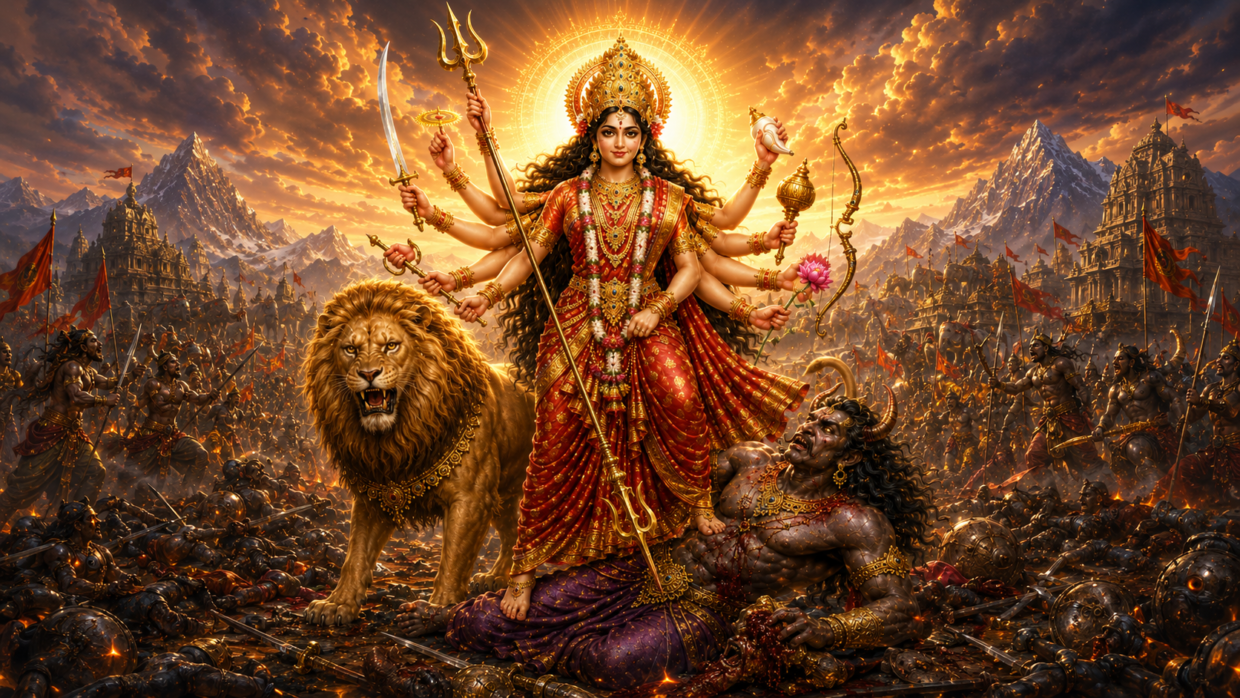
She was magnificent beyond description — with the face of Shiva, the hair of Yama, the arms of Vishnu, the breasts of the moon, the waist of Indra, the thighs of Varuna, the hips of the earth, and the feet of Brahma. Each god then gifted her a weapon: Shiva gave his trishula (trident), Vishnu his Sudarshana Chakra (discus), Indra his vajra (thunderbolt), Yama his staff of death, Varuna his conch and noose, Agni his spear of fire, Vayu his bow and arrows, Kubera his club, and so on. The great serpent Shesha gave her a necklace of serpents; the Himalayas offered her a lion as her mount. The goddess stood thus armed with eighteen arms, each bearing a divine weapon, magnificent and terrible in her glory — and she laughed, causing the three worlds to tremble.
The Battle with Mahishasura: Nine Days, Ten Days, Eternal Victory
When Mahishasura heard the terrible war-cry of the newly-manifested goddess, he sent his generals — Chikshura, Chamara, Asiloma, Vidala, and others — at the head of vast demon armies. Each was defeated. Durga slew them all, her lion tearing through the demon ranks as she rode into battle, the clash of her weapons sending thunderclaps across the cosmos.
Mahishasura then attacked personally — and here the myth enters its most dramatic phase. The demon was a master of shape-shifting (maya). He charged at Durga as a buffalo, then transformed into a lion, then a man with sword and shield, then a massive elephant, then back to a buffalo of titanic proportions. Each time, Durga countered with divine weapons. The battle raged for nine days and nine nights — the mythological template for the nine nights of Navaratri.
On the tenth day, as Mahishasura was mid-transformation — half-man, half-buffalo — Durga pinned him beneath her lion’s paw, pierced him with her trishula, and decapitated him with her sword. The demon fell, and the cosmos rejoiced. The devas showered flowers from heaven; the gandharvas sang; the apsaras danced. This tenth day of victory is celebrated as Vijayadashami (victory on the tenth day), popularly known as Dussehra — one of India’s most important national holidays.
The image of Durga in her Mahishasuramardini (slayer of Mahisha) form is one of the most iconic in all of Hindu art. She stands or rides her lion, her many arms spread in a halo of divine power, one foot on the demon-buffalo’s neck or on the buffalo’s body as the demon emerges from it, her trishula plunged into his chest. The image is simultaneously fearsome and serene — the violence of cosmic necessity, performed without anger, without ego, as a pure act of restoration.
The Battle with Shumbha, Nishumbha, and the Legend of Raktabija
The Devi Mahatmyam continues with two more episodes, known as the Madhyama Charita (middle episode) and the Uttama Charita (final episode). In these sections, the goddess faces a new set of adversaries: the demon brothers Shumbha and Nishumbha, who have similarly dispossessed the gods through boons of near-invincibility.
When the brothers learn of the goddess’s incomparable beauty, they first attempt to claim her as a consort — sending their general Dhumralochana, then the armies of Chanda and Munda. Durga defeats them all. (From the slaying of Chanda and Munda she receives the name Chamunda.) Then Shumbha sends his most devastating general: Raktabija — whose name means “blood-seed.”
Raktabija possessed the most terrifying boon: every drop of his blood that fell upon the earth would instantly generate a new demon of equal strength and size. As Durga and her companion Ambika (Parvati) wounded him, the battlefield filled with thousands of Raktabija-clones, each drop spawning another, until the ground was thick with identical demons.
To end this escalating horror, Durga called forth Kali — her dark, fierce aspect — from her own forehead. Kali, black-skinned, red-tongued, garlanded with severed heads, laughing wildly, spread her enormous mouth across the battlefield and drank every drop of Raktabija’s blood before it could touch the ground. As Durga and the Matrikas (divine mothers) struck him again and again, Kali swallowed the blood, and no new demons were born. Finally drained, Raktabija fell dead. Shumbha and Nishumbha were subsequently slain by the goddess herself, and the cosmos was restored once more.
This episode is theologically significant: it shows that Durga and Kali are not separate goddesses but aspects of the same supreme power. Kali emerges from Durga; she is Durga’s wrath given autonomous form. Together they represent the complete spectrum of divine feminine energy — the nurturing and the terrible, the protective and the destructive.
Iconography: The Visual Language of Divine Power
The iconography of Durga is one of the most deliberately coded visual systems in religious art. Every element carries theological meaning, and the full image functions as a kind of sacred diagram (yantra) of divine power.
The Multiple Arms and Their Weapons
Durga is most commonly depicted with ten arms, though traditions range from eight to eighteen. Each arm holds a weapon or symbolic object gifted by a different god at the time of her creation:
- Trishula (Trident) — from Shiva: The three prongs represent the three gunas (tamas, rajas, sattva), the three worlds, and the three aspects of time. It is Durga’s primary weapon.
- Sudarshana Chakra (Discus) — from Vishnu: Symbol of divine mind and righteous judgment; it spins constantly, cutting through ignorance and evil.
- Conch (Shankha) — from Varuna: Its sound, Om, is the primordial vibration of the universe. Blown in battle, it demoralises enemies.
- Thunderbolt (Vajra) — from Indra: Represents firmness of character; the weapon that destroys evil without being itself destroyed.
- Bow and Arrows — from Vayu and the Wind gods: Represent potential energy (the drawn bow) and kinetic energy (the arrow). The bow also symbolises the mind; the arrow is concentration.
- Sword (Khadga) — from Kala (Time) or the gods collectively: Represents knowledge; just as a sword cuts through material, knowledge cuts through ignorance.
- Shield (Khetaka): Protection; the divine grace that guards devotees.
- Club (Gada) — from Kubera: Authority, strength; the power to rule.
- Lotus (Padma): Spiritual perfection and non-attachment; the ability to remain pure in the midst of impurity.
- Noose (Pasha) — from Varuna: The power to bind and restrain evil; also the power of attachment by which the goddess draws devotees to herself.
- Snake (Nagastra) — from Shesha Naga: Primordial energy, kundalini; the serpentine power coiled at the base of reality.
- Fire (Agni’s weapon): Purification; the transformative power that burns away impurity.
The Lion Vahana
The lion (or tiger, in some regional traditions) on which Durga rides is her vahana — her divine vehicle. The lion represents power, will, and determination. By riding and controlling it, Durga demonstrates mastery over these forces. The lion also represents the ego: the goddess rides and controls the ego rather than being controlled by it. In the context of the battle, the lion’s ferocity is channelled by divine will — power in service of righteousness.
The Three Eyes
Like Shiva, Durga has three eyes. The left eye represents desire (the moon, the cool emotional aspect), the right eye represents action (the sun, the active aspect), and the central eye represents knowledge (fire, the illuminating aspect). Together, the three eyes see past, present, and future simultaneously. Her gaze is both penetrating and compassionate — she sees into the hearts of devotees and demons alike.
The Mahishasuramardini Pose
In the canonical Mahishasuramardini pose, Durga’s expression is famously paradoxical: simultaneously fierce and serene. She kills without anger, destroys without hatred. Her face in the great Bengali Puja idols — perhaps the most refined artistic tradition of Durga iconography — is typically gentle, almost maternal, even as her arms bristle with weapons. This paradox is the theological heart of the goddess: she is mahakali (great death) and mahalakshmi (great abundance) and mahasaraswati (great wisdom) simultaneously — the complete spectrum of existence.
The Navadurga: Nine Sacred Forms Across Nine Nights
During Navaratri (the nine nights of the goddess), each day is dedicated to one of the nine forms of Durga, collectively called the Navadurga. Each form has its own mythology, iconography, associated colour, mantra, and spiritual significance. Together, they trace a complete spiritual journey from the individual soul’s birth to its liberation.
1. Shailaputri — Day 1 (Colour: Yellow)
The first form, Shailaputri (“daughter of the mountain”), represents Parvati as the daughter of Himavan, the Himalayan mountain god. She carries a trishula in her right hand and a lotus in her left, riding Nandi (the bull). She is the foundation — rooted, stable, the earth itself. Her worship on the first day of Navaratri invokes grounding, stability, and the raw power of nature. Mantra: Om Devi Shailaputryai Namah.
2. Brahmacharini — Day 2 (Colour: Green)
Brahmacharini (“the one who practises brahmacharya or divine austerity”) represents Parvati’s intense tapas (austerities) to win Shiva as her husband. Barefoot, serene, holding a japamala (prayer beads) and a kamandala (water pot), she walked through forests, lived on leaves, fasted for years, and ultimately abandoned even leaves to survive on air alone — hence her other name Aparna. She embodies the power of disciplined devotion, the divine energy that accumulates through spiritual practice. Day 2 is for seekers who walk the austere path. Mantra: Om Devi Brahmacharinyai Namah.
3. Chandraghanta — Day 3 (Colour: Grey)
Chandraghanta (“she who bears the crescent moon as a bell”) is the married form of Parvati — adorned for her wedding, wearing a half-moon on her forehead that resembles a bell (ghanta). She is golden-complexioned, rides a tiger, and has ten arms bearing weapons. The bell-like moon she bears makes a terrifying sound that destroys demons and fills devotees with courage. Day 3 worship is for those seeking bravery, grace in social life, and freedom from fear. Mantra: Om Devi Chandraghantayai Namah.
4. Kushmanda — Day 4 (Colour: Orange)
Kushmanda (“the cosmic egg”) is the creator form. When the universe was darkness and void, Kushmanda smiled — and her smile became the primordial light, the Big Bang of Hindu cosmology. She created the universe from nothing (ku = little, ushma = warmth/energy, anda = egg). She dwells in the sun, riding a lion, her eight arms holding divine weapons as well as a jar of amrita (nectar of immortality). Day 4 is for those seeking health, vitality, and the creative force of the cosmos. Mantra: Om Devi Kushmandayai Namah.
5. Skandamata — Day 5 (Colour: White)
Skandamata (“mother of Skanda/Kartikeya”) represents the motherhood aspect of the goddess. She sits on a lotus, holding the infant Kartikeya (the war-god) in her lap — the most powerful divine general, cradled in the arms of the supreme mother. Her four arms hold Skanda, a lotus, a bell, and a gesture of blessing. She rides a lion. Day 5 honours the mother-child bond, the love that protects and nurtures. Mantra: Om Devi Skandamatayai Namah.
6. Katyayani — Day 6 (Colour: Red)
Katyayani is the warrior form, born specifically to slay Mahishasura. She is named after the sage Katyayana, in whose hermitage she was born to answer his prayers. She has three eyes, four arms, and rides a lion, bearing a sword and a lotus. In folk tradition, she is especially worshipped by young women seeking good husbands — the Gopis of Vrindavan famously worshipped Katyayani for this purpose, as described in the Bhagavata Purana. Day 6 honours courage, determination, and righteous action. Mantra: Om Devi Katyayanyai Namah.
7. Kalaratri — Day 7 (Colour: Blue)
Kalaratri (“the dark night of time”) is the most fearsome form — dark as night, with dishevelled hair, four arms, three eyes blazing like lightning, and a garland of skulls. She rides a donkey and carries a scimitar, a torch, and a noose. Despite this fearsome appearance, she is called Shubhankari (the auspicious one) because her fearsome form destroys all fears in her devotees. She removes all darkness — literal and metaphysical. Day 7 is for the dissolution of all that must be destroyed before liberation can be attained. Mantra: Om Devi Kalaratryai Namah.
8. Mahagauri — Day 8 (Colour: Pink)
Mahagauri (“the supremely white/pure one”) is Parvati after she was purified by Shiva, who bathed her in the Ganga to wash away the dark complexion she had acquired through years of austerity. She gleams white as snow, wears white garments, and rides a white bull. She holds a trishula and a damaru (drum), and her right hand gestures abhaya (fearlessness) while her left grants boons. She is serene, beautiful, the promise of purification and new beginnings. Day 8 (Ashtami) is particularly important in Durga worship. Mantra: Om Devi Mahagauryai Namah.
9. Siddhidatri — Day 9 (Colour: Purple)
Siddhidatri (“giver of supernatural powers/siddhis”) is the final, most complete form. She sits on a lotus, surrounded by siddhas (perfected beings), gods, and devotees, bestowing the eight classical siddhis: Anima (becoming microscopic), Mahima (becoming immense), Garima (heaviness), Laghima (lightness), Prapti (reaching everywhere), Prakamya (fulfilling desires), Ishita (mastery), and Vashita (dominion). Shiva himself worshipped Siddhidatri and received all siddhis — and it is said that his left half became female, making him Ardhanarishvara (half-woman), because the goddess pervaded even him. Day 9 is the culmination — the attainment of ultimate liberation. Mantra: Om Devi Siddhidatryai Namah.
Shakta Philosophy: Durga as the Supreme Reality
In the Shakta philosophical tradition — one of the major currents of Hinduism alongside Vaishnavism and Shaivism — Durga is not merely a powerful deity but the supreme reality itself: Brahman, the ultimate ground of all existence, manifesting as feminine divine energy (Shakti).
The Devi Bhagavata Purana, the most important scripture of the Shakta tradition, repeatedly identifies the Goddess as the source from which Brahma, Vishnu, and Shiva themselves arise. She is not created by the male gods — she creates them. When the gods combine their energies to birth Durga, they are not giving her power; they are returning power to its source. The episode is understood as the male gods recognising and releasing the Shakti that was always hers.
The concept of the Tridevi — the divine feminine trinity of Saraswati (knowledge), Lakshmi (wealth and beauty), and Durga/Parvati/Kali (power and time) — represents the three aspects through which this single feminine reality operates: the power of knowing, the power of having, and the power of becoming. Each is an aspect of Shakti, the cosmic energy without which Brahma cannot create, Vishnu cannot sustain, and Shiva cannot destroy.
The Sri Vidya tradition, which represents perhaps the most sophisticated philosophical development within Shaktism, identifies the Goddess with the Sri Yantra — a geometric diagram of interlocking triangles that represents the cosmos as the play of consciousness (Shiva, the upward triangles) and energy (Shakti, the downward triangles). The goddess in this tradition is Lalita Tripura Sundari, the beautiful one who is beyond the three worlds — but she is ultimately the same power as Durga, viewed from the perspective of bliss rather than war. In both her fierce and beautiful forms, she is the one absolute reality behind all appearance.
The Devi Mahatmyam itself contains what may be the most powerful theistic statement in all of Hindu literature, spoken by the goddess herself: “By me this universe is pervaded in my unmanifest form; all beings exist in me, not I in them.” This is not the language of a war-goddess receiving prayers on the battlefield; this is the language of the Absolute.
Durga in the Vedas: The Ancient Roots
While the elaborate mythology of Durga as described above belongs primarily to the Puranic literature (roughly 4th–12th century CE), the goddess’s roots extend all the way to the Rig Veda, the oldest surviving text in any Indo-European language.
The Durga Sukta (Rig Veda 4.28, though some identify it with the Taittiriya Aranyaka verse) invokes the goddess as the protector on perilous roads and the overcomer of all obstacles — an early invocation of the same power that would later be elaborated in the great Puranic epics.
More dramatically, the Devi Sukta (Rig Veda 10.125) — one of the most extraordinary hymns in the Vedic corpus — is spoken in the first person by the goddess herself. It begins: “I travel with the Rudras, and also with the Vasus; I travel with the Adityas and with all the gods. I hold aloft both Mitra and Varuna, I hold Indra-Agni and the Twin Ashvins. I am the Queen, the gatherer of treasures, the most thoughtful, the first of those worthy of worship. Thus the gods have established me in many places, making me enter many homes and abide in many forms.”
This hymn, believed to have been revealed to the female sage Vak Ambhrini, is remarkable not only for its theistic content but for its assertion of feminine sovereignty over the entire Vedic cosmos. The goddess speaks not as a consort or a helper but as the sovereign reality that pervades all. The Devi Sukta is considered the Vedic seed of the entire Shakta tradition; it is recited daily in many Devi temples and forms the philosophical cornerstone of the Devi Mahatmyam’s theology.
Regional Traditions: Bengal Durga Puja
If there is one festival that defines the religious and cultural calendar of an entire people, it is Bengal’s Durga Puja — the five-day celebration from Shashthi (sixth day) to Vijaya Dashami that transforms the entire state of West Bengal (and Bangladesh) into a vast open-air art gallery, theatre, and spiritual experience.
The preparation begins months in advance in the workshops of Kumartuli, a neighbourhood in north Kolkata where generations of artisan families (the Kumars, potters by caste) create the enormous clay idols of Durga. A standard idol shows the goddess in her Mahishasuramardini form, flanked by her four children — Lakshmi, Saraswati, Kartikeya (Kartik), and Ganesha — and framed by banana trees and an elaborate chala (decorative canopy). The idols are built on bamboo frames, covered with hay, then layered with clay from the Ganga’s banks. The eyes are painted last, in a ceremony called Chakshu Daan (gift of sight), which ritually animates the goddess.
Across the city, thousands of pandals (temporary structures) are erected, each more elaborate than the last, competing for prizes in a festival of public art that draws comparisons to the carnival at Venice or the Rio festival. Durga Puja has in recent decades been inscribed by UNESCO on its list of Intangible Cultural Heritage of Humanity (2021), the first such recognition for any Indian festival.
The soundtrack of Durga Puja is the dhak — a large cylindrical drum played by professional dhakis who travel from villages to the city to play for the duration of the festival. The dhak’s deep, rhythmic beats are the heartbeat of Puja; its sound triggers an almost Pavlovian emotional response in Bengalis worldwide.
The festival culminates on Vijaya Dashami with two of Bengal’s most poignant rituals. In Sindoor Khela (vermilion play), married women apply sindoor to the goddess’s feet and then to each other’s faces in a joyous, chaotic celebration of womanhood and auspiciousness. The goddess is then carried to the Ganga for bisarjan (immersion) — sent back to her divine home, leaving her devotees to wait until the following year.
Regional Traditions: Mysore Dasara
Six hundred miles to the south, the city of Mysore in Karnataka celebrates Durga’s victory as a royal pageant of extraordinary splendour. Mysore Dasara — declared the state festival of Karnataka — has roots stretching back to the Vijayanagara Empire of the 14th century and was continued and expanded by the Wadiyar kings of Mysore.
The presiding deity is Chamundeshwari — a form of Durga — whose temple crowns Chamundi Hill overlooking the city. Chamundeshwari is Durga as the slayer of Chanda and Munda (hence Chamundi), and her hill has been a site of worship for over a thousand years. During the ten days of Dasara, the temple is especially crowded with pilgrims who climb the 1,000 steps to seek the goddess’s blessing.
The defining spectacle of Mysore Dasara is the Jamboo Savari — the royal elephant procession on Vijayadashami. The idol of Chamundeshwari, housed in a golden howdah (palanquin) weighing 750 kilograms, is carried by an elaborately caparisoned elephant at the head of a procession that winds through the city’s streets. Thousands of soldiers in traditional dress, musicians, dancers, camels, horses, and marching bands follow in a procession that has no parallel anywhere in the world for its combination of royal tradition and popular celebration. The Mysore Palace is illuminated by nearly one hundred thousand light bulbs, visible for miles.
Other Major Regional Centres
Beyond Bengal and Mysore, Durga is worshipped in distinctive regional forms across the subcontinent.
Vindhyavasini Devi at Vindhyachal (Uttar Pradesh) is one of the most ancient and important Shakti shrines in northern India. Located at the junction of the Ganga and Karmanasha rivers in the Vindhya mountain range, this temple is mentioned in the Devi Mahatmyam itself, and pilgrims have made the journey here for at least fifteen centuries. She is believed to be the goddess who appeared to Kansa’s gaze as a flash of lightning — the divine Maya who exchanged identities with the infant Krishna to foil the demon-king’s plan.
Mahalakshmi (Ambabai) of Kolhapur (Maharashtra) is one of the eighteen Mahasaktipeetas, and one of the most famous temples of Maharashtra. Though primarily identified as Mahalakshmi, the deity here is understood in the local tradition as a fully armed warrior goddess — more like Durga than the household Lakshmi of prosperity. Her temple has been standing for over a thousand years and is described in Puranic literature.
In Himachal Pradesh, the goddess manifests as Jwala Ji (the flame goddess), Chintpurni, Chamunda Devi, and Naina Devi — four of the famous Shakti Pithas of the hills, drawing millions of pilgrims, particularly during the spring and autumn Navaratri.
The 51 Shakti Pithas: The Goddess Mapped Onto the Land
One of the most remarkable geographical-theological constructs in world religion is the system of the Shakti Pithas — the “seats of power” where, according to tradition, portions of the body of the goddess Sati fell to earth.
The myth: Sati, the first wife of Shiva and a manifestation of Durga/Parvati, attended a great sacrifice hosted by her father Daksha against Shiva’s advice — and Daksha publicly humiliated Shiva at the ceremony. Unable to bear the dishonour to her husband, Sati immolated herself in the sacrificial fire. Shiva, in an ecstasy of grief, took up her body and began to wander the three worlds, unable to let go. The cosmos was threatened by his grief-stricken wandering; to restore balance, Vishnu used his Sudarshana Chakra to cut Sati’s body into pieces as Shiva carried it. Each piece fell to earth at a different location, and at each place a temple arose. These are the 51 Shakti Pithas.
The number varies by tradition — some texts name 4 principal pithas, others 18, 51, or 108 — but the most widely accepted system identifies 51 pithas corresponding to the 51 letters of the Sanskrit alphabet (the Matrikas), reinforcing the idea that the goddess is identical to sacred sound and language itself.
The pithas are scattered across the entire subcontinent and beyond — from Hinglaj Mata in Balochistan (now Pakistan) to Kamakhya in Assam, from Jwala Ji in Himachal Pradesh to Srisailam in Andhra Pradesh. Kamakhya (Assam), where Sati’s womb is said to have fallen, is considered the most powerful of all pithas and is particularly associated with Tantric traditions. Kalighat (Kolkata), where Sati’s toes fell, is one of the holiest sites in Bengal. Vaishno Devi (Jammu), Kangra Devi, Jwala Ji, and Naina Devi in the Himalayan foothills are among the most visited pilgrimage sites in India.
The Shakti Pitha system is profound in its implications: the body of the goddess literally is the land of India. The geography of the subcontinent is understood as the body of the divine mother, making every hill, river, and town near a pitha a site of divine immanence. Pilgrimage to the pithas is not merely travel to holy sites; it is a journey across the body of the mother, a reunion of devotee and deity that is simultaneously geographic and mystical.
Worship, Liturgy, and Festival Calendar
Durga is worshipped throughout the Hindu calendar, but her most concentrated worship occurs during the two annual Navaratri festivals: the Chaitra Navaratri (spring, March-April) and the Sharad Navaratri (autumn, September-October). The Sharad Navaratri is by far the larger of the two and forms the occasion for Durga Puja in Bengal and Dasara across southern and western India.
The Durga Saptashati (Chandi Path) — the 700 verses of the Devi Mahatmyam — is the primary liturgical text. Its three sections describe the three battles (Madhu-Kaitabha, Mahishasura, Shumbha-Nishumbha) and are preceded by three preparatory texts: the Devi Kavach (armour), the Argala Stotram (the bolt-hymn), and the Kilakam (the pin-hymn). Together these frame the Saptashati in a complete liturgical package. The full recitation of the Saptashati takes approximately two to three hours.
The Durga Chalisa — a forty-verse devotional hymn in Hindi — is one of the most widely recited texts in popular Durga worship, accessible to ordinary devotees who may not have the Sanskrit training for the Saptashati.
Tuesdays and Fridays are traditionally Durga’s days of the week. On these days, special worship is performed at Durga temples; devotees fast, wear red (the goddess’s sacred colour), and offer red flowers — particularly hibiscus (jaswand), which is Durga’s most beloved flower. The sacred metal is iron (representing strength) and her sacred number is nine.
Durga Ashtami — the eighth day of the bright fortnight in the month of Ashwin — is perhaps the most important day in the festival calendar for Durga worship. On this day, young girls (kanya) are worshipped as manifestations of the goddess in a ceremony called Kanya Puja: girls between the ages of two and ten are invited, their feet are washed, they are offered food, and they receive gifts. This practice embodies the theological insight that the divine feminine is not abstract but immanent in every girl-child.
Sandhi Puja — performed at the juncture of Ashtami and Navami nights — is considered the most auspicious moment of the entire Navaratri, the precise instant when Durga slew the demon Mahishasura according to one tradition. In Bengal, 108 lamps and 108 lotus flowers are offered at this moment, accompanied by the sound of conches and bells.
Durga’s Place in World Religious History
The worship of Durga represents one of the oldest continuous traditions of goddess veneration anywhere on earth. Archaeological evidence from the Indus Valley Civilisation (c. 3000–1500 BCE) includes figurines of standing, decorated female figures that many scholars interpret as early goddess representations. Whether these are direct ancestors of Durga is debated, but the unbroken continuity of goddess worship in the Indian subcontinent from pre-Vedic times to the present is remarkable.
Comparative religionists have noted structural parallels between Durga and other warrior goddesses of the ancient world — the Mesopotamian Inanna/Ishtar, the Greek Athena, the Norse Freya — suggesting that the image of the armed divine feminine resonates across cultures. But Durga’s specific theological elaboration, her identification with the absolute reality of the cosmos, her manifestation as the combined power of all male gods rather than the consort of any one, sets her apart as perhaps the most fully developed expression of this archetype in world religion.
In an era when the question of divine feminine representation has renewed relevance, Durga stands as an ancient, sophisticated answer: power is not inherently masculine; the cosmos is not governed by force alone but by wisdom, compassion, and justice wielded by a goddess who is simultaneously mother and warrior, creator and destroyer, immanent and transcendent.
Key Takeaways
Key Takeaways: Goddess Durga at a Glance
- Name meaning: “Difficult to reach or defeat” — she is invincible and beyond the grasp of evil.
- Origin: Emerged from the combined divine energies of all the gods to slay Mahishasura, the buffalo-demon who had conquered heaven.
- Primary scripture: The Devi Mahatmyam (700 verses, Markandeya Purana) — recited in full during Navaratri.
- Iconography: 10 or 18 arms bearing weapons from every god; three eyes; lion/tiger vahana; simultaneously fierce and serene expression.
- Nine forms (Navadurga): Shailaputri, Brahmacharini, Chandraghanta, Kushmanda, Skandamata, Katyayani, Kalaratri, Mahagauri, Siddhidatri — worshipped on successive days of Navaratri.
- Kali connection: Kali is Durga’s fierce aspect, called forth from Durga to drink Raktabija’s blood — they are one supreme power in two expressions.
- Philosophical status: In Shaktism, Durga is identified with Brahman — the ultimate reality, not merely a powerful deity.
- Great festivals: Bengal Durga Puja (5 days, ending with Vijaya Dashami) and Mysore Dasara are the two largest celebrations.
- 51 Shakti Pithas: Sacred sites across the subcontinent where pieces of Sati’s body fell — the landscape of India is the goddess’s body.
- Sacred days: Tuesdays and Fridays weekly; Navaratri twice yearly; Durga Ashtami and Sandhi Puja are the holiest moments of the year.
- Vedic roots: The Devi Sukta (RV 10.125) reveals the goddess speaking in the first person as the queen of all the gods — one of the oldest theistic declarations of divine feminine sovereignty.
Frequently Asked Questions
1. What is the difference between Durga, Kali, and Parvati — are they the same goddess?
In the theological framework of Shaktism, Durga, Kali, and Parvati are all aspects or manifestations of the one supreme Goddess (Adi Shakti or Devi). Parvati is the benevolent, nurturing form — Shiva’s consort, the devoted mother. Durga is Parvati in her warrior aspect, armoured and armed for cosmic battle. Kali is Durga’s most fierce and unrestrained form, the power of time and destruction. They are not separate deities but a single divine reality experienced at different frequencies. In popular practice, however, they are often worshipped as distinct goddesses with their own temples, rites, and mythology, just as white light is one but can be experienced as many colours through a prism.
2. Why does Durga have multiple arms — what is the theological meaning?
Durga’s multiple arms — most commonly ten or eighteen — are not merely artistic convention but a theological statement. Each arm holds a weapon donated by a different god, showing that she contains and wields the power of every deity in the cosmos. More profoundly, the multiple arms represent the limitlessness of divine action: while human beings can only do one thing at a time with their two hands, the goddess acts simultaneously in every direction across all planes of existence. She protects here, punishes there, creates elsewhere, and dissolves elsewhere still — all at once. The number of arms thus represents omnipotence: the capacity to act without limit simultaneously in service of dharma.
3. What is Navaratri and why is it celebrated nine nights rather than ten?
Navaratri literally means “nine nights” (nava = nine, ratri = night). The celebration spans nine nights and ten days, corresponding to the nine nights Durga battled Mahishasura and the tenth day (Vijayadashami/Dussehra) on which she slew him. The emphasis on the nights rather than the days reflects the Shakta theological orientation: the goddess is associated with the feminine principle, which in Indian cosmology is associated with the night, the moon, and the interior world, as opposed to the masculine solar principle of the day. The nine nights represent the gestation of divine energy — the darkness before the victory. The tenth day is then the dawn of a new cosmic order.
4. What are the 51 Shakti Pithas and how were they created?
The 51 Shakti Pithas are sacred sites scattered across the Indian subcontinent (and some in Nepal and Bangladesh) where, according to tradition, parts of the body of Sati fell to earth. Sati was Durga’s previous life as the daughter of Daksha; after she self-immolated at her father’s sacrifice, Shiva carried her body in grief until Vishnu used his Sudarshana Chakra to cut it into 51 pieces. Wherever a piece fell, a temple arose. The sites range from Kamakhya (Assam) to Hinglaj (Balochistan) and from Jwala Ji (Himachal Pradesh) to Kanyakumari (Tamil Nadu). The system maps the goddess onto the entire geography of the subcontinent, making India itself the body of the mother goddess. Each pitha is associated with a specific body part of Sati and a specific form of the goddess.
5. Why is the Durga Puja of Bengal so culturally significant, and what makes it unique?
Bengal’s Durga Puja is UNESCO-recognised as Intangible Cultural Heritage (2021) and is arguably the largest annual arts festival in the world. Its uniqueness lies in several factors: the tradition of creating new, elaborate clay idols each year (rather than permanent temple images), which makes it an annual festival of sculptural and decorative art; the community-organised pandals which are public art installations of extraordinary ambition; the democratic nature of the celebration (the goddess comes to the streets, not the public to the temple); the emotional arc of the five days, which mirrors the visit of a daughter returning to her parents’ home; and the ritual of immersion (bisarjan), which adds an element of impermanence and longing to the joy of celebration. In Bengal, Durga is understood not primarily as a distant cosmic warrior but as the daughter of the land — Umā, who comes home once a year from her mountain abode with Shiva, bringing her children, and departs after five days, leaving her devotees bereft until the following year.
6. How does one begin a personal practice of Durga worship at home?
A personal practice of Durga worship (Devi upasana) can be as simple or elaborate as the practitioner wishes. At the simplest level, the devotee can establish a small altar with an image or idol of Durga, light a lamp and incense each morning and evening, and recite the Durga Chalisa or a simple mantra such as Om Dum Durgayai Namah. On Tuesdays and Fridays — Durga’s days — the practice can be deepened with the offering of red flowers (especially hibiscus), red clothing on the idol, and the recitation of the Durga Ashtottara (108 names of Durga). During Navaratri, the devotee can observe a fast (full or partial), recite or listen to the full Devi Mahatmyam, and worship each of the nine forms of Navadurga in sequence. The essence of Durga worship is not elaborate ritual but sincere devotion — the recognition that the power which protects us, which enables us to overcome every obstacle, is not external but the very Shakti within our own consciousness, which is a ray of the divine mother’s infinite light.