Saumitri · Lakshmanaya Namah · Ramanuja · Sheshavatar · Ananta-amsha
Who Is Lakshmana?
Lakshmana — third son of King Dasharatha, son of Queen Sumitra, inseparable companion of Rama — is the Ramayana’s supreme embodiment of fraternal devotion, selfless service, and warrior excellence placed entirely at the disposal of a higher cause. Where Rama is the dharmic ideal of the king, Lakshmana is the dharmic ideal of the companion: the one who asks for nothing, demands no credit, endures every hardship without complaint, and guards the one he loves with ferocious vigilance.
Lakshmana is theologically identified as the avatar of Ananta-Shesha — the cosmic serpent on whom Lord Vishnu rests in the primordial cosmic ocean. As Shesha eternally supports Vishnu, Lakshmana eternally supports Rama. This identification is not metaphorical — it is a theological statement about the nature of the Lakshmana-Rama relationship: it precedes this birth, continues through all cosmic cycles, and transcends individual personality.
Birth and the Ananta-Shesha Connection
Lakshmana was born to Queen Sumitra as one of the twins produced from the sacred payasam (ritual rice pudding) that Dasharatha distributed among his three wives after the Putrakameshti yajna. Sumitra received two portions — one went to the birth of Lakshmana, one to Shatrughna. The Puranic tradition explains this twin birth through the cosmic framework: Ananta-Shesha, who eternally supports Vishnu, needed to manifest in two forms — one to support Vishnu’s avatar Rama directly (Lakshmana), and one to support his other brother Bharata (Shatrughna).
From the moment of birth, the bond between Rama and Lakshmana was extraordinary. The Valmiki Ramayana notes that Lakshmana could not bear to be separated from Rama even for a moment. He ate only when Rama ate, slept only when Rama slept. This inseparability was not mere sibling affection — it was the expression of a cosmic reality: Shesha and Vishnu have never been apart.
At Vishwamitra’s Ashram
When the sage Vishwamitra came to Dasharatha’s court requesting Rama’s assistance in protecting his sacrifice, Lakshmana went as well — inseparable from his brother even then. In the adventures that followed — the killing of Tataka, the protection of the sacrifice, the journey to Mithila — Lakshmana established himself as a warrior of ferocious capability and a protector of razor-sharp vigilance. At the swayamvara in Mithila, when other kings grew angry at Rama’s breaking of the bow and threatened war, it was Lakshmana who stepped forward with ready bow, making clear that any who challenged Rama would face him first.
Lakshmana’s temperament is famously more fiery than Rama’s. Where Rama embodies cool, composed dharmic restraint, Lakshmana embodies the burning, urgent energy of protective love — capable of great anger, great impatience, great passion. Together, they form a complementary whole: the serene ideal and the fierce protector.
The Exile and Lakshmana’s 14-Year Vow
When Rama was ordered into exile, Lakshmana’s response was volcanic. He argued fiercely — something Rama did not — that the injustice of Kaikeyi’s demand should be resisted, that Dasharatha was acting from weakness, and that a son’s duty to his father did not extend to accepting irrational injustice. He was prepared to seize Ayodhya by force if necessary, to install Rama as rightful king. It was Rama who calmed him, explaining with deep tenderness the dharmic framework that required acceptance.
But Lakshmana’s acceptance, once given, was total. Before going to the forest, he made an extraordinary vow: for the fourteen years of exile he would not sleep at night, subsist on minimal food, and remain perpetually vigilant as guardian of Rama and Sita. According to later Ramayana traditions (particularly the Ramcharitmanas), the sleep he forsook was absorbed by his wife Urmila at home in Ayodhya — Urmila slept for fourteen continuous years so that Lakshmana could remain wakeful. This story of Urmila’s sacrifice, while not in Valmiki, became enormously popular in the devotional tradition as the story of the hidden devotee — the one who performs the greatest sacrifice in private, without any witness, without any glory.
The Lakshmana Rekha
The Lakshmana Rekha — the line drawn by Lakshmana around the hermitage before going to help Rama, across which no evil could pass — is one of the most culturally resonant images in the entire Ramayana tradition, and one of the most interesting textual puzzles. It appears in later retellings (including Tulsidas’s Ramcharitmanas) but is largely absent from Valmiki’s original text. In Valmiki, Lakshmana simply argues against leaving Sita alone, expresses his certainty that the golden deer’s cries for help are an illusion, and departs only when Sita accuses him of wanting Rama to die so he can have her. This accusation devastates Lakshmana but does not change his judgment — he leaves in grief.
In the popular tradition, the Lakshmana Rekha became a symbol of the protective boundary — the limit drawn by love and vigilance. The phrase has entered everyday Hindi, meaning a line one must not cross. Its cultural life independently of the original text illustrates how the Ramayana lives as a living tradition that generates new meaning across generations.
The War in Lanka
Lakshmana was among the supreme warriors of the Lanka war, but his greatest battles — and his most agonising crisis — were with Indrajit (Meghanada), the son of Ravana and the conqueror of Indra.
The Nagapasha Binding
In their first encounter, Indrajit used the Nagapasha — the serpent-noose weapon — which he loosed invisibly from the sky. Both Rama and Lakshmana were bound by thousands of serpent-coils and fell unconscious. The vanara army was in despair. Hanuman flew to bring Garuda, the divine eagle whose very presence dissolved serpent weapons. Garuda arrived, touched both brothers, and they were freed.
The Shakti Weapon and Lakshmana’s Near-Death
The crisis of crises came in the second great encounter between Lakshmana and Indrajit. Indrajit, unable to kill Lakshmana directly in open battle, used the Shakti — a weapon given by Brahma himself, which could not be countered by any other weapon. The Shakti struck Lakshmana with full force. He fell from the battlefield as if dead.
Rama’s grief at this moment is one of the most emotionally intense passages in the Valmiki Ramayana. He wept over Lakshmana’s body with an anguish he had not displayed even for the loss of Sita. He said he could find another wife but never another Lakshmana. The physician Sushena of Lanka, brought to the battlefield, explained that only the Sanjeevani herb from the Himalayas, brought before sunrise, could restore him. Hanuman flew north, lifted the Dronachala mountain, brought it back, and Lakshmana was revived. Lakshmana’s near-death and miraculous revival became one of the most celebrated episodes of the Lanka war.
The Killing of Indrajit
The final encounter between Lakshmana and Indrajit was decisive. Indrajit was performing a secret yajna (fire sacrifice) that, if completed, would grant him absolute invincibility and doom Rama’s army. Vibhishana knew the location of this hidden yajna and guided Lakshmana to it. The rules of dharmic warfare required that the yajna be disrupted before it could be completed — a task that Lakshmana undertook with divine mandate.
In the ensuing battle, Lakshmana and Indrajit fought ferociously. Indrajit deployed every weapon in his arsenal — including maya (illusion) combat forms. Lakshmana responded with corresponding divine weapons. Finally Lakshmana loosed the Aindra astra (weapon of Indra) and the Brahmastra in combination, and Indrajit fell — the great warrior’s head severed from his body. His death was a turning point from which Lanka could not recover.
Urmila and the Hidden Sacrifice
Urmila — Sita’s younger sister, who married Lakshmana at the same ceremony — remains one of the Ramayana’s most moving and least sung figures. She chose to stay in Ayodhya when Lakshmana went to the forest, accepting the unimaginable separation without complaint. In Tulsidas’s tradition she absorbed Lakshmana’s sleep for fourteen years, sleeping continuously so that he could remain wakeful. In some later literary traditions, Urmila’s wait became an entire literary subject: the perfect devotee who performs her sacrifice entirely in private, without witness or recognition.
The twentieth-century Hindi poet Maithilisharan Gupta wrote a celebrated poem called Saket (1931) in which Urmila is the central figure, her suffering and dignity given full literary expression for the first time. This poem catalysed a new appreciation for the silent heroes of the Ramayana — those who sacrificed not through dramatic action but through years of patient, invisible waiting.
Lakshmana’s Departure
The end of Lakshmana’s earthly life is among the most poignant passages in the Uttara Kanda. When Rama’s divine mission was complete and Kala (Time personified) came to call Rama back to his divine abode, Lakshmana became the means through which that cosmic departure was set in motion. Rama was placed in the dharmic impossibility of breaking his word — and Lakshmana, always protective, took the transgression upon himself. He walked to the Sharayu river and submerged himself in it — departing from his earthly body before Rama. The cosmic serpent Shesha re-ascended to Vaikuntha (Vishnu’s heavenly abode), returning to his position as Vishnu’s eternal support, ready for the next cosmic cycle.
Lakshmana in Later Tradition and Worship
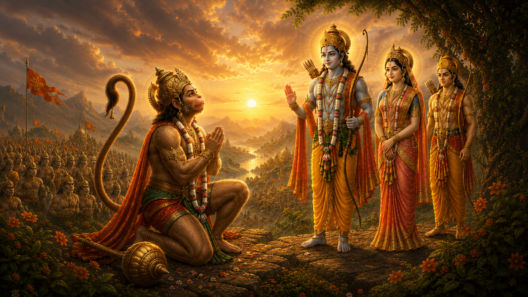
Lakshmana is worshipped across South and North India, usually alongside Rama in the Rama-Sita-Lakshmana triad that forms the central icon of Rama temples. The image of Lakshmana standing guard beside Rama — bow in hand, vigilant — is the visual embodiment of protective devotion. Separate Lakshmana temples are found particularly in Uttar Pradesh and Rajasthan; the Lakshmana temple at Khajuraho (10th century) is one of the finest examples of early medieval Indian temple architecture. In the Sri Vaishnava tradition, Lakshmana is honoured as the ideal of kainkarya (divine service) — a model for all who aspire to serve the divine with total dedication.
Key Takeaways
- Ananta-Shesha avatar — Lakshmana is the human incarnation of the cosmic serpent Shesha, who eternally supports Vishnu; his support of Rama is therefore a cosmic constant, not merely a personal choice.
- The 14-year vigil vow — Lakshmana’s vow to remain sleepless and guard Rama and Sita for the entire exile period is the epic’s supreme expression of selfless service.
- Urmila’s hidden sacrifice — The story of Urmila sleeping Lakshmana’s sleep during the exile reveals the Ramayana’s appreciation for the invisible, uncelebrated sacrifice.
- The Lakshmana Rekha — A cultural symbol of protective love and inviolable limits, this image entered everyday language as a metaphor for lines that must not be crossed.
- The Sanjeevani crisis — Lakshmana’s near-death and revival by Sanjeevani is the war’s emotional pivot, demonstrating that the Rama-Lakshmana bond is so central that its severance would end the mission itself.
- Killing of Indrajit — Lakshmana’s defeat of Indrajit — the Lanka war’s most feared warrior — is considered his supreme achievement, turning the tide of the entire war.
- Fiery temperament as complement — Lakshmana’s passionate, impatient protective energy is not a flaw but the necessary complement to Rama’s composed restraint; together they form a complete dharmic expression.
Frequently Asked Questions
Q: Why is Lakshmana considered an avatar of Shesha?
Just as the cosmic serpent Shesha eternally supports the reclining Vishnu in the primordial ocean, Lakshmana eternally supports Rama — in thought, word, and deed — throughout their lives. This cosmic parallel is acknowledged in Vaishnava theology, where the Rama-Lakshmana relationship is seen as the human expression of the eternal Vishnu-Shesha relationship.
Q: Did Lakshmana really not sleep for fourteen years?
The fourteen-year sleeplessness vow appears in later traditions rather than the Valmiki original. Tulsidas’s Ramcharitmanas and many regional Ramayana traditions elaborate it, often adding the Urmila sleep-transfer story. In symbolic terms it expresses Lakshmana’s absolute vigilance and the totality of his sacrifice for Rama’s mission.
Q: Is the Lakshmana Rekha in the original Valmiki Ramayana?
No. In Valmiki’s text, Lakshmana departs after Sita’s accusation but draws no protective line. The Lakshmana Rekha appears in later retellings, particularly in vernacular traditions. Its cultural life outside the original text demonstrates how the Ramayana generates new meaning across generations of retelling.
Q: What happened to Lakshmana after Rama’s time?
According to the Uttara Kanda and Puranic accounts, when Rama’s time on earth was complete, Lakshmana walked to the Sharayu river and departed from his body before Rama — taking the dharmic transgression upon himself so that Rama would not have to break his word. The cosmic Shesha returned to Vaikuntha to resume his eternal position as Vishnu’s support.
Q: How did Lakshmana finally defeat Indrajit?
Lakshmana defeated Indrajit by disrupting his protective yajna before its completion (guided by Vibhishana), then fighting him directly with divine weapons. The decisive blow was delivered with the Aindra astra (Indra’s weapon) combined with the Brahmastra, which severed Indrajit’s head. The killing of Indrajit was universally acknowledged as the Lanka war’s decisive turning point.