The Egg of Brahma
Long before modern cosmology posed its deepest questions — How large is the universe? What is its structure? Did it begin, and will it end? — the ancient sages of India had developed a rich and elaborate cosmological vision that addressed these same questions with breathtaking imagination and philosophical depth. This vision is encoded in the concept of Brahmāṇḍa — the Brahma-Egg, the Cosmic Egg, the entire universe conceived as a vast, structured, living reality emanating from and returning to the formless Absolute.
Brahmāṇḍa is a Sanskrit compound: brahma (the creator; or more broadly, the Absolute, Brahman) + aṇḍa (egg). The universe is envisioned as an egg — not merely metaphorically but as a precise cosmological concept. Just as an egg contains within its shell a structured hierarchy of layers (shell, albumen, yolk, the germ of life), the Brahmanda contains within its cosmic “shell” the structured hierarchy of all worlds, realms, planes of existence, and the multidimensional cosmos in which every being from the smallest organism to the greatest god has its place.
This vision is not the speculation of armchair philosophers. It is embedded in the oldest Vedic hymns, elaborated in the Upanishads, systematized in the Puranas, and presupposed by every element of Hindu ritual, astrology, and spiritual practice. Understanding the Brahmanda is to understand the cosmological container within which dharma, karma, moksha, the Four Yugas, the Trimurti, and all of Hindu theology operate.
Scriptural Sources
The cosmological vision of the Brahmanda is assembled from multiple scriptural sources, each contributing different aspects and levels of detail:
The Ṛg Veda’s famous Nāsadīya Sūkta (10.129) describes the primordial state before creation — neither being nor non-being, neither death nor immortality, neither day nor night — and asks the profound question of how the universe arose from that undifferentiated ground. The Puruṣa Sūkta (10.90) describes the cosmos as the body of the cosmic Purusha, whose sacrifice generated the world — a foundational cosmological myth.
The Upanishads — particularly the Chāndogya, Bṛhadāraṇyaka, and Taittirīya — explore the nature of the cosmos in relation to the ātman (Self) and Brahman (the Absolute). The Taittirīya Upanishad‘s famous pañca-kośa doctrine (five sheaths of the self) is a micro-cosmological model that parallels the macro-cosmological structure of the Brahmanda.
The major Puranas — particularly the Viṣṇu Purāṇa, Bhāgavata Purāṇa, Brahmāṇḍa Purāṇa, Matsya Purāṇa, and Vāyu Purāṇa — provide the most detailed cosmological accounts, with elaborate descriptions of the structure of the universe, the names and positions of the various worlds, and their relationships to one another.
The Brahmāṇḍa Purāṇa — one of the eighteen Mahapuranas — is specifically named for this concept and devotes extensive sections to the description of the cosmic egg’s structure, the various worlds within it, and the cosmic geography of mountains, rivers, and continents.
The Origin of Brahmanda: Cosmic Emergence
The origin of the Brahmanda begins with the primordial undifferentiated Reality — Brahman, the Absolute, pure Consciousness without any qualities or modifications. From this unmanifest state, through the stirring of the divine will or creative power (icchā śakti), the process of manifestation begins.
In the Puranic account, Vishnu reclines on the cosmic waters in his primordial rest (yoga nidrā, the yogic sleep). A lotus emerges from his navel, and upon this lotus, Brahma — the creator — is born. Brahma meditates and receives the knowledge of creation from the Vedas (which exist eternally as the blueprint of the universe). He then proceeds to create.
The initial creative act generates the subtle elements (tanmātras) from pure Consciousness, which then condense into the gross elements (mahābhūtas): ākāśa (space/ether), vāyu (air/wind), agni (fire), ap (water), and pṛthivī (earth). These five elements, in various combinations, form everything in the material universe — a remarkably sophisticated proto-physics that combines cosmology with ontology.
The cosmic egg itself is described as forming within the primordial waters — golden-shelled, radiant, floating in the infinite ocean of unmanifest potentiality. The Manusmṛti describes how, after resting for a year within the egg, Brahma splits it in two, forming the earth from the lower half and the sky from the upper half. The space between them is the atmospheric world (antarikṣa).
Āpo nārā iti proktāḥ āpo vai narasūnavaḥ / Ayanaṃ tasya tāḥ pūrvaṃ tena nārāyaṇaḥ smṛtaḥ — The waters are called Nara (the primal waters), for they are the offspring of Nara (the primordial being); since they were his first abode, he is called Narayana (one who dwells in the waters). (Manusmrti 1.10)
The Fourteen Worlds: Chaturdaśa Bhuvanas
Within the Brahmanda, existence is organized into fourteen worlds (caturdaśa bhuvanas or lokas) — seven ascending realms of increasing subtlety and spiritual refinement, and seven descending realms of increasing density and limitation. The earth (Bhūloka) is the middle realm, the pivot point of the entire cosmic structure.
The Seven Upper Worlds (Sapta Urdhva Lokas)
- Bhūloka — the earth; the realm of physical existence, where karma is generated and worked out through embodied life.
- Bhuvarloka — the atmospheric world between earth and sun; inhabited by subtle beings, ghosts, and nature spirits; the realm through which souls travel after death.
- Svarloka (or Svarga) — the heavenly realm; the abode of the gods and of humans who have accumulated great merit through righteous action; a realm of pleasure and fulfillment, but not permanent — souls return to earth when their merit is exhausted.
- Maharloka — the great realm; the abode of great sages who survive even the partial dissolutions (pralaya) between kalpas; beings here live for extraordinarily long periods.
- Janarloka — the realm of Brahma’s sons (the primordial sages like Sanaka and Sanandana); a realm of pure sattva and advanced spiritual awareness.
- Taparloka — the realm of supreme austerity; abode of beings who have transcended even the most refined mental states; associated with the most advanced states of consciousness.
- Satyaloka (or Brahmaloka) — the realm of Truth; the highest realm within the manifest universe; the abode of Brahma the creator; beings here are liberated from the cycle of rebirth, though complete liberation (moksha) requires merging with the Absolute beyond even this realm.
The Seven Lower Worlds (Sapta Adhara Lokas)
Below the earth are seven descending realms of increasing density, sometimes called Pātāla (literally “what is below the feet”):
- Atala, Vitala, Sutala, Talātala, Mahātala, Rasātala, and Pātāla — the seven subterranean realms, each with its own characteristics, inhabitants, and conditions.
Importantly, the lower realms are not simply places of punishment (as in some Western cosmologies). The Bhāgavata Purāṇa describes Patala as extraordinarily beautiful, filled with pleasures even exceeding those of heaven, inhabited by Nagas (serpent beings), Daityas (titans), and Danavas (cosmic giants) who live in palaces adorned with precious gems. The famous demon-king Bali Maharaja rules in Sutala under Vishnu’s own protection, an indication that virtue can exist even in the lower realms.
Separate from the Patalas, and even lower, are the Narakas — the purgatories or hells — where beings experience the consequences of specific sins. But these too are temporary; once the karmic debt is exhausted, the soul is released and reborn.
Mount Meru: The Cosmic Axis
At the center of the Brahmanda stands Mount Meru — the cosmic axis (axis mundi), the pillar of the universe that connects all the worlds from the deepest subterranean realm to the highest heavenly domain. Meru is described in the Puranas as an immense golden mountain of unimaginable height — some texts give 84,000 yojanas (one yojana = approximately 8 miles) above the earth and 16,000 yojanas below.
Meru’s peak is the abode of Brahma; on its slopes dwell the gods, gandharvas (celestial musicians), apsaras (divine dancers), and all the celestial beings. The sun, moon, and stars revolve around Meru — which is why the Puranas describe the sun as circling the earth (from the perspective of the geocentric worldview embedded in this cosmological model).
Around Meru are arranged the seven dvīpas (continents or islands) in a series of concentric circles, each separated by an ocean. The central island is Jambūdvīpa (the Rose Apple continent), at the center of which is Meru. India (Bhāratavarṣa) is one of nine regions (varṣas) of Jambudvipa — specifically in the south, near the rim of the innermost continent.
The cosmic geography of Meru and the dvipas is mirrored in Hindu and Buddhist temple architecture: the central tower (śikhara) of a Hindu temple represents Meru, and the temple complex as a whole maps the Brahmanda in miniature. Entering a temple is not merely entering a building but entering the cosmic structure of reality itself. This is powerfully evident at sites like Brihadeeswara, Chidambaram, and Tirupati.
The Cosmic Ocean and Seven Dvipas
The seven continents of Vedic cosmography are arranged in concentric rings around Meru, each separated by a corresponding ocean:
- Jambūdvīpa — surrounded by the Salt Ocean (Lavaṇa Samudra)
- Plakṣadvīpa — surrounded by the Sugarcane Juice Ocean (Ikṣu Samudra)
- Śālmalīdvīpa — surrounded by the Wine Ocean (Surā Samudra)
- Kuśadvīpa — surrounded by the Clarified Butter Ocean (Ghṛta Samudra)
- Krauñcadvīpa — surrounded by the Curds Ocean (Dadhi Samudra)
- Śākadvīpa — surrounded by the Milk Ocean (Kṣīra Samudra)
- Puṣkaradvīpa — surrounded by the Fresh Water Ocean (Śuddha Jala Samudra)
Beyond Pushkaradwipa is the Lokaloka mountain — a range that divides the illuminated portion of the universe (where the sun shines) from the outer dark regions. Beyond Lokaloka is infinite darkness, and beyond that, the outer shell of the Brahmanda itself.
The famous Samudra Manthana (churning of the ocean) occurs in the Milk Ocean (Kshira Sagara) — confirming that the mythological events of the Puranas are set within this cosmic geographic framework. The Kṣīra Sāgara is also where Vishnu-Narayana reclines on the serpent Ananta — the center of the preserving function of the universe.
The Navagraha and Cosmic Influences
Within the Brahmanda, the Navagraha — the nine planetary bodies — occupy specific positions in the celestial order and continuously influence life on earth through their movements. The science of Jyotisha (Vedic astrology) maps the influence of these celestial bodies on human life — a direct application of the Brahmanda cosmology to practical human guidance.
The Puranic model places the celestial bodies at specific levels within the Brahmanda: the moon is closest to earth, then Mercury, Venus, the Sun, Mars, Jupiter, Saturn, and then the stars. Above the stellar sphere are the realms of the Saptarishis (the Seven Sages), then Dhruva (the Pole Star), and above that, the upper lokas. This vertical cosmic geography integrates astronomical observation with spiritual hierarchy: the higher the realm, the more refined the consciousness that inhabits it.
The Sūrya Siddhānta — an ancient Vedic astronomical treatise — presents a mathematical model of the solar system that, while geocentric (as all ancient astronomical systems were), contains remarkably accurate calculations of planetary periods, eclipses, and the circumference of the earth. The Vedic astronomical tradition operated within the Brahmanda cosmological framework while developing genuinely sophisticated mathematical astronomy.
Brahman Beyond Brahmanda
The most philosophically important aspect of the Brahmanda concept is what it points beyond itself toward. The Brahmanda — however vast — is finite. It is contained within a shell, enclosed within the primordial waters, itself floating in the infinite ocean of unmanifest Brahman. And there is not just one Brahmanda — the Puranas declare that there are countless Brahmandas, like bubbles in the infinite ocean of Brahman, each with its own Brahma, Vishnu, and Shiva, each going through its own cycle of creation and dissolution.
The Bhāgavata Purāṇa describes Brahma of our Brahmanda encountering another Brahma from a different cosmic egg — a remarkable passage that prefigures the modern concept of a multiverse. When our Brahma asks this visitor who he is, the visitor reveals that there are countless Brahmas, each presiding over their own universe, like bubbles endlessly arising and dissolving in the infinite Being of Vishnu-Narayana.
Yad yad vibhūtimat sattvaṃ śrīmad ūrjitam eva vā / Tat tad evāvagaccha tvaṃ mama tejo-‘ṃśa-sambhavam — Whatever being is glorious, prosperous, or powerful, know that to have sprung from a spark of my splendor. (Bhagavad Gita 10.41)
The teaching of Advaita Vedanta goes further: the entire Brahmanda — all fourteen worlds, all the cosmic cycles, all the gods and demons and sages and human beings — is an appearance within the one, undivided Brahman. Maya — the cosmic power of illusion — makes the one appear as many, the formless appear as formed, the infinite Brahman appear as the finite Brahmanda. The goal of spiritual practice is to pierce through this appearance and realize the Brahman that is not merely the container of the cosmic egg but the reality in which the very distinction between container and contained dissolves.
Micro-Cosmos and Macro-Cosmos
One of the most profound teachings of the Vedic cosmological tradition is the principle of yathā piṇḍe tathā brahmāṇḍe — “as in the individual body, so in the cosmic body.” The Brahmanda and the human body are structured according to the same principles; the macrocosm and the microcosm mirror each other.
The seven upper worlds correspond to the seven cakras (energy centers) of the human subtle body: Bhuloka to the Muladhara (root chakra), Bhuvarloka to the Svadhisthana, Svarloka to the Manipura, Maharloka to the Anahata (heart), Janarloka to the Vishuddha (throat), Taparloka to the Ajna (third eye), and Satyaloka to the Sahasrara (crown). The ascent through the worlds is mirrored in the ascent of spiritual energy through the body’s energy centers — this is the cosmological foundation of Kundalini Yoga.
The five elements of the cosmos (space, air, fire, water, earth) correspond to the five senses (hearing, touch, sight, taste, smell) and the five organs of action (speech, hands, feet, reproductive organs, excretory organs). The cosmic Purusha — the vast Being whose body is the universe — is reflected in the individual Purusha — the being whose body is the human organism. Realizing this identity is the essence of the Vedantic teaching: the meditator who fully knows aham brahmāsmi (I am Brahman) knows that their own self is the Brahmanda itself — not as a small part of it, but as its very ground and substance.
Key Takeaways
- Brahmanda — Sanskrit brahma + aṇḍa (egg): the Cosmic Egg, the structured universe emanating from and eventually returning to the formless Absolute.
- Fourteen Worlds — seven upper realms (Bhuloka through Satyaloka) and seven lower realms (Atala through Patala) organized by ascending subtlety and spiritual refinement, with earth as the pivot point.
- Mount Meru — the golden cosmic axis at the center of Jambudvipa, around which all celestial bodies revolve; mirrored architecturally in the central towers of Hindu temples.
- Seven Dvipas — seven concentric continents around Meru, each separated by a different type of ocean, forming the horizontal structure of the Brahmanda’s earthly dimension.
- Countless Brahmandas — the Puranas describe infinite cosmic eggs floating in the ocean of Brahman, prefiguring the modern concept of a multiverse.
- As above, so below — yathā piṇḍe tathā brahmāṇḍe: the macrocosm and microcosm mirror each other; the seven worlds correspond to the seven chakras of the human subtle body.
- Maya and Brahman — the entire Brahmanda, however vast, is an appearance within the one, undivided Brahman; spiritual liberation is the recognition that the self is Brahman, not merely a part of the Brahmanda.
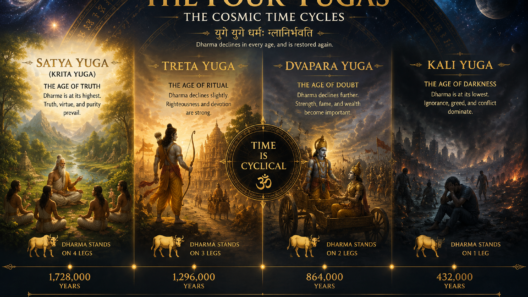
- Cosmic Time — the Brahmanda is not eternal but goes through cycles of creation and dissolution governed by the Four Yugas and the larger Kalpa framework.
Frequently Asked Questions
Q: Is Mount Meru a real mountain?
Meru is a cosmological concept, not a geographical location in the ordinary sense — though various mountains have been proposed as its earthly correlates, including Mount Kailash in Tibet (sacred as Shiva’s abode), Meru in the Himalayas (a real peak in Uttarakhand), and even the North Pole in some esoteric interpretations. The Puranic Meru is described with dimensions (84,000 yojanas tall) that far exceed any physical mountain; it is a symbol of the cosmic axis, the center of being, around which all existence revolves. The spiritual meaning — that there is a divine center to all existence — is the primary teaching.
Q: Do the fourteen worlds correspond to real places, or are they symbolic?
The tradition holds both. For most devotional and theological purposes, the fourteen worlds are real dimensions of existence, inhabited by real beings (gods, ancestors, demons, sages), and souls genuinely travel through them after death according to their karma. For the non-dual philosophical tradition (Advaita Vedanta), all the worlds — including the physical earth — are ultimately appearances within the one Brahman, and their “reality” is provisional, the same kind of reality that dreams have while one is dreaming. Both levels of understanding are valid within their respective frameworks.
Q: What is the connection between Brahmanda and the concept of Maya?
The Brahmanda is the product of Maya — the divine creative power that makes the formless Brahman appear as the structured, multidimensional universe. Maya is not “nothing” — the universe it creates has genuine relative reality, just as a dream is genuinely experienced while it lasts. But just as the dream dissolves upon waking, the Brahmanda dissolves upon liberation (moksha) — not because it disappears, but because its appearance as something separate from Brahman is seen through. The liberated being sees the Brahmanda as the self-expression of Brahman, not as a separate entity.
Q: How does Vedic cosmology compare to modern scientific cosmology?
The two systems ask similar questions but operate from different premises. Modern cosmology is empirical, mathematical, and based on physical observation; it describes a universe approximately 93 billion light-years in observable diameter, approximately 13.8 billion years old. Vedic cosmology is visionary, mythological, and philosophical; it describes a universe of spiritual dimensions as well as physical ones, with a time scale (4.32 billion years per Brahma day) that interestingly parallels some modern estimates for the earth’s age. The most honest comparison is to treat them as complementary rather than competing: modern science describes the physical universe; Vedic cosmology describes the full spectrum of manifest reality including dimensions that modern science does not yet have instruments to measure.
Q: What happens to the soul after death in the context of the Brahmanda?
According to the Vedic-Puranic tradition, after death the soul (jīva) travels through the Bhuvarloka (the intermediate realm between earth and sky), where it is assessed according to its accumulated karma by Yama and his ministers. Souls with positive karma ascend to appropriate heavenly realms (Svarloka and above) to enjoy the fruits of their good actions; souls with negative karma descend to appropriate purgatories (Naraka) to experience the consequences of wrong actions. Both experiences are temporary; once the karmic consequences are exhausted, the soul returns to earth for another embodied life. Only the soul that achieves liberation (moksha) — the direct realization of its identity with Brahman — transcends this cycle entirely.
Q: Is there a connection between Brahmanda cosmology and Hindu pilgrimage?
Absolutely. The geography of sacred pilgrimage in India is embedded within Brahmanda cosmology. Kashi (Varanasi) is said to be situated on Shiva’s trident, outside the normal rules of the Brahmanda — a sacred exception where even ordinary death is transformed into liberation because Shiva himself whispers the Taraka mantra into the dying person’s ear. The sacred sites of the Char Dham represent the four directions of the Brahmanda. Pilgrimage is thus a physical enactment of the cosmological journey — moving through sacred space as a way of aligning the individual microcosm with the divine macrocosm.
“