Saubhadra · Phalguni-Nandana · Chakravyuha-Bhedaka
Introduction: The Half-Knowledge Hero
In the vast theater of the Mahabharata, few deaths are as haunting as that of Abhimanyu. He was sixteen years old. He entered a deadly military formation alone — the Chakravyuha, a rotating spiral array — and fought his way through six layers of the greatest warriors alive. He killed thousands, wounded dozens of commanders, and finally fell not because he was outmatched, but because seven maharathis conspired to surround and destroy him simultaneously in violation of the laws of dharmic warfare.
His story resonates across millennia because it touches something universal: the courage of youth, the tragedy of incomplete knowledge, the injustice of those who use their power to destroy rather than honor greatness. Abhimanyu knew how to enter the Chakravyuha but not how to exit. This single gap in his knowledge — a story with one of the most poignant origins in all literature — sealed his fate. And the Mahabharata uses this gap as a philosophical teaching: courage without complete knowledge is heroism, but heroism that must be supplemented by wisdom if it is to survive.
Abhimanyu is the son of Arjuna and Subhadra (the sister of Krishna), nephew of Krishna, and a warrior who, by the thirteenth day of Kurukshetra, had already established himself as one of the most formidable combatants on the battlefield. His death on that day was not a failure — it was the sacrifice that broke Arjuna’s restraint, unleashed his most terrible oath, and set in motion the chain of events that determined the war’s outcome.
Divine Lineage: The Moon God and the Womb-Knowledge
Abhimanyu’s origins in the cosmic narrative are as remarkable as his earthly story. He is identified in the Mahabharata’s theological layers as an amsha (partial incarnation) of Varchas, the son of the moon god Chandra. When the gods took partial births on earth to participate in the drama of the Dvapara Yuga’s culmination, Chandra reluctantly agreed to let his beloved son Varchas be born as a mortal — but extracted a promise: his son would live only as long as necessary to accomplish his purpose, and no longer. Thus Abhimanyu came into the world already carrying the moon’s luminous but brief nature — shining intensely and then setting.
This divine origin gives Abhimanyu his characteristic qualities: the luminescence of spirit, the swiftness that is the moon’s motion, and a kind of otherworldly completeness that made him seem, to those who encountered him, to be something more than fully human. His maternal uncle Krishna loved him with particular tenderness — not merely as a nephew but as a being whose extraordinary nature Krishna recognized from a divine perspective that others could not share.
His birth to Subhadra and Arjuna combined two of the most potent lineages in the epic: the Pandava line and the Yadava line. He carried Arjuna’s martial gift and Krishna’s divine connection in his very blood. The Kuru elders recognized from his earliest years that he was exceptional — they said that if Arjuna was matchless in archery, Abhimanyu was Arjuna-in-miniature, a condensed version of his father’s greatness already present at birth.
The Womb Story: Chakravyuha Knowledge
The most celebrated story about Abhimanyu’s birth is one of the most poignant in the entire epic. While Subhadra was pregnant with Abhimanyu, Arjuna sat beside her and began explaining to her the intricate military formation known as the Chakravyuha — the wheel or spiral array that rotated like a discus, drawing enemies inward and destroying them.
The Chakravyuha was one of the most complex and deadly of ancient military formations, requiring extraordinary individual skill to penetrate. Arjuna, who had learned all the vyuha formations and their counter-penetrations from his guru Drona, was explaining both how to enter the formation and — crucially — how to exit it once you were inside. The unborn Abhimanyu, in his mother’s womb, was listening.
But Subhadra fell asleep before Arjuna reached the explanation of how to exit the Chakravyuha. Arjuna, noticing that his wife had slept and that there was no conscious listener for the second half of the teaching, stopped. The result: Abhimanyu was born knowing how to enter the Chakravyuha in full detail, but knowing nothing of how to exit it. This incomplete transmission — this half-knowledge — would determine his fate seventeen years later.
This story is not merely a narrative device. The Mahabharata is suggesting something profound about the nature of vidya (knowledge): it must be complete to be safe. Partial knowledge — ardha-vidya — is in many respects more dangerous than ignorance, because it grants confidence without providing protection. Abhimanyu entered the Chakravyuha with supreme confidence in his ability to do so, and that confidence was entirely justified. But he could not exit, and that inability was fatal.
Some commentators have further noted that this story encodes a teaching about prenatal education (garbha samskara) — the tradition recorded in the Sixteen Samskaras that a child in the womb is capable of learning and that what is taught during pregnancy shapes the child’s abilities and character. The story of Abhimanyu is the most famous Mahabharatan evidence for this teaching.
Childhood, Training, and Youth
Abhimanyu grew up in Dvaraka during the years of the Pandavas’ forest exile — his early childhood was shaped by the twin influences of his father Arjuna‘s teachings (during the periods when Arjuna was in Dvaraka) and his uncle Krishna‘s presence. From Krishna he absorbed something of the divine perspective — an understanding of the cosmic stakes of the Bharata conflict that gave his fighting a quality beyond mere valor. From Arjuna he received the technical mastery of weapons, chariot warfare, and military formations.
He is described as having surpassed all his teachers in speed of learning. The weapons that took ordinary students years to master, Abhimanyu absorbed in weeks. His archery was said to approach the standard of Arjuna himself — not quite equal, because Arjuna was unparalleled, but close enough that experienced warriors watching him practice would shake their heads in wonder. He was also taught by Pradyumna, Krishna’s son, and through this training gained knowledge of divyastras (celestial weapons) beyond the ordinary curriculum.
He also received training from Krishna himself in certain aspects of combat philosophy and from Arjuna in the full science of dhanurvidya (archery-science) as he had learned it from Drona and from Indra during his celestial sojourn. By the time he was fifteen, Abhimanyu’s reputation had reached Hastinapura, and even the Kaurava commanders spoke of him with a mixture of admiration and wariness.
There is a particular sweetness in the Mahabharata’s portraits of young Abhimanyu — his relationship with his father Arjuna (distant but intense, shaped by years of separation during the exile), his closeness to his uncle Krishna, his playful bonds with his cousins the Upa-Pandavas (the sons of Draupadi). He was, by all accounts, a joyful young man — full of the confidence that comes from supreme ability and untarnished by bitterness or calculation.
Marriage to Uttara
The incognito year that the Pandavas spent in King Virata’s court in Matsya concluded with a crisis: Duryodhana sent a Kaurava army to attack Virata’s cattle, sensing that the Pandavas might be hiding in Matsya. It was Arjuna — disguised as the dance-teacher Brihannala — who drove the young prince Uttara’s chariot in a confrontation with the Kaurava forces, revealing himself only when necessary and single-handedly routing the attackers.
King Virata, overwhelmed with gratitude, offered his daughter Uttara in marriage to Arjuna. Arjuna declined for himself (he had spent a year as her dance teacher, and the student-teacher relationship made such a marriage inappropriate) but proposed Abhimanyu as the groom. Uttara was thus married to Abhimanyu — a marriage that the Mahabharata presents with warmth and celebration, as the union of Arjuna’s beloved son with the daughter of the king whose hospitality had preserved the Pandava secret through the most dangerous year of their lives.
Uttara was pregnant at the time of the Kurukshetra war. She was carrying the child who would be Parikshit — the heir to the Pandava line, the future king who would carry the Kuru dynasty forward, the infant who would be burned by Ashwatthama’s Brahmastra in the womb and revived by Krishna. Abhimanyu thus fathered, in the brief span between his marriage and his death at sixteen, the sole inheritor of a dynasty.
The Chakravyuha: Day Thirteen of Kurukshetra
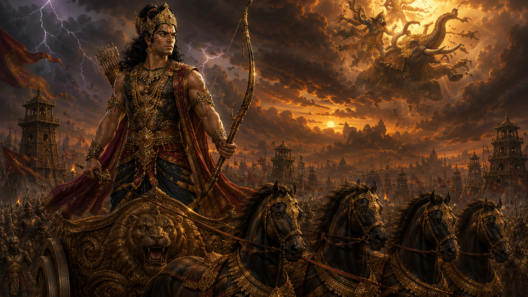
The thirteenth day of the Kurukshetra war brought a crisis that changed the battle’s entire moral character. Drona, now commanding the Kaurava forces, had arranged his army in the Chakravyuha formation — the rotating spiral array that only a handful of warriors knew how to penetrate. Of those who could, most were unavailable: Arjuna and Krishna had been drawn away from the main battle to confront the Samsaptakas (the sworn warriors of Susharma’s division, who had challenged Arjuna specifically to keep him occupied). The other Pandava commanders — Yudhishthira, Bhima, and the others — knew how to fight in open array but not how to penetrate the Chakravyuha’s rotating defenses.
Drona’s strategy was precise and deliberate: capture Yudhishthira alive (the agreed-upon Kaurava war objective) before Arjuna could return. The Chakravyuha made the Pandava army effectively helpless before this tactic.
It was Abhimanyu who stepped forward. Yudhishthira, in his desperation, turned to the sixteen-year-old: “You know how to enter the Chakravyuha. Can you do it?” Abhimanyu’s answer was direct and honest: he could enter, but he did not know how to exit. The plan was therefore modified: Abhimanyu would break open the outer ring, and the Pandava commanders — Bhima, Yudhishthira, Dhrishtadyumna, and others — would follow immediately behind him, expanding the breach and supporting him from within.
This plan failed almost immediately. As Abhimanyu broke through the first ring, the Kaurava commander Jayadratha — who had received a boon from Shiva that he could hold back all the Pandavas except Arjuna for one day — used this boon to close the gap behind Abhimanyu before his supporters could follow. Abhimanyu was sealed inside the Chakravyuha, alone.
The Battle Inside: Abhimanyu’s Last Stand
What followed was one of the most extraordinary single-warrior performances narrated in the Mahabharata. Abhimanyu, alone inside the Chakravyuha, fought through layer after layer of the formation. The Drona Parva records his progress in remarkable detail:
He broke through successive rings of the formation, leaving a trail of dead and wounded behind him. He wounded Salya, routed entire divisions of infantry and elephant corps, and stood firm against the greatest warriors of the Kaurava side. Drona himself, watching from outside, reportedly said with undisguised admiration: “This boy fights like Arjuna. No — today he fights even better than Arjuna.” Karna, who attempted to stop him, was repulsed with such violence that even the Suryaputra retreated.
He killed Lakshmana, the son of Duryodhana — the Kaurava king’s beloved eldest son — in single combat. This killing, more than any other, transformed the day from a military operation into a personal catastrophe for Duryodhana and dramatically escalated the Kaurava desperation to end Abhimanyu.
The Conspiracy: Adharmic Killing
The Kaurava commanders — Drona, Karna, Ashwatthama, Kripa, Brihatbala, Kritavarma, and Jayadratha — held an emergency council. No single one of them could stop the boy. Their solution was to attack him simultaneously — seven maharathis against one. Karna was assigned the specific task of cutting Abhimanyu’s bow string from behind. Ashwatthama was to kill his horses. Others were to break his chariot wheels and destroy his equipment before he could respond.
This conspiracy was an explicit and acknowledged violation of the dharma of war. A maharathi — a warrior of great-chariot rank — was bound by honor to fight only one opponent at a time, to refrain from attacking an already-engaged warrior from behind, to honor the principle of equal combat. The simultaneous attack by seven on one was adharma in its most naked form. Drona — Abhimanyu’s own grand-teacher — knew it. He sanctioned it anyway.
This moment is one of the Mahabharata’s most uncomfortable passages, because Drona — a figure of immense respect and genuine greatness — becomes complicit in something he knows to be wrong, driven by his own impossible position (serving Duryodhana while loving the Pandavas, bound by the obligation of bread to the Kaurava king). The Mahabharata does not excuse Drona; it understands him, and in understanding makes the moral failure more painful.
Karna cut Abhimanyu’s bowstring from behind. His horses were killed. His chariot wheels were broken. His sword shattered on an enemy’s shield. He fought on with a chariot wheel as his weapon, breaking it on Ashwatthama’s horses. He fought with his bare hands. The description of his final minutes — weaponless, surrounded, refusing to yield — is among the most moving passages in Sanskrit literature. He fell at last under a storm of weapons from all seven warriors simultaneously.
He was sixteen years old.
Arjuna’s Terrible Vow
When Arjuna learned of his son’s death — delivered to him by Yudhishthira with enormous reluctance and grief — the Mahabharata describes his reaction as the most terrible display of a father’s love transforming into avenging fury that the epic contains. Arjuna, who had maintained his equanimity through the deaths of friends and comrades, who had imbibed the Gita’s teachings about the eternal soul and the duty of the warrior, who was himself the consummate professional warrior — broke.
He made a vow: by sunset the following day, he would kill Jayadratha (whose boon had sealed Abhimanyu inside the Chakravyuha). If he failed, he would immolate himself on a pyre of his own arrows. This vow, made before the entire army at nightfall on the thirteenth day, transformed the fourteenth day into one of the most dramatic in the entire eighteen-day war. The narrative describes Krishna working with extraordinary cunning — including creating a temporary illusion of sunset that made Jayadratha emerge from his defensive position, at which moment Arjuna killed him. The sun then reappeared, and the army of Duryodhana understood with horror that they had been outwitted.
Uttara and Parikshit: The Dynasty Continued
After Abhimanyu’s death, his pregnant wife Uttara faced the even greater horror of the war’s aftermath. After the battle ended and the Pandavas stood victorious, Ashwatthama — in his final act of vengeance for his father Drona’s adharmic death — unleashed the Brahmastra, the most devastating celestial weapon, at the Pandava camp at night. His target was the sons of Draupadi; the weapon instead fatally injured the unborn child in Uttara’s womb.
Uttara came to Krishna in anguish, holding her womb. Krishna’s response was among the most profound acts of divine compassion in the epic: he entered the womb and revived the dead child, surrounding him with his own cosmic light. The child was born alive and named Parikshit — “the one who was tested” or “the examined one” — because he had been examined (by the Brahmastra’s killing force) and found worthy of life by divine grace.
Parikshit would become the king of Hastinapura after the Pandavas’ final departure, would be bit by the snake Takshaka (and die from the bite), and it is this king’s story that provides the framing narrative for the entire Bhagavata Purana — for it was to the dying Parikshit that the sage Shuka narrated the Bhagavata in seven days, giving the king moksha before the snakebite killed him. Abhimanyu is thus the grandfather of the listener whose liberation forms the culminating frame of one of Hinduism’s supreme devotional texts.
Symbolic Significance and Philosophical Teaching
Abhimanyu’s story carries several layers of symbolic meaning that have made it endlessly compelling to philosophers, poets, and teachers across the centuries.
The most fundamental is the teaching about incomplete knowledge (ardha-vidya). The womb-knowledge story is not simply a charming origin explanation — it is a metaphysical statement. To know how to enter a situation (a career, a relationship, a spiritual practice, a political struggle) without knowing how to exit it or what to do when things go wrong is to possess half of what you need. Courage alone, the story insists, is not enough. Dharma and wisdom must accompany it. The Bhagavad Gita‘s teaching that action must be informed by knowledge and surrendered in wisdom is what Abhimanyu had only in part.
At the same time, Abhimanyu represents the supreme form of selfless action (nishkama karma). He entered the Chakravyuha knowing that his chances of survival without a way out were minimal. He was not a fool — he understood the situation. He entered anyway, because it was necessary. The Pandava army would have collapsed without his intervention. His willingness to sacrifice himself completely for the sake of the larger cause represents the Gita’s ideal of action without attachment to personal survival.
In certain devotional traditions, Abhimanyu is seen as a manifestation of the divine quality of vira-bhakti — heroic devotion — that expresses itself through the complete offering of one’s capacities in service of the right cause. His story is read as a parable of the soul’s entrance into the world: we come in knowing how to enter life (birth, growth, action) but not always knowing how to exit it wisely (death, renunciation, moksha). The teacher who was supposed to complete the instruction — Arjuna, the ego-self — was interrupted by sleep. The seeker must therefore complete the transmission through experience, through struggle, through surrender.
Legacy and Worship
Abhimanyu occupies a unique place in the Mahabharata’s gallery of heroes. He is not one of the five Pandavas, and he does not carry the weight of dharmic complexity that defines Arjuna, Yudhishthira, or Karna. His story is shorter and in some ways simpler — but its simplicity is the simplicity of pure things, and it strikes with the directness of lightning.
In the folk traditions of Rajasthan and Haryana, Abhimanyu is particularly celebrated as a hero-figure whose courage in the face of impossible odds inspires warrior communities to this day. Stories of Abhimanyu are told to children as examples of what a true warrior looks like: not one who calculates his odds before committing, but one who commits completely when commitment is called for.
In classical Sanskrit poetry and drama, the death of Abhimanyu became a standard subject for expressions of the vira (heroic) and karuna (compassionate) rasas — the emotional essences of heroism and grief that the tradition holds to be among the most powerful in artistic experience. The image of the young man, weaponless, fighting on with a chariot wheel, became an archetype of noble defiance.
His lineage through Parikshit to Janamejaya and beyond meant that every subsequent recitation of the Mahabharata was, in a sense, an act of memory on behalf of Abhimanyu’s descendants. The text was narrated first in full at Janamejaya’s snake sacrifice — performed to avenge Parikshit’s death — making Abhimanyu the grandfather whose sacrifice set in motion the events that produced the epic’s first public recitation.
Key Takeaways
- Moon-amsha — Abhimanyu was a partial incarnation of Varchas, son of the moon god Chandra, explaining his brief but brilliant life and his extraordinary luminosity as a warrior.
- Womb-knowledge — The incomplete Chakravyuha instruction (Arjuna taught entry but not exit, as Subhadra slept) is the Mahabharata’s key teaching on ardha-vidya — the danger of partial knowledge.
- Divine lineage — As son of Arjuna and nephew of Krishna, Abhimanyu combined the greatest warrior-lineage and divine connection in the Dvapara Yuga.
- The conspiracy — The killing of Abhimanyu by seven maharathis simultaneously was an explicit violation of dharmic warfare, making his death a crime rather than a defeat.
- Selfless sacrifice — He entered the Chakravyuha knowing his survival was unlikely, embodying the Gita‘s principle of action without attachment to personal survival.
- Arjuna’s vow — His death catalyzed Arjuna’s most terrible vow (to kill Jayadratha by sunset) and transformed the fourteenth day into one of the war’s most dramatic turning points.
- Parikshit’s lineage — Through his wife Uttara’s pregnancy, Abhimanyu fathered Parikshit — whose story becomes the frame for the Bhagavata Purana, one of Hinduism’s greatest devotional texts.
- Folk veneration — In Rajasthani and Haryanvi warrior traditions, Abhimanyu is celebrated as the ultimate symbol of courageous commitment regardless of personal cost.
Frequently Asked Questions
Q: Why didn’t Abhimanyu learn the exit strategy for the Chakravyuha from Krishna or someone else?
The Mahabharata does not give a simple answer. Some commentators suggest that the transmission of this knowledge was meant to happen in a single uninterrupted teaching session, and once Arjuna stopped (because Subhadra slept and the audience was gone), the moment passed. Krishna himself could have taught Abhimanyu, but the cosmic design — which the text treats as operative — required that this specific gap remain. The story operates on both a narrative level (explaining why Abhimanyu entered alone) and a metaphysical level (teaching about incomplete knowledge).
Q: Was the killing of Abhimanyu by seven maharathis considered adharmic at the time?
Yes — explicitly and universally. The Drona Parva records that the conspirators themselves knew they were violating the laws of war. Drona, Karna, and the others discussed it openly. Even those who participated (like Drona) showed evidence of knowing it was wrong. Arjuna’s fury was driven partly by grief and partly by righteous outrage at the dharmic violation. The killing is treated by the narrative as a moral low-point that contributed to the inevitable destruction of the Kaurava side.
Q: How old was Abhimanyu when he died?
The text consistently describes Abhimanyu as very young — sixteen years old at the time of the Kurukshetra war is the most commonly cited age. This youth is central to the story’s emotional power: he was a boy who fought with the skill and courage of a seasoned warrior and died as a consequence of a conspiracy that required seven great commanders to kill him.
Q: What happened to Uttara after Abhimanyu’s death?
Uttara survived the war and gave birth to Parikshit — the child in her womb who was killed by Ashwatthama’s Brahmastra and revived by Krishna. She raised Parikshit under the protection of the Pandava elders. Parikshit became king of Hastinapura after the Pandavas’ final departure, carrying forward the Kuru dynastic line.
Q: What is the philosophical teaching of Abhimanyu for spiritual practitioners?
Abhimanyu’s story teaches that courage without complete knowledge is insufficient for survival, but may be necessary for fulfillment of duty. The ideal is to develop complete wisdom — knowing how to enter AND exit every situation. In the interim, when complete knowledge is unavailable, dharmic commitment requires acting on what one knows, surrendering the rest to divine will. His story is also read as a teaching on garbha samskaras — the profound influence of what a child absorbs before birth — and on the importance of complete transmission in any teaching relationship.
Q: Is Abhimanyu worshipped as a deity?
Abhimanyu is not widely worshipped as a deity in mainstream Hindu practice, but in several folk traditions — particularly in Rajasthan and Haryana — he is venerated as a vira (hero-deity) whose image is kept in warrior family shrines. In these communities, invoking Abhimanyu’s memory is a form of prayer for courage and martial spirit. The Mahabharata itself, in the Swargarohana Parva, confirms his elevation to the celestial realm after death.