Arjuna is the archetypal hero of the Mahabharata: a peerless archer, a relentless student, an honourable warrior, a tender friend, a devoted disciple. He is the third of the five Pandava brothers, son of Kunti by Indra, king of the gods. He wins the hand of Draupadi for the brothers, marries Krishna’s sister Subhadra, fathers Abhimanyu, and, on the field of Kurukshetra, becomes the recipient of the Bhagavad Gita — the dialogue spoken to him by Krishna that has come to define theistic Hinduism. In classical theology he is Nara, eternal companion of Narayana — the soul to whom the Lord turns when the soul collapses in despair.
This profile gathers the canonical Arjuna: birth, training, vows, exile, the Khandava forest, the celestial weapons, the year as Brihannala, the war, and the long aftermath that ends with the Mahaprasthanika.
Names and epithets
Arjuna means “the white, the bright, the spotless” — and the Mahabharata‘s Virata Parva lists his ten famous names with their meanings:
- Arjuna — the spotless, of pure deeds
- Phalguna — born under the Phalguni nakshatra
- Jishnu — the unconquered
- Kiriti — wearer of the diadem given by Indra
- Shvetavahana — driver of white horses
- Bibhatsu — abhorring an unfair fight
- Vijaya — the ever-victorious
- Krishna — the dark-complexioned (he is described as dark-skinned, like Vasudeva-Krishna)
- Savyasachi — ambidextrous, equally skilled with both hands
- Dhananjaya — winner of wealth (from his digvijaya before the Rajasuya)
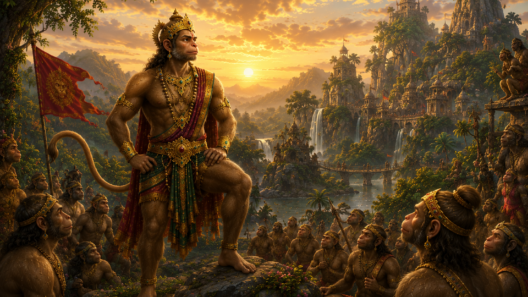
Other epithets include Partha (son of Pritha = Kunti), Gudakesha (conqueror of sleep / of darkness), Parantapa (scorcher of foes), and Kapidhvaja (he whose banner bears Hanuman).
Birth, lineage and training
After Pandu‘s curse made conception with his queens impossible, Kunti used the putra-kama mantra given to her by sage Durvasa to invoke gods on her husband’s behalf. From Dharma she conceived Yudhishthira; from Vayu, Bhima; from Indra, Arjuna. Madri, Pandu’s second queen, conceived the twins Nakula and Sahadeva from the Ashwins. The five brothers grew up first in the forest hermitage of Shatashringa and then, after Pandu’s death, at the Hastinapura court of their uncle Dhritarashtra alongside the hundred Kaurava cousins.
Their first martial teacher was Kripacharya; their main guru was Drona, the brahmin master of arms. Arjuna’s defining quality emerged here: total, undivided attention. Drona once asked the assembled princes, sighting at a wooden bird in a tree, what they could see. Each named the tree, the branches, the leaves, their fellow students. Arjuna alone said, “I see only the eye of the bird.” Drona made him his special pupil and promised him the title of greatest archer of his generation — a promise complicated by the appearance of Karna and the tribal prince Ekalavya, whose right thumb Drona claimed as guru-dakshina to remove him from competition.
The svayamvara of Draupadi
The Pandavas survived the Kaurava plot of the Lakshagriha — the lacquer house meant to burn them alive — and went into hiding among brahmin households. In Panchala, Arjuna won the svayamvara of Draupadi by performing a feat that defeated every other archer present: stringing the great bow, looking only at the reflection of the spinning fish-target in the oil below, and shooting it through the eye. Returning to their hermitage, the brothers told Kunti they had brought back alms; she instructed without looking, “share whatever it is, equally”. The word of a mother and the word of Yudhishthira made Draupadi the common wife of all five brothers — a polyandrous arrangement defended in the epic by appeal to past-life karma and divine sanction.
The exile, the Khandava forest, the celestial weapons
Arjuna observed a year-long self-imposed exile after intruding on Yudhishthira and Draupadi to retrieve weapons; the rule was that whichever brother saw any of the others alone with her must accept this penance. During this year he traveled the subcontinent, married the Naga princess Ulupi in the Ganga, the princess Chitrangada of Manipura (with whom he fathered Babhruvahana), and finally reached Dwarka, where he met and married Subhadra, Krishna’s sister, with Krishna’s blessing.
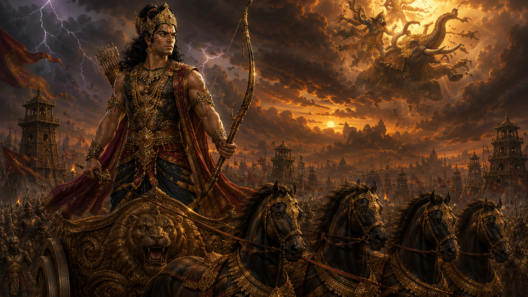
After his return and the establishment of Indraprastha, Arjuna and Krishna helped Agni consume the Khandava forest. From the grateful Agni Arjuna received the Gandiva — the divine bow originally crafted by Brahma — together with two inexhaustible quivers and the chariot drawn by white horses with the banner of Hanuman. From Indra, his celestial father, he later received the Pashupata training mission: Arjuna ascended to the Himalaya, performed tapas, and won from Shiva — disguised as a kirata hunter — the supreme weapon Pashupata-astra. Years in Indra’s heaven followed, where he learned music and dance from the gandharva Chitrasena (skills that saved his life as Brihannala) and gathered every divine astra known to the gods.
The Virata year as Brihannala
After the dice game and the thirteen-year exile (twelve in the forest, one in disguise), Arjuna spent the agyatavasa in the court of King Virata of Matsya as Brihannala, a eunuch dance-teacher to princess Uttara — the curse of the apsara Urvashi (who had made advances he refused) commuted to a single year. When the Trigartas and Kauravas raided Virata’s cattle, Arjuna alone, with the young prince Uttara as his charioteer, retrieved the Gandiva from its hiding place in the cremation ground tree, revealed himself, and routed the entire Kuru army single-handed — the great Virata-yuddha, one of the high points of the epic’s preparation for war.
The Bhagavad Gita and the eighteen days
When the Kuru war began, Arjuna asked Krishna — by then his charioteer by his own choice — to drive his chariot between the two armies so he might see those he was about to fight. The sight of his cousins, his teachers, his grandsire Bhishma in the opposing host collapsed his will. He set down the Gandiva and refused to fight. Krishna’s response is the Bhagavad Gita: eighteen chapters, seven hundred verses, the most influential dialogue in the Hindu canon. Krishna teaches him karma yoga, jnana yoga, bhakti yoga, dhyana yoga; he reveals the Vishvarupa in chapter eleven; and he closes with the unconditional refuge formula, mam ekam sharanam vraja. Arjuna takes up the bow and fights.
The eighteen days saw Arjuna kill or assist in the death of every great Kuru champion: the strategy that brought down Bhishma on the tenth day; the slaying of Jayadratha before sundown on the fourteenth (after Abhimanyu’s death) by the famous solar deception; the killing of Karna on the seventeenth day; and the long single combats against Bhagadatta, Susharma and others.
Aftermath, Anu Gita, Mahaprasthanika
After the war Arjuna escorted the Ashvamedha horse around the subcontinent for Yudhishthira’s sacrifice and fought his own son Babhruvahana, who killed him in single combat — only to have him revived by Ulupi’s naga-mani. After Krishna’s departure he failed for the first time to lift the Gandiva — the divine astras left him — and he led the surviving Yadava women out of the sinking Dwarka. The Anu Gita — Krishna’s recapitulation of teaching he had given on Kurukshetra — was given to him after the war; he confessed that he had not retained the Gita’s full meaning under the pressure of battle. In the Mahaprasthanika Parva, the five brothers and Draupadi walked north toward the Himalaya; Draupadi fell first, then Sahadeva, Nakula, Arjuna and Bhima. Only Yudhishthira, with the dog who turned out to be Dharma, ascended bodily.
Symbolism, theology, legacy
In Vaishnava theology Arjuna is Nara, the eternal jiva (individual soul) whose perfect partner is Narayana (Krishna). The Gita is the dialogue between every soul and its Lord. Arjuna’s collapse on the battlefield is the soul’s collapse before the contradictions of dharma; Krishna’s response is the universal answer of theism.
In the wider epic, Arjuna is the disciplined counterpart to Bhima’s force, the bow to Bhima’s mace; Yudhishthira’s calm versus Arjuna’s brilliance versus Bhima’s terror form the three-fold heroic register of the Pandava brotherhood.
His banner of Hanuman — given by Hanuman after their meeting at Rameswaram — links the Mahabharata to the Ramayana; his role as recipient of the Gita ties him to every later philosophical school that comments on it (Shankara, Ramanuja, Madhva, Abhinavagupta, Tilak, Gandhi, Aurobindo). The bow Gandiva, the chariot of Hanuman-banner, the white horses, the diadem — these have become a complete iconography of dharmic kingship.