When the Divine Descends
Among the most distinctive and philosophically rich concepts in all of Hindu theology is the doctrine of avatāra — the divine descent. Unlike prophets who receive revelation from above, or saints whose lives gradually approach the divine, an avatar is the Divine itself voluntarily assuming human (or other) form to intervene directly in the affairs of the world. The Sanskrit word avatāra means “descent” — from ava (down) + tṛ (to cross over) — the divine crossing over from the transcendent realm into the immanent world.
Of the infinite manifestations of Lord Vishnu, the Dashavatara — the Ten Principal Avatars — is the most celebrated and theologically elaborated sequence. Daśa means ten; the ten avatars span the entire arc of cosmic and biological history, from the primordial waters of creation to the distant future end of the current cosmic age. As a sequence, they describe not merely ten separate stories but a continuous cosmic narrative: the story of divine love for creation and the divine commitment to uphold dharma in every age and under every circumstance.
The scriptural authority for the Dashavatara comes primarily from the Bhāgavata Purāṇa (which contains the most elaborate accounts of each avatar), the Viṣṇu Purāṇa, the Mahābhārata, and various other Puranas. Lord Krishna himself, in the Bhagavad Gita, states the theological principle underlying the entire avatara doctrine:
Yadā yadā hi dharmasya glānirbhavati Bhārata / Abhyutthānam adharmasya tadātmānaṃ sṛjāmy aham / Paritrāṇāya sādhūnāṃ vināśāya ca duṣkṛtām / Dharmasaṃsthāpanārthāya sambhavāmi yuge yuge — Whenever there is a decline of righteousness, O Bharata, and a rise of unrighteousness, I manifest myself. For the protection of the good, for the destruction of the wicked, for the establishment of righteousness, I come into being from age to age. (4.7–8)
The remarkable aspect of the Dashavatara is that, viewed in sequence, the ten forms trace an arc that modern eyes have found strikingly parallel to the theory of biological evolution — from aquatic life (Matsya the fish), through amphibian (Kurma the tortoise), land animals (Varaha the boar), the liminal between animal and human (Narasimha the man-lion), primitive humanity (Vamana the dwarf), to progressively more evolved human forms culminating in the ideal human (Rama), the fully divine human (Krishna), and looking toward the future (Kalki). Whether this parallel is coincidental, symbolic, or represents an ancient intuition about the nature of life’s development remains a fascinating question.
1. Matsya: The Fish
The first avatar, Matsya (matsya = fish), is Vishnu’s manifestation in the primordial waters before the earth was fully formed — in the cosmic time before recorded human history, in the earliest epoch of creation.
The story: the great sage Manu (the progenitor of humanity, whose name is the root of the word “man” in many Indo-European languages) is meditating by a river when a small fish comes to him, asking for protection from larger fish. Manu nurtures the fish, which keeps growing until it is vast beyond measure — revealing itself as Vishnu. The divine fish then warns Manu of an impending great flood (pralaya) that will destroy the world, instructs him to gather all seeds, plants, animals, and the seven great sages (Saptarishis) in a great boat, and ties the boat to his own horn with the cosmic serpent Vasuki as a rope. Manu and his cargo survive the flood, and from them, life in the new cosmic cycle is reestablished.
The Matsya avatar contains one of the world’s oldest flood narratives — predating Noah’s flood in the Hebrew Bible by centuries in the textual tradition, and paralleling flood myths found in Mesopotamia, Greece, China, and indigenous cultures worldwide. Within Hindu cosmology, it marks the transition between cosmic cycles — the divine act of preservation that ensures creation’s continuity across the dissolution.
The Matsya avatar also rescued the Vedas: while Brahma slept at the end of the previous cosmic cycle, the demon Shankhasura stole the Vedas from him and hid them in the cosmic ocean. Vishnu as Matsya defeated Shankhasura and restored the Vedas to Brahma, ensuring that the knowledge of creation would be preserved into the new cycle. This aspect makes Matsya the avatar of the preservation of wisdom itself.
2. Kurma: The Tortoise
The second avatar, Kūrma (kūrma = tortoise), appears during the famous Samudra Manthana — the churning of the cosmic ocean — one of the most beloved and symbolically rich stories in all of Hindu mythology.
The gods (suras) and demons (asuras), in the early eons of the current cosmic cycle, have been weakened. The sage Durvasa cursed Indra, and with Indra’s weakening, the gods lost their power and were driven from heaven. Vishnu advises them to churn the cosmic ocean (the Milky Ocean, Kṣīra Sāgara) to extract the amṛta — the nectar of immortality — that will restore their strength. The gods and demons cooperate: they use Mount Mandara as a churning rod, and the cosmic serpent Vasuki as a rope. But Mandara begins to sink into the ocean floor — at which point Vishnu assumes the form of the gigantic cosmic tortoise (Kurma) and places himself under the mountain as a foundation, his vast shell providing the stable base on which the churning continues.
From the churning emerge many wonders: the wish-fulfilling tree Kalpavṛkṣa, the divine physician Dhanvantari bearing the amrita, the beautiful Goddess Lakshmi (who chooses Vishnu as her eternal consort), the elephant Airavata, the horse Ucchaishravas, the moon, and — most dangerously — the deadly poison Hālāhala that threatens to destroy everything. Lord Shiva consumes the poison to save creation, holding it in his throat (hence the name Nīlakaṇṭha — the Blue-throated One).
The symbolism of Kurma is profound: the tortoise withdraws into its shell just as the realized sage withdraws the senses into the self. In the Bhagavad Gita (2.58), Krishna uses this very image: “One who withdraws the senses from sense objects, as a tortoise withdraws its limbs into its shell — that person is established in wisdom.” The stable foundation Kurma provides also symbolizes the divine support that underlies all cosmic creativity.
3. Varaha: The Boar
The third avatar, Varāha (varāha = boar), rescues the earth goddess herself from the cosmic ocean. The demon Hiraṇyākṣa — twin brother of Hiranyakashipu — had seized the earth (Bhūdevī) and dragged her to the bottom of the primordial cosmic ocean. Vishnu assumes the form of an enormous cosmic boar, dives into the ocean, battles Hiranyaksha for a thousand years, kills him with his discus, and lifts the earth on his tusks back to her proper place in the cosmos.
The image of Varaha lifting the earth on his tusks — the earth goddess (Bhūdevī) sitting on his tusk as he rises from the waters — is one of the most magnificent in all of Hindu iconography. It celebrates the divine as the force that upholds the very foundation of existence. The Varāha Purāṇa devotes particular attention to this avatar, and the great Varaha temple complex at Khajuraho contains one of the most spectacular sculptures of this form.
4. Narasimha: The Man-Lion
The fourth avatar, Narasiṃha (nara = man, siṃha = lion), is perhaps the most dramatic and theologically complex of all ten avatars — a form that embodies the absolute supremacy of divine grace over even the most seemingly impenetrable defenses.
The demon king Hiraṇyakaśipu had received a seemingly invincible boon from Brahma: he could not be killed by man or beast, god or demon; not by day nor by night; neither inside nor outside; neither on earth nor in the sky; by no weapon created or living. Drunk on this power, Hiranyakashipu declared himself god and forbade the worship of Vishnu in his kingdom. His own son, Prahlāda, refused to renounce his devotion to Vishnu and endured torture after torture — thrown from mountains, trampled by elephants, drowned in the ocean, subjected to fire — all without harm, protected by his absolute surrender to the divine.
When Hiranyakashipu demanded of the young Prahlada, “Where is your Vishnu? Is he in this pillar?” and struck the pillar with his fist — Vishnu emerged from the pillar as Narasimha: half-man, half-lion (neither man nor beast), appearing at dusk (neither day nor night), at the threshold of the palace (neither inside nor outside), taking Hiranyakashipu on his lap (neither on earth nor in the sky) and tearing him apart with his claws (not a weapon, but the natural nails of a living being). Every condition of the boon was honored while the demon was still destroyed.
The story of Prahlada and Narasimha is one of the most beloved in all of Hindu devotional literature. Prahlada represents the ideal devotee — unshakable in faith, immune to threats, utterly surrendered. His famous words to his father encapsulate the essence of Bhakti:
Nārada uvāca: Śreyaḥ-sṛtiṃ bhaktim udasya te vibho kliśyanti ye kevala-bodha-labdhaye — Those who, setting aside the highest path of devotion, torment themselves for mere mental knowledge are misguided. (Bhagavata Purana 10.14.4)
Narasimha also teaches the divine omnipresence: the pillar from which Vishnu emerges represents any object — the divine is equally present in the most ordinary thing as in the most sacred. This teaching echoes the Chandogya Upanishad’s sarvaṃ khalv idaṃ brahma — “all this is indeed Brahman.”
5. Vamana: The Dwarf
The fifth avatar, Vāmana (vāmana = dwarf), demonstrates that the divine can overcome even the most virtuous of adversaries when the cosmic order (ṛta) requires it — and that surrender to the divine is the highest virtue even for a great king.
The demon king Bali Mahārāja is unusual: he is a great and virtuous ruler, devoted to dharma, generous beyond measure, who through his accumulated merit has conquered all three worlds and displaced the gods from heaven. The gods petition Vishnu to restore the cosmic order. Vishnu takes birth as Vamana, a dwarf Brahmin boy, and approaches Bali during a great sacrifice. Bali, true to his generosity, offers Vamana any boon he wishes. Vamana asks only for “three paces of land.” Despite his advisor Shukracharya warning him that this tiny Brahmin is Vishnu himself, Bali — valuing his sworn word (vākya dāna) above even his life — grants the boon.
Immediately, Vamana grows to cosmic proportions — becoming Trivikrama, the three-strider. With his first step he covers the entire earth; with his second, the entire sky. For his third step, there is nowhere left to place it. Bali, realizing what has happened, offers his own head as the third placement. Vishnu blesses Bali for his integrity and grants him rulership of the underworld and the promise of being the next Indra in a future age. The story beautifully balances cosmological necessity with justice: the cosmic order must be maintained, but the virtue of the defeated is honored and rewarded.
6. Parashurama: The Warrior-Brahmin
Paraśurāma (paraśu = axe, Rāma = the pleasing one) is the only avatar who did not come to defeat a specific cosmic demon but to correct a systemic corruption in human society. He is unique among the Dashavatara in being a Brahmin by birth who takes up the warrior’s arms — a violent response to the abuse of power by the warrior class (kṣatriyas).
When the arrogant king Kartavirya Arjuna (thousand-armed) stole the wish-fulfilling cow Kāmadhenu from Parashurama’s father Jamadagni and had the sage killed, Parashurama took up his axe and — in a series of battles driven by grief and righteous fury — destroyed the corrupt kshatriya class twenty-one times over three generations, exterminating those who had abandoned dharma for tyranny.
Parashurama represents the principle that systemic corruption requires a systemic response. He is also unique in remaining present even after his primary mission is accomplished — unlike most avatars who complete their work and depart, Parashurama is considered a chirañjīvī (immortal, still living) and is said to be in deep meditation in the Western Ghats mountain range. He appears briefly in both the Ramayana and the Mahabharata — meeting Rama after his defeat at the svayamvara and training Karna in archery.
7. Rama: The Perfect King
The seventh avatar, Rāma — Maryādā Puruṣottama, the highest ideal of righteous human conduct — is the subject of the Rāmāyaṇa, one of the two great epics of Hinduism. His life story is not merely mythology but a complete manual of dharmic living: how to be a son, a husband, a king, a warrior, a friend, and a human being.
A complete exploration of Rama’s life and significance appears in our dedicated article on Rama and the Ramayana. In the context of the Dashavatara, Rama is the avatar who demonstrates that the divine can appear as a fully human being — subject to human emotions, human limitations, and human relationships — while still upholding dharma with perfect consistency. Rama weeps for Sita; Rama struggles with the pain of exile; Rama faces impossible choices. In all of this, he does not abandon his dharmic commitments. This is his greatness and his teaching: not the transcendence of human feeling, but the alignment of human feeling with divine purpose.
The festival of Ram Navami celebrates Rama’s birth in Treta Yuga, while Diwali celebrates his triumphant return to Ayodhya after defeating Ravana — making Rama’s story the template for two of Hinduism’s most beloved celebrations.
8. Krishna: The Complete Avatar
The eighth avatar, Kṛṣṇa — Pūrṇāvatāra, the full or complete avatar — is considered by the Vaishnava tradition to be the most complete manifestation of Vishnu, the form in which the divine is most fully revealed in all its aspects simultaneously: as cosmic lord, as warrior, as lover, as friend, as philosopher, as king.
A full treatment of Krishna’s life, teachings, and significance appears in our article on Krishna in the Mahabharata. In the Dashavatara context, Krishna represents the pinnacle of the avatara tradition: the divine appearing in a form of extraordinary beauty, warmth, and accessibility, engaging with every dimension of human life from birth to death, from village life to cosmic war, from the playfulness of the Vrindavan years to the philosophical depth of the Bhagavad Gita.
The Bhagavad Gita — delivered by Krishna to Arjuna on the battlefield of Kurukshetra — is considered the supreme scriptural gift of the Krishna avatar: the divine’s own declaration of the full path to liberation, applicable to all people in all times. Festivals like Janmashtami celebrate Krishna’s birth as one of the most joyous events in the Hindu calendar.
9. Buddha: The Compassionate One
The ninth avatar in most lists is Buddha — specifically Gautama Buddha, the historical founder of Buddhism (c. 563–483 BCE). The inclusion of Buddha in the Dashavatara is theologically fascinating and has been interpreted in several ways:
The Bhāgavata Purāṇa states that Vishnu appeared as Buddha to mislead the demons and asuras who had become powerful by properly performing Vedic sacrifices — by teaching them a philosophy (Buddhism) that denied the Vedic sacrificial system, he weakened their ritual power and allowed the gods to reassert cosmic order. This interpretation is clearly polemical and reflects early Hindu-Buddhist tensions.
A more generous and widely accepted interpretation is that Buddha appeared to teach ahimsa (non-violence) and compassion at a time when Vedic animal sacrifice had been taken to excess. The Buddha avatar’s teaching of the middle path, non-violence, and the relief of suffering was a divine intervention appropriate to the moral conditions of his time.
In some regional traditions, particularly in South India and some Vaishnava schools, Balarāma (Krishna’s elder brother) replaces Buddha as the ninth avatar, with Krishna being moved to the eighth position. This variation reflects the diversity within the Vaishnava tradition regarding the precise composition of the Dashavatara list.
10. Kalki: The Future Avatar
The tenth and final avatar in the current cosmic cycle, Kalki, has not yet appeared — he is a prophecy, a promise, the hope embedded in the darkest age. The Kalki Purāṇa and the Bhāgavata Purāṇa describe him in vivid detail: Kalki will appear on a white horse, wielding a blazing sword, at the end of the Kali Yuga, when dharma has utterly collapsed, when the last kings have become mere robbers, when people live for only a few decades, when truth has become merely a matter of power.
Kalki’s coming is simultaneously an end and a beginning. He will purge the world of those who have become irredeemably corrupted by adharma, extinguishing the darkness of Kali Yuga. In the wake of his coming, a new Satya Yuga — a new golden age — will dawn. The cycle begins again.
The name Kalki is interpreted variously: as “eternity” (kalka = filth, and Kalki = destroyer of filth), as “white horse” in some dialects, or as related to kalpa (the cosmic time cycle). In popular imagination, Kalki appears as a messianic figure — a divine warrior-king who comes to restore what has been utterly lost.
The Kalki avatar embeds within the Dashavatara an important teaching about the nature of time and hope: no matter how deep the darkness, the divine has not abandoned the world. The promise of Kalki is the promise that dharma will be restored — not by human effort alone, but by divine intervention at the appropriate cosmic moment.
The Theological Significance of the Dashavatara
Viewed as a whole, the Dashavatara is one of the most sophisticated theological constructs in the history of religion. Several profound teachings are encoded in the ten-avatar sequence:
First, the doctrine of kāruṇya (divine compassion): the Supreme Being is not distant or indifferent but actively concerned with the welfare of all beings, willing to assume any form — however humble or fierce — to respond to the world’s need. The fish that approaches Manu as a tiny creature, the dwarf who asks for only three paces — these forms of smallness and limitation are not diminishments of the divine but expressions of its infinite flexibility and humility in the service of love.
Second, the principle of yugānukūlatā (appropriateness to the age): each avatar’s form and method are perfectly suited to the needs and capacities of its time. The fish for the primordial flood; the boar for restoring the earth; the man-lion for defeating the pride of a particularly clever demon’s boon; the perfect human king for a society that needed the model of ideal human conduct. The divine does not impose a single form or method but infinitely adapts to the specific need.
Third, the teaching of evolutionary ascent: from water (Matsya), through amphibian (Kurma), land animal (Varaha), the liminal animal-human (Narasimha), primitive human (Vamana), the warrior-sage (Parashurama), the ideal dharmic human (Rama), the complete divine-human (Krishna), the renouncer-philosopher (Buddha), to the apocalyptic warrior-king (Kalki) — the sequence describes the full arc of life’s increasing complexity and consciousness.
The Navaratri tradition in some Vaishnava regions includes meditations on the Dashavatara; the Guru Purnima celebrations honor Veda Vyasa who compiled the Puranic accounts of the avatars.
Key Takeaways
- Avatara — Sanskrit for “descent”: the voluntary manifestation of Vishnu in a specific form to restore dharma when it declines, protect the virtuous, and destroy evil.
- Dashavatara — the ten principal avatars: Matsya (fish), Kurma (tortoise), Varaha (boar), Narasimha (man-lion), Vamana (dwarf), Parashurama (warrior-brahmin), Rama (ideal king), Krishna (complete avatar), Buddha (compassionate teacher), Kalki (future avatar).
- Evolutionary Arc — the Dashavatara traces a sequence from aquatic to amphibian to land animal to semi-human to human, seen by many as an ancient intuition about biological evolution.
- Bhagavad Gita’s Declaration — Lord Krishna states the avatara principle in Gita 4.7–8: whenever dharma declines and adharma rises, the divine manifests, age after age.
- Prahlada and Narasimha — the story of the boy-devotee Prahlada and his rescue by Narasimha is the Dashavatara’s supreme statement about the power of devotion and the omnipresence of the divine.
- Kalki — the yet-to-appear tenth avatar, who will purge the world at the end of Kali Yuga and inaugurate a new Satya Yuga; the divine promise embedded in the darkest age.
- Divine Compassion — the deepest teaching of the Dashavatara: the Supreme Being is not distant but actively engaged, willing to assume any form to respond to the world’s need.
- Regional Variations — in some traditions, Balarama replaces Buddha as the ninth avatar; some lists include other forms; the Dashavatara reflects the living, adaptive nature of the Hindu theological tradition.
Frequently Asked Questions
Q: Why is Buddha included in the Dashavatara?
Budha’s inclusion in the Dashavatara is interpreted differently across traditions. The Bhagavata Purana’s account — that Buddha appeared to mislead demons who were gaining power through Vedic rituals — is clearly polemical. A more theologically generous interpretation holds that Buddha’s teachings of non-violence, compassion, and the cessation of suffering represented a divine intervention appropriate to his time, correcting excesses in the Vedic sacrificial system. Either way, the inclusion of the historical Buddha as an avatar of Vishnu represents an extraordinary act of theological inclusion — the Hindu tradition recognizing the divine inspiration behind one of the world’s great religious traditions.
Q: Is the Dashavatara related to the theory of biological evolution?
The parallel has fascinated many modern thinkers. The sequence from aquatic fish (Matsya) through amphibious tortoise (Kurma) and land animal (Varaha) to the liminal man-beast (Narasimha) to primitive human (Vamana) to modern humans (Parashurama through Krishna) does broadly parallel the sequence of evolutionary emergence on earth. The 19th-century scholar Nehemiah Grew noted this parallel, and Bal Gangadhar Tilak wrote about it. However, the traditional purpose of the Dashavatara sequence is theological (describing the divine response to cosmic need across ages), not biological — and the time scales in the two systems are vastly different. The parallel is most helpfully understood as a remarkable convergence of mythological vision with scientific observation, rather than a prehistoric theory of evolution.
Q: Are there more than ten avatars of Vishnu?
Yes, the Puranas describe many more than ten. The Bhagavata Purana, in its account (1.3), lists twenty-two named avatars and then says that the avatars of Vishnu are “countless as streams flowing from an inexhaustible lake.” The Trimurti’s Vishnu aspect itself is said to manifest as every being in creation to some degree. The Dashavatara represents the ten most significant and theologically elaborated manifestations — a “greatest hits” of the avatara tradition, not an exhaustive list.
Q: How does the concept of the Avatar relate to the concept of Maya?
An avatar is not deluded by maya — the avatar knows its true nature as the Supreme even while appearing in a limited form. This is the key theological distinction: an ordinary soul is born into maya without knowledge of its true nature; an avatar descends into maya voluntarily, maintaining full awareness. This is why the Bhagavad Gita says that Krishna’s birth and deeds are divya (divine) — those who know his divine nature truly are not reborn. The avatar uses maya as a costume, not as a prison.
Q: What is the significance of Vishnu’s avatars specifically (rather than Brahma or Shiva)?
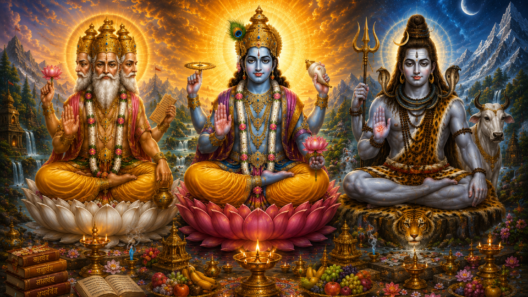
The doctrine of avatara is specifically associated with Vishnu because of his cosmic function as the preserver. When dharma — the cosmic order — is threatened, it is Vishnu’s function to preserve and restore it. Shiva’s role is dissolution (which operates according to a cosmic timetable independent of dharmic conditions), and Brahma’s role is creation (which happens at fixed cosmic moments). Vishnu, as the sustainer and protector, is the member of the Trimurti whose function specifically requires ongoing, responsive intervention — hence the avatara tradition belongs to him. Shiva, however, also manifests in the world in forms like the Jyotirlingas and various direct appearances, though these are typically not called “avatars” in the technical sense.
Q: How are the Dashavatara celebrated in worship and festivals?
The individual avatars are celebrated through their own dedicated festivals: Ram Navami (Rama’s birth), Janmashtami (Krishna’s birth), Diwali (Rama’s return), and various others. The complete Dashavatara is worshipped as a unified set at Vaishnava temples, particularly those associated with the Tirupati tradition and the Sri Vaishnava lineage founded by Ramanuja. The Dashavatara stotra — hymns describing all ten forms — are recited during Vaishnava rituals and the celebration of Ekadashi fasts.
“