Three Faces of the One Reality
The word Trimurti comes from Sanskrit: tri (three) + mūrti (form, image, embodiment). It refers to the three principal manifestations of Brahman — the ultimate, formless reality — each governing a fundamental cosmic function. These three are Brahma (sṛṣṭi — creation), Vishnu (sthiti — preservation), and Shiva (saṃhāra — dissolution). Together, they form the cosmic triad that governs the entire cycle of existence — from the first moment of creation to the final dissolution back into the unmanifest Absolute.
The Trimurti is one of Hinduism’s most elegant and philosophically rich concepts. On one level, it is a theology of the divine: three great personal gods, each with their own mythology, iconography, devotees, and scriptural traditions. On a deeper level, it is a cosmological model: the universe as a perpetual cycle of creation, maintenance, and dissolution — the three phases that every thing, every being, and every era must pass through. And at the deepest level, the Trimurti is an affirmation of non-duality: the three gods are ultimately one reality, three faces of the same formless Absolute, just as the same ocean manifests as waves, current, and still depth simultaneously.
The concept is grounded in the Vedic understanding that existence operates in triads. The three qualities (guṇas) — tamas (inertia), rajas (activity), sattva (clarity) — map onto the three gods: Shiva’s dissolving force corresponds to tamas, Brahma’s creative outburst to rajas, and Vishnu’s preserving harmony to sattva. The three states of consciousness — waking (jāgrat), dreaming (svapna), and deep sleep (suṣupti) — are also sometimes mapped onto the Trimurti, with the transcendent fourth state (turīya) representing the formless Brahman that underlies all three.
Scriptural Sources
The Trimurti concept, while present in embryonic form in the Vedas, reaches its fullest development in the Puranic literature. The Kūrma Purāṇa, the Matsya Purāṇa, the Liṅga Purāṇa, the Brahmāṇḍa Purāṇa, and the Skanda Purāṇa all contain explicit descriptions of the Trimurti. The Viṣṇu Purāṇa provides perhaps the most systematic account:
Sargādinimitto yo brahmaviṣṇumaheśvarāṇām / Avibhāgena vartante tat paraṃ brahma kathyate — That which manifests as Brahma, Vishnu, and Maheshvara for the purposes of creation and so on, undivided — that is called the supreme Brahman.
The Māṇḍūkya Upaniṣad alludes to the triad through its analysis of the sacred syllable AUM: the sound A corresponds to the waking state and Brahma (the creator of the outer world), U to the dream state and Vishnu (the sustainer of the inner world of dreams), and M to deep sleep and Shiva (the dissolver of all distinctions). The silence after AUM is the transcendent Brahman itself.
The Māhānirvāṇa Tantra states explicitly: Brahma Viṣṇuśca Rudraśca ekameva trayīmayam — “Brahma, Vishnu, and Rudra — these three together form the One.” This non-dual understanding of the Trimurti is the key to understanding why, in the great philosophical traditions of Hinduism, there is no fundamental contradiction between Shaiva, Vaishnava, and Brahma devotees — they are all worshipping the same One Reality through different faces.
Brahma: The Creator
Brahmā (with a long second ‘a’, distinguished from Brahman, the Absolute) is the cosmic creator — the first of the Trimurti, responsible for sṛṣṭi (projection or creation). He is called Svayambhū (self-born), Prajāpati (lord of progeny), Pitāmaha (grandfather), and Vedanātha (lord of the Vedas).
Brahma’s iconography is distinctive and loaded with meaning. He is depicted with four heads, one facing each of the four directions — representing his all-encompassing knowledge of the four Vedas, the four cardinal points, the four ages (yugas), and the four aspects of consciousness. He has four arms holding: the Vedas (scriptural knowledge), a kamaṇḍalu (water pot, representing the primordial waters), a sruva (sacrificial ladle), and a mālā (rosary for measuring time). He is dressed in white, representing purity and sattva. His vehicle is a haṃsa (swan or goose) — the bird that, in tradition, can separate milk from water, symbolizing the faculty of discrimination (viveka) between the real and the unreal.
Brahma’s consort is Saraswati — the goddess of knowledge, language, and the arts — a fitting match: creation without the ordering principle of knowledge and language would be chaos. Together, Brahma and Saraswati embody the cosmic principle that creation is an act of intelligence, not mere randomness.
The mythology of Brahma’s creation is described in elaborate detail in the Manusmṛti and various Puranas. The Bhāgavata Purāṇa describes how Vishnu, in his cosmic sleep, generated Brahma from a lotus that emerged from his navel (nābhi-kamala). Brahma, finding himself alone on the lotus with no ground beneath him, dove into the stem to find its source and could not. He then sat in meditation, and from that meditation received the knowledge of the Vedas and proceeded to create the manifest universe.
Notably, Brahma is the least worshipped of the Trimurti in modern times — there are very few temples dedicated to Brahma in India, the most famous being at Puṣkara in Rajasthan. The Puranas explain this through various stories: the most common is that Brahma spoke untruthfully to Vishnu during a dispute with Shiva about who was supreme, claiming to have seen the top of Shiva’s endless flame of light, when in fact he had not. Shiva cursed Brahma to have no temples. Another story says that Brahma’s creative force is already fully exhausted in the act of creation itself; we live in the result of his work, so there is no need to petition him further. These are theological and mythological explanations for a real sociological fact: Brahma is more a philosophical concept — the cosmic creative principle — than an object of popular devotion.
Vishnu: The Preserver
Viṣṇu — whose name derives from the Sanskrit root viś (to pervade) — is the all-pervading cosmic preserver, the second of the Trimurti, responsible for sthiti (maintenance and sustenance of the universe). He is also called Nārāyaṇa (one who abides in the waters), Hari (one who removes sin), Keśava (one with fine hair), Janārdana (one who is worshipped by all people), and hundreds of other names, catalogued in the famous Viṣṇu Sahasranāma (thousand names of Vishnu) found in the Mahābhārata.
Vishnu’s iconography places him reclining on the cosmic serpent Ādiśeṣa (Ananta) on the primordial milky ocean (Kṣīra Sāgara). His four arms hold the śaṅkha (conch shell, representing the sacred sound of creation), the cakra or Sudarśana (discus, representing the wheel of time and dharmic order), the gadā (mace, representing the power of knowledge), and the padma (lotus, representing the unfolded cosmos). His color is blue — the color of infinite space, of the sky and ocean — symbolizing his all-pervading, limitless presence.
Vishnu’s consort is Lakshmi, the goddess of abundance, beauty, and grace — the perfect complement to his sustaining function. His vehicle is Garuḍa, the golden eagle, representing the Vedas and the speed of divine grace.
The most distinctive theological feature of Vishnu is the doctrine of avatāra (descent) — the teaching that whenever dharma declines and adharma rises, Vishnu descends into the world in a physical form to restore cosmic order. The Dashavatara (ten principal incarnations) — from Matsya (fish) through Kalki (the future avatar) — constitute one of Hindu mythology’s most compelling narratives. The Bhagavad Gita contains the most famous statement of this doctrine:
Yadā yadā hi dharmasya glānirbhavati Bhārata / Abhyutthānam adharmasya tadātmānaṃ sṛjāmy aham — Whenever there is a decline of dharma, O Bharata, and a rise of adharma, I manifest myself. (4.7)
The Vaishnava tradition — the tradition centered on Vishnu and his avatars — is the largest single tradition within Hinduism, encompassing Krishna devotion, Rama devotion, and many other forms. The great philosopher-saints of the South — Ramanuja, Madhva, Vallabha — developed sophisticated theologies in which Vishnu-Narayana is the Supreme Reality and the individual soul’s relationship to him is one of loving devotion (bhakti).
Shiva: The Dissolver
Śiva — whose name means “the auspicious one” — is the cosmic dissolver, the third of the Trimurti, responsible for saṃhāra (withdrawal, dissolution, or transformation). He is also called Mahādeva (the great god), Śaṃbhu (the beneficent one), Rudra (the roarer, the howler), Bholenāth (the innocent lord), and Mahākāla (the great time). His nature is paradox: simultaneously the god of destruction and the most accessible of the divine, the greatest yogi and the lord of all living beings (Paśupati), the cosmic ascetic and the conjugal partner of Parvati.
Shiva’s iconography is extraordinarily rich. As described in comprehensive detail in his complete guide, his form includes: the matted hair (jaṭā) in which the river Ganges flows, the crescent moon on his forehead, the third eye of wisdom, the ash smeared on his body (representing impermanence and the dissolution of ego), the snake around his neck (representing the cycle of time and the power over death), the Ḍamaru (drum that beats the rhythm of creation), the triśūla (trident representing the three functions of the Trimurti), and the tiger skin on which he sits. His vehicle is Nandi the bull, representing dharmic steadfastness.
The most profound symbol of Shiva is the liṅga — the pillar of light or cosmic column — which represents the infinite, aniconic presence of Shiva beyond all form. The famous story of the Trimurti itself involves the jyotiḥ-liṅga: when Brahma and Vishnu argued about who was supreme, a pillar of infinite light appeared. Vishnu in the form of a boar dove into the depths to find its base; Brahma as a swan flew upward to find its top. Neither could find the end, and thus Shiva’s supremacy as the formless Absolute was acknowledged. This story is told to explain the twelve Jyotirlingas — the sacred shrines of light.
The Shaiva tradition holds that Shiva is not merely one-third of the Trimurti but the Supreme Reality itself (Paramaśiva) of which Brahma and Vishnu are aspects. The Śiva Purāṇa systematically presents this view. Similarly, the Vaishnava tradition holds that Vishnu is the Supreme of whom Brahma and Shiva are aspects. The Smārta tradition, following Adi Shankaracharya, holds that all three — along with Ganesha, Surya, and Devi — are equal manifestations of the one Brahman, and worships them all through the practice of Pañcāyatana Pūjā.
The Trimurti and the Three Gunas
One of the most illuminating frameworks for understanding the Trimurti is through the three guṇas — the three fundamental qualities or modes of prakṛti (nature) described in the Sāṃkhya philosophy and elaborated in the Bhagavad Gita:
- Sattva (clarity, harmony, luminosity) — corresponds to Vishnu, the preserver. Sattva is the quality that maintains order, creates harmony, and supports the sustained unfolding of life. Vishnu’s preserving function requires the clear, steady intelligence of sattva.
- Rajas (activity, passion, creation) — corresponds to Brahma, the creator. The explosive, generative energy of creation is rajasic in nature: full of movement, desire, and outward thrust.
- Tamas (inertia, dissolution, darkness) — corresponds to Shiva, the dissolver. The force that brings things to an end, that dissolves structures back into potentiality, is tamasic — but in Shiva’s hands, even tamas becomes transformative and ultimately liberating.
This mapping is not a demotion of Shiva (tamas is not “bad” in an absolute sense — it is the necessary force of dissolution without which creation would be impossible). It is a cosmological map: the universe requires all three qualities operating simultaneously and in balance. The dominance of any one quality at the exclusion of the others leads to imbalance — too much rajas (unchecked creation) leads to chaos; too much sattva (excessive preservation) leads to stagnation; too much tamas (premature dissolution) leads to destruction without renewal.
The Bhagavad Gita teaches that spiritual liberation requires transcending all three gunas — not choosing sattva over tamas and rajas (which would merely make one a “sattvic” being, not a liberated one) but going beyond all three to the guṇātīta state — the state that is the ground of the Trimurti itself: the formless, attributeless Brahman.
Tridevi: The Feminine Counterparts
The Trimurti is incomplete without its feminine dimension — the Tridevī or three goddesses who are the śaktis (powers) of the three gods:
- Saraswati is the shakti of Brahma — the power of knowledge, language, and art that makes creation meaningful and ordered rather than chaotic.
- Lakshmi is the shakti of Vishnu — the power of abundance, grace, beauty, and prosperity that makes preservation worthwhile and fills the sustained world with richness.
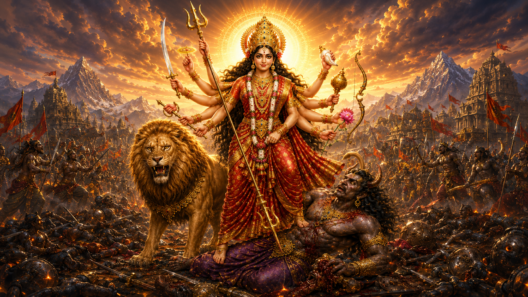
- Parvati (also known as Durga, Kali, and many other forms) is the shakti of Shiva — the power of transformation and liberation that gives dissolution its redemptive quality.
In the Shakta tradition, the Tridevi is not subordinate to the Trimurti but is in fact their source: the three gods can only act because the Goddess animates them with her Shakti. This is the meaning of the famous image of Kali standing on the supine body of Shiva — without Shakti, even Shiva (the supreme consciousness) is inert (śava, the corpse). Consciousness without power, the Shakta tradition teaches, cannot act; power without consciousness cannot know itself. The union of Shiva and Shakti — and by extension of the entire Trimurti with the Tridevi — is the ground of all existence.
The Trimurti in Art and Architecture
The artistic representation of the Trimurti as a single three-headed or three-faced deity — called the Trimūrti mūrti or Sadāśiva image in certain traditions — is one of the great achievements of Hindu sculptural art. The most celebrated example is the monumental Trimurti sculpture in the Elephanta Caves near Mumbai, carved in the mid-sixth century CE. This 5.5-meter-high three-faced bust shows Brahma (the creator face, looking left), Vishnu (the preserver face, looking right), and Shiva (the central face, serene and transcendent) as aspects of a single being.
In temple architecture, the Trimurti concept is often expressed through the three prāsāda (towers) of a temple complex, or through sculptures at the three principal directional faces of a temple’s outer wall. At Chidambaram, the Nataraja form of Shiva encapsulates all three cosmic functions in a single dance: the drum in his upper right hand represents creation, the fire in his upper left hand represents dissolution, and his raised foot represents the grace of preservation and liberation.
The Liṅgodbhava image — found on the western wall of Shaiva temples — depicts the scene of Brahma and Vishnu’s failed quest to find the top and bottom of Shiva’s infinite flame, with Shiva emerging from the pillar of light in the center. This image is a three-dimensional theological statement about the relationship among the Trimurti: all three are present, but the formless ground of the Absolute transcends and contains them all.
The Trimurti and Cosmic Time
The Trimurti’s three functions map directly onto the Hindu understanding of cosmic time as described in the Four Yugas and the larger Puranic cosmology. One complete cycle of creation-preservation-dissolution is called a kalpa — equivalent to one day of Brahma’s existence (4.32 billion human years). During Brahma’s day, Vishnu sustains and manages the universe through his avatars and interventions. At the end of Brahma’s day, Shiva performs the Mahāpralaya (great dissolution), absorbing the entire universe back into himself. Then Brahma’s night begins — a period of cosmic sleep equal in length to his day — after which a new creation begins.
Brahma’s life span is 100 Brahma years (each year consisting of 360 Brahma days and nights), amounting to approximately 311 trillion human years. We are currently in the first day of the 51st year of the current Brahma’s life — meaning this universe is approximately 155 trillion years old in Puranic reckoning. At the end of Brahma’s life, even he is dissolved back into Vishnu or Shiva (depending on which tradition’s cosmology one follows), and eventually a new Brahma is born to begin the next cycle.
This cosmic time scale — utterly dwarfing human history — is itself a philosophical statement: individual human dramas, even the rise and fall of civilizations, are but brief ripples in the infinite ocean of cosmic time that the Trimurti governs.
Key Takeaways
- Trimurti — Sanskrit tri (three) + mūrti (form): the three principal manifestations of Brahman as Brahma (creator), Vishnu (preserver), and Shiva (dissolver).
- Three Cosmic Functions — sṛṣṭi (creation), sthiti (preservation), and saṃhāra (dissolution) are the three operations through which the universe perpetually renews itself.
- Three Gunas — Brahma corresponds to rajas (creative energy), Vishnu to sattva (preserving clarity), and Shiva to tamas-transformed-into-liberation; the Trimurti is the divine governance of all three qualities.
- Tridevi — Saraswati, Lakshmi, and Parvati are the Shaktis of Brahma, Vishnu, and Shiva respectively; without the Tridevi’s power, the Trimurti cannot act.
- Non-dual Foundation — all three deities are ultimately one Reality; the three are united in the formless Brahman that underlies and transcends all form.
- AUM and the Trimurti — the three sounds of AUM (A-U-M) correspond to Brahma, Vishnu, and Shiva, while the silence after AUM is Brahman itself.
- Elephanta Caves — the 6th-century three-faced Trimurti sculpture remains the most celebrated artistic expression of this theological concept.
- Brahma’s Rare Temples — unlike Vishnu and Shiva who have countless temples, Brahma is primarily a cosmological principle; the Pushkar temple in Rajasthan is among the few dedicated to him.
- Kalpa and Cosmic Scale — one Brahma day (kalpa) = 4.32 billion human years; the Trimurti governs unimaginably vast cycles of cosmic time.
Frequently Asked Questions
Q: Is the Trimurti the same as the Christian Trinity?
The Trimurti and the Christian Trinity share the structural feature of “threeness” in the divine, but the similarities are largely surface-level. The Christian Trinity (Father, Son, Holy Spirit) concerns the internal relationships within a personal God and his self-revelation in history. The Trimurti is a cosmological model describing the three functional aspects of the divine as they relate to the universe — creation, preservation, and dissolution. More importantly, the Trimurti rests on a non-dual foundation (the three are ultimately one formless Brahman) that is different from Trinitarian theology. The parallel was enthusiastically noted by early European scholars but should be treated with care.
Q: Why is Brahma not widely worshipped when he is one of the Trimurti?
Brahma’s lack of popular worship has both theological and mythological explanations. Mythologically, various Puranas describe curses preventing his worship (from Shiva for falsehood, or from Brahma’s own daughter for inappropriate desire). Philosophically, Brahma represents the completed act of creation — we already live within the result of his work, so petitioning him for new creation makes little theological sense. Vishnu and Shiva, by contrast, are actively engaged in sustaining and transforming the world in every moment, making them more directly accessible to devotion.
Q: Do Shaiva and Vaishnava traditions accept the Trimurti concept equally?
Not always in the same way. Most traditions accept the concept but differ on who is supreme. The Shaiva tradition holds that Shiva is the Supreme Reality of whom Brahma and Vishnu are aspects or emanations. The Vaishnava tradition holds the same for Vishnu-Narayana. The Smarta tradition, following Adi Shankaracharya, takes the genuinely egalitarian view that all three (and Shakti, Ganesha, and Surya) are equal manifestations of the same Brahman. The Smarta position is probably closest to the original intent of the Trimurti concept.
Q: What is the significance of the Trimurti in the context of liberation (Moksha)?
The Trimurti governs samsara — the cycle of creation, preservation, and dissolution into which souls are born and reborn through karma. Moksha — liberation — is the transcendence of this cycle entirely. In Vedantic terms, the liberated being realizes that their true nature is Brahman — the formless ground that underlies and transcends even the Trimurti. The Trimurti, therefore, points toward its own transcendence: the ultimate aim of Hindu spiritual practice is not merely to be reborn favorably within the Trimurti’s domain but to realize the Brahman that is beyond all form.
Q: How is the concept of Maya related to the Trimurti?
Maya — the cosmic illusion or creative power — is the mechanism through which the formless Brahman appears as the Trimurti and their manifold universe. In Advaita Vedanta, Brahma’s act of creation is itself a function of Maya — the apparent multiplicity that arises within the one Brahman. Vishnu’s preservation sustains Maya’s appearance; Shiva’s dissolution temporarily lifts it during the great dissolutions. For individual souls, the goal of spiritual practice is to see through Maya’s veil and recognize the Brahman that underlies even the three gods themselves.
Q: Is there a female equivalent of the Trimurti?
Yes — the concept of Tridevi (Saraswati, Lakshmi, and Parvati-Durga as the respective Shaktis of Brahma, Vishnu, and Shiva) is the female counterpart of the Trimurti. Moreover, in the Shakta tradition, the Mahātripurasundarī (the supreme goddess of the Śrī Vidyā tradition) is considered the feminine Absolute of whom the entire Trimurti is a manifestation. Navaratri is the great festival celebrating this Tridevi through its three-phase structure.
“