Vasusena · Radheya · Anga-raja · Suryaputra
Who is Karna?
Karna — Vasusena at birth, Radheya by adoption, Anga-raja by gift, Suryaputra by parentage — is the Mahabharata’s tragic mirror to Arjuna. Same divine grade, same teacher’s tradition, same prowess — but born to the wrong mother at the wrong moment, and chained by gratitude to the wrong cause. The epic uses him to ask: how much of identity is birth, how much is loyalty, and how much is the crushing accident of who finds you in the river?
Names and epithets
- Vasusena — ‘born with wealth,’ from the golden kavach (armour) and kundal (earrings) he wore at birth.
- Radheya — son of Radha, his adoptive mother.
- Karna — ‘ear,’ for the earrings, or for being the ear of Duryodhana’s counsel.
- Anga-raja — King of Anga, gifted by Duryodhana.
- Suryaputra / Arka-nandana — son of Surya.
- Daanaveer — hero of giving.
Divine birth and abandonment
As a princess, Kunti received a mantra from the irascible sage Durvasa: any deva she invoked would give her a son. To test it, she called Surya. The Sun God appeared and a child was born complete with celestial armour and earrings fused to his body. Terrified of social ruin, Kunti placed the infant in a basket on the Ashvanadi river. He drifted to Hastinapura, where the charioteer Adhiratha and his wife Radha raised him as their own. He grew up a suta — neither kshatriya nor brahmana — a fact the entire epic refuses to let him forget.
Training and the rejection
Karna mastered archery first under his father’s craft, then sought out Drona at Hastinapura. Drona refused — he taught only kshatriyas. Karna then went to Parashurama, claiming brahmana birth, and learned the Brahmastra and the Bhargavastra. Truth surfaced when a worm bit Karna’s thigh and he sat through the pain rather than disturb his sleeping guru; Parashurama, recognising kshatriya endurance, cursed him: ‘Your weapons will fail you when you most need them.’ This is the first of three curses that converge on his death.
The tournament and the friendship
At the Hastinapura tournament where the Kuru princes displayed their skills, Karna matched Arjuna arrow for arrow. Kripa demanded his lineage; the field went silent. Duryodhana rose, declared him King of Anga on the spot, and bound him in friendship. From that moment Karna’s loyalty to Duryodhana became absolute — and tragic, because Duryodhana’s cause was adharma. The friendship is one of the most sincere bonds in the epic; the cause it served, one of the most ruinous.
The curses
Three curses shape Karna’s death:
- Parashurama: weapons forgotten in the hour of need.
- A brahmin whose cow Karna accidentally killed: chariot wheel sinking into the earth at the decisive moment.
- Bhumi-devi (the earth): when Karna once forced her to surrender milk by squeezing it from her, she swore his wheel would be swallowed at his most vulnerable instant.
All three came due on the seventeenth day.
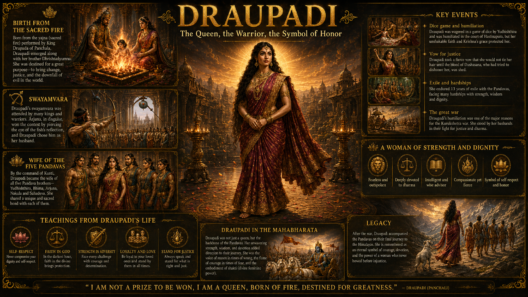
The Draupadi episode
When Draupadi was brought into the dice-hall, Karna was among those who insulted her — calling her a bandhaki (unchaste) for having five husbands and inviting Duhshasana to disrobe her. This is the moral stain his admirers cannot wash off. Yet later, when Krishna offers him kingship if he switches sides, Karna refuses; and during the vastraharana itself the epic does not allow him a redemption. The text holds both truths.
Krishna’s revelation
Before the war, Krishna drove out alone to meet Karna. He revealed the secret of his birth, offered him the throne of Indraprastha, the love of Draupadi, and the legitimacy he had craved his whole life. Karna refused — not out of pride, but because Adhiratha was his real father, Radha his real mother, Duryodhana his real friend. Then Kunti herself came and asked him to spare the Pandavas. He pledged that at the war’s end she would still have five sons — but only four of his rival brothers, plus or minus himself.
Giving away the kavach
Indra, fearing for Arjuna, came as a brahmin and asked for Karna’s birth-armour and earrings. Surya warned him in a dream. Karna gave them anyway — his single greatest act of daana — and received in exchange the one-use Vasava-shakti spear. This spear he saved for Arjuna; it was forced out of him on Bhima’s son Ghatotkacha, sealing Arjuna’s survival. The transaction is one of the epic’s bleakest jokes: virtue gave away the armour; necessity wasted the spear.
Senapati and death (Days 16-17)
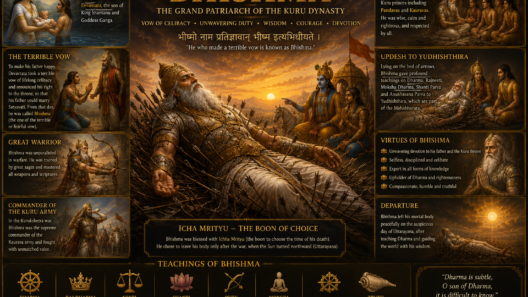
After Bhishma fell (see Bhishma) and Drona was killed, Karna became senapati on the sixteenth day. He fought all five Pandavas, sparing four for his vow. On the seventeenth day, his duel with Arjuna is the climax of the Kurukshetra war. The earth swallowed his chariot wheel. The Brahmastra mantra fell from his memory. He stepped down to lift the wheel and asked Arjuna to honour the rules of war. Krishna replied that adharma asking for dharma’s protection has no claim. Arjuna shot the Anjalika arrow. Karna fell. The sun set on a war that, by some readings, his side had already lost.
Symbolism and interpretation
Karna is the patron of daana (selfless giving), of friendship over morality, and of merit denied by birth. B. R. Ambedkar, Iravati Karve, and Marathi novelist Shivaji Sawant (Mrityunjaya) all read him as the casualty of caste. Tamil tradition (in Villi Bharatam and the modern Karnan film, 1964) elevates him almost above Arjuna. Bengali Tagore’s poem Karna-Kunti Sambad dramatises the meeting with his mother as the moral centre of the epic.
Iconography and worship
Karna is worshipped at small shrines in Anga (modern Bhagalpur, Bihar), at Karna-mandir sites in Uttarakhand, and as a folk hero across the Deccan. His golden armour appears in Pahari and Mysore paintings. The Surya worship at the Konark and Modhera traditions counts him as a paradigmatic devotee. His act of giving is invoked during daana portions of samskaras.
Regional variants
- Tamil Karnan (1964 film) presents him as the moral hero.
- Telugu Daana Veera Soora Karna (1977) is a NTR landmark.
- Bengali Karna-Kunti Sambad by Tagore.
- Marathi Mrityunjaya by Shivaji Sawant — the standard ‘Karna’s-eye-view’ novel.
- Indonesian Karna Tanding in wayang depicts the final duel as a tragedy of cousins, not enemies.
Legacy
Karna’s question — what does a man owe to the people who raised him versus the people who made him? — recurs in every Indian discussion of friendship, caste, and loyalty. He is the only major Mahabharata character whose admirers and detractors share equal eloquence.