Few figures in any world tradition gather as many roles as Krishna. He is a smiling infant stealing butter; a flute-playing cowherd whose music draws the gopis of Vrindavan into ecstatic dance; a strategist and king who founds the citadel of Dwarka; a diplomat whose peace mission to Hastinapura nearly stops the great war; the charioteer of Arjuna; and, on the field of Kurukshetra, the speaker of the Bhagavad Gita — the most influential single text in the Hindu philosophical canon. He is, in classical theology, the Purna Avatara — the “complete descent” of Vishnu, in which all sixteen kalas (qualities) of divinity are made manifest. Whether read as historical king, divine avatara, mystical lover, supreme cosmic principle, or all of these at once, Krishna stands at the centre of the Hindu imagination of the Dvapara Yuga.
This profile gathers the canonical narrative of his life, his major episodes from the Bhagavata Purana, Harivamsha, Vishnu Purana and Mahabharata, his philosophical teaching, his iconography and worship, and the way regional traditions across India and Southeast Asia have re-told him.
Names and epithets
The name Kṛṣṇa (कृष्ण) literally means “the dark one” or “the all-attractive”. Both senses are theologically charged: he is depicted with skin the colour of a thundercloud or the deep blue-black of the night, and the Bhagavata Purana etymologises the name as karṣati ākarṣati iti kṛṣṇaḥ — “he who attracts (the heart) is Krishna”. His epithets each open a different door into his persona:
- Govinda / Gopala — protector of cows; the cowherd
- Madhava — descendant of Madhu; lord of the Yadavas
- Vasudeva — son of Vasudeva; also the cosmic indweller (vāsudeva)
- Damodara — “rope around the belly”, from the episode in which Yashoda binds him
- Murari / Madhusudana / Keshava — slayer of the demons Mura, Madhu and Keshi
- Hrishikesha — master of the senses
- Yogeshwara — lord of yoga
- Parthasarathi — charioteer of Partha (Arjuna)
- Giridhari — lifter of the Govardhana hill
- Shyama / Ghanashyama — the dark, cloud-coloured one
- Banke Bihari, Ranchhod, Dwarakadhisha, Jagannatha — regional names from Vrindavan, Saurashtra, Dwarka and Puri respectively
The Vishnu Sahasranama — the “thousand names of Vishnu” — is recited primarily as a thousand epithets of Krishna in living devotional practice.
Birth and lineage
Krishna belongs to the lunar dynasty (Chandravamsha), and within it to the Yadava branch descended from Yayati’s son Yadu. His parents are Vasudeva, a Yadava nobleman of Mathura, and Devaki, sister of the tyrant king Kamsa. A celestial voice at Devaki’s wedding warned Kamsa that her eighth child would be his death. Kamsa imprisoned the couple and killed each newborn as it appeared.
On the eighth night — Krishna Janmashtami, the eighth day of the dark fortnight of Bhadrapada — under the Rohini nakshatra, Krishna was born inside the prison. The chains fell open, the guards slept, the doors swung wide; Vasudeva carried the infant across the swollen river Yamuna, whose waters parted to reveal a path. He exchanged the boy for a newborn girl in the household of the cowherd chief Nanda and his wife Yashoda in the village of Gokul. The girl, when seized by Kamsa, revealed herself as the goddess Yogamaya and warned him that his slayer was already alive elsewhere. So Krishna grew up among cowherds, hidden in plain sight — a divine prince fostered as a village boy.
His ancestral house, the Vrishni-Yadava clan, eventually settles in the island citadel of Dwarka off the western coast (modern Gujarat). His blood relatives include his elder brother Balarama (an amsha of Shesha-Ananta), his sister Subhadra (later wife of Arjuna and mother of Abhimanyu), his cousin Krishna of the Pandavas via his aunt Kunti (mother of Yudhishthira, Bhima and Arjuna), and his eight principal queens — Rukmini, Satyabhama, Jambavati, Kalindi, Mitravinda, Nagnajiti, Bhadra, Lakshmana — together with the sixteen thousand one hundred women he liberated from the demon Narakasura and married to give them social standing.
Vrindavan: the childhood that became a mysticism
The Bhagavata Purana devotes its Tenth Canto to Krishna’s childhood and youth in Braj — the region around Mathura, Vrindavan, Gokul, Govardhan and Barsana. These episodes are not biographical filler. They become, in the hands of medieval bhakti poets like Surdas, Mirabai, Chaitanya, Vallabhacharya and Jayadeva, the foundational images of one of the world’s great devotional movements.
The infant exploits. Yashoda once pried open his mouth, suspecting him of eating mud, and saw the entire universe inside — galaxies, oceans, gods, time itself. He killed the demoness Putana who came to nurse him with poisoned milk; the cart-demon Shakatasura; the whirlwind Trinavarta; and the python Aghasura. The point of the cycle is not violence but disclosure: every threat sent against the divine child reveals his identity to those with eyes to see.
Damodara-lila. Caught stealing butter, the boy let Yashoda bind him to a mortar with a rope. No matter how much rope she added, it was always two finger-breadths short — a famous emblem in Vaishnava theology of the truth that the divine cannot be measured but consents to be bound by love.
Govardhan. When the cowherds prepared their annual sacrifice to Indra, Krishna persuaded them to worship the Govardhan hill instead, since it was the hill that fed their cattle. Indra, enraged, sent a seven-day deluge. Krishna lifted Govardhan on the little finger of his left hand and held it as an umbrella over the village. The episode is read as a programmatic shift in Hindu theology — from the older Vedic ritualism centered on Indra to the bhakti worship of the immanent personal god.
Kaliya-mardana. He danced on the hoods of the serpent Kaliya in the Yamuna until the serpent surrendered, then released him to the ocean — a story routinely interpreted as the conquest of the kundalini and the purification of consciousness.
Rasa-lila. On full-moon nights of autumn, Krishna multiplied himself so that each gopi in the rasa dance had him fully as her partner. Radha, the chief of the gopis, becomes in later Vaishnava theology the personification of the highest devotional love — prema, parakiya bhakti — the love that has no calculation. The Gita Govinda of Jayadeva (12th c.) and the Bhagavata‘s tenth canto are the classical Sanskrit sources; the Hindi poetry of Surdas, the Brajbhasha of the Ashtachhap poets, the Bengali padavali literature of Vidyapati and Chandidas, and the Tamil Periyalvar and Andal all draw from this well.
Mathura, Dwarka and the Yadava polity
Krishna leaves Vrindavan as a youth, never to return in the body — a separation the gopis mourn in some of the most plangent verse in any language. In Mathura he kills Kamsa, restores his maternal grandfather Ugrasena to the throne, and inaugurates the alliance with the Pandavas through his aunt Kunti.
Repeated invasions by Jarasandha of Magadha — Kamsa’s father-in-law — make Mathura untenable. Krishna leads the Yadavas westward to the coast of Saurashtra and establishes Dwarka, an island citadel said to have been raised from the sea by the divine architect Vishvakarma. From Dwarka he rules as king-statesman; his brother Balarama and the council of Yadava elders share governance in a federated kshatriya republic. He marries Rukmini, princess of Vidarbha, by abducting her from her own wedding to the king Shishupala — at her own request, conveyed in a brahmin’s letter that is one of Sanskrit literature’s great love letters.
The Mahabharata: counsel, diplomacy, war
In the Mahabharata, Krishna’s role is at once that of cousin, ally, statesman, and incarnated god. Neutral on paper between the Pandavas and Kauravas, he offers each side a choice on the eve of war: his entire Narayani Sena of one million soldiers on one side, himself unarmed on the other. Duryodhana takes the army; Arjuna takes Krishna. The choice is the moral hinge of the epic.
His peace embassy to Hastinapura — in which he asks Duryodhana to grant the Pandavas just five villages — is the last attempt to stop the war. When Duryodhana tries to seize him as a hostage, he reveals his Vishvarupa (cosmic form) in the assembly hall, then walks out.
On the eve of battle, in the chariot stationed between the two armies, he speaks the Bhagavad Gita to a despairing Arjuna. The Gita’s eighteen chapters move from the problem of righteous violence to the metaphysics of the imperishable Self, the disciplines of karma yoga (action without attachment), bhakti yoga (devotion), and jnana yoga (knowledge), and finally to the climactic theophany of Chapter 11 in which the Vishvarupa is revealed — Time itself, “the destroyer of worlds”. The closing instruction, sarva-dharman parityajya mam ekam sharanam vraja (“abandon all dharmas and take refuge in me alone”), has been read for two millennia as the highest invitation of theistic Hinduism.
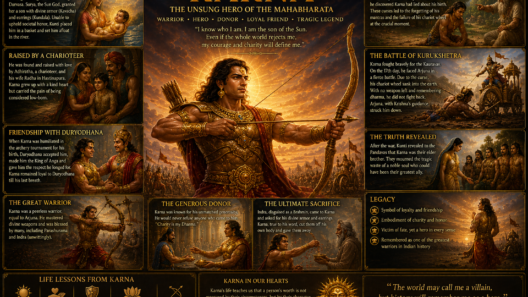
Through the eighteen days of war Krishna does not lift a weapon, but his counsel decides every major event: the strategy by which Bhishma is brought down, the mid-day ruse that breaks Drona, the moonlit revelation that disarms Karna, and the famous oath-bending move by which Jayadratha is killed before sunset on the day after Abhimanyu falls. After the war he installs Yudhishthira and consoles the bereaved Gandhari, who curses him with the destruction of his own clan.
The end: Mausala parva and the departure
Thirty-six years after the war, Gandhari’s curse ripens. The Yadava youth, drunk and quarrelsome, kill each other with iron mausalas (clubs) on the beach near Prabhasa. Balarama withdraws into yogic samadhi and his amsha returns to Shesha. Krishna sits beneath a pipal tree; a hunter named Jara — Old Age — mistakes the sole of his foot for a deer’s eye and looses an arrow that pierces it. Krishna blesses him and ascends to his own divine abode. The waters rise and Dwarka sinks beneath the sea. The Bhagavata ends with Arjuna escorting the surviving Yadava women to Hastinapura, the Kali Yuga beginning at the moment of his departure.
Teachings: the philosophy of the Gita and beyond
Krishna’s teaching is not a single doctrine but a synthesis. The Gita can be read as harmonising the older paths:
- Karma yoga — act, but renounce attachment to the fruits of action; let the act itself be the offering.
- Jnana yoga — discriminate between the imperishable Self (atman) and the perishable field (kshetra); the Self is never born and never dies.
- Bhakti yoga — the easiest and surest path: take refuge in the personal god, who carries the devotee across the ocean of samsara.
- Dhyana yoga — the disciplines of yoga taught in chapter 6, foundational to later Hindu meditation.
The Uddhava Gita (Bhagavata 11) and the Anu Gita (Mahabharata 14) elaborate on the same themes for advanced students. Together they form the second-tier scriptural foundation of Vaishnava Vedanta, alongside the Upanishads and the Brahma Sutras.
Iconography and worship
Krishna’s classical iconography is unmistakable: dark blue body, yellow pitambara silk, a peacock feather in his hair, a vaijayanti garland of forest flowers, a flute at his lips. He stands in tribhanga — the triple-bend pose — left foot crossed in front of the right, weight on the right leg. His chatur-bhuja (four-armed) icon as Vishnu carries the conch (panchajanya), discus (sudarshana), mace (kaumodaki), and lotus.
Major temples include:
- Dwarkadhish at Dwarka, one of the Char Dham (see Char Dham Yatra)
- Jagannatha Puri in Odisha, also part of the Char Dham
- Banke Bihari, Radha-Raman, Govind Dev in Vrindavan
- Guruvayoor in Kerala
- Udupi Krishna Matha in Karnataka, founded by Madhvacharya
- Nathdwara in Rajasthan, the seat of the Vallabha sampradaya
Major festivals include Krishna Janmashtami (his birth), Holi (associated with the play of Krishna and Radha in Braj), Govardhan Puja (the day after Diwali), and the great Rath Yatra of Puri.
Regional and sectarian variants
The Krishna of the Tamil Alvars (8th–10th c.) is a Mal, a beloved divine child; Andal writes love poems to him as her bridegroom. The Vaishnava acharyas — Ramanuja, Madhva, Nimbarka, Vallabha, Chaitanya — each construct a school of theology around him. The Gaudiya Vaishnava lineage of Chaitanya elevates Radha to co-equal divinity and treats Krishna of Vrindavan as svayam bhagavan — God himself, of whom Vishnu is an expansion. The Pushtimarga of Vallabha worships him as the infant Bal Krishna of Shrinathji. In the Dvaita of Madhva he is the supreme Vishnu, ontologically distinct from the soul.
Outside India: in Bali, Krishna lore is woven into the wayang shadow plays; in Java, the Bharatayuddha kakawin retells the Kurukshetra war; in Thailand and Cambodia, the Mahabharata traditions thread through court literature; in the modern West, the International Society for Krishna Consciousness (ISKCON, 1966) carries Gaudiya Vaishnavism into a global setting.
The Jain tradition includes Krishna as the ninth Vasudeva of his half-cycle, contemporary of the Tirthankara Neminatha; his ethical role is reframed but his historicity affirmed. The Buddhist Ghata Jataka preserves a parallel narrative.
Symbolism and philosophical interpretation
Read symbolically, Krishna’s life enacts the program of the classical Trimurti: he is Vishnu’s descent into history, a preserver whose every action restores dharma in his age. The flute is the call of the divine to the soul; Vrindavan is the inner heart in which the call is heard; Radha is the soul’s response; the rasa-lila is the play of the One and the many; Kurukshetra is the moral arena; the Gita is the manual.
The Bhagavata Purana makes the structural claim explicit: Krishna is svayam bhagavan, the source from whom even other avatars descend. The Vishnu Sahasranama names him as purushottama, the supreme person.