In the vast and luminous cosmos of Sanathana Dharma, no figure is more paradoxical, more awe-inspiring, or more profoundly beautiful than Lord Shiva — the Mahadeva, the Great God. He is the ascetic who meditates in absolute stillness on the snow-crowned peaks of Kailash, yet the dancer whose cosmic tandava sets the universe in perpetual motion. He is the destroyer of worlds and the most compassionate of fathers. He is dressed in rags, smeared in ash, seated among cremation grounds — yet worshipped as the Supreme Being, the source and the dissolution of all that exists.
Shiva is one of the three primary deities of the Hindu Trinity (Trimurti), alongside Brahma the Creator and Vishnu the Preserver. In the Shaiva tradition — one of the largest and oldest living religious traditions in the world — Shiva is not merely a member of a triad but the singular, absolute, self-luminous reality: Brahman himself in personal form. The Shaiva Agamas, the Shiva Puranas, the Mahabhashya of Patanjali, the Rig Veda’s Rudra hymns, the Atharva Shiras Upanishad, the Shvetashvatara Upanishad — all converge to paint a portrait of an intelligence so vast, so layered with meaning, that millennia of scholarship have not exhausted the attempt to understand him.
This article is a comprehensive guide to Lord Shiva — his names, iconography, cosmological function, family, sacred forms, mythology, temples, and living worship — compiled with the depth and rigour of a sacred reference work.
Etymology: What Does “Shiva” Mean?
The Sanskrit word Śiva (शिव) carries a constellation of meanings, each pointing to a different dimension of the deity. Derived from the root śī (to lie, to reside) or from śav (auspiciousness), Shiva most directly means “The Auspicious One” or “The Benevolent One.” The Nirukta and classical grammarians also connect the name to śi (in whom all things repose) — making Shiva literally the ground of being, the substratum in which the entire universe rests.
The name is profoundly intentional. The wild, ash-smeared, skull-garlanded deity who haunts cremation grounds is called “the Auspicious One” precisely because auspiciousness in Shaiva thought is not the avoidance of darkness but the transformation of it. Where most beings flee death, Shiva presides over it — and in doing so, makes it sacred. His very name is an act of teaching.
Among his most sacred epithets:
- Mahadeva — The Great God
- Maheshvara — The Supreme Lord
- Shankara — The Giver of Joy / Beneficent One
- Rudra — The Roarer, the Storm God (Vedic form)
- Adiyogi — The First Yogi, the originator of yoga
- Nataraja — The Lord of Dance
- Pashupati — The Lord of All Creatures
- Neelakantha — The Blue-Throated One
- Tryambaka — The Three-Eyed One
- Mahakala — The Lord of Great Time / Beyond Time
- Dakshinamurti — The Teacher Who Faces South
- Bholenath — The Innocent Lord (easily pleased)
- Vishwanath — The Lord of the Universe
- Chandrashekhara — He Who Bears the Crescent Moon
- Gangadhara — He Who Bears the River Ganga
Traditionally, Shiva is held to have 1,008 names (sahasranamas), each encapsulating a specific divine attribute or cosmic function. The Shiva Sahasranama appears in multiple Puranas and is recited daily by millions of devotees.
Shiva in the Vedas: The Origins of Rudra
Long before the fully formed Shiva of the Puranas emerged, a deity of similar nature appears in the oldest stratum of Hindu scripture — the Rig Veda — under the name Rudra. The Rig Veda dedicates three hymns specifically to Rudra (Mandala 1.114, Mandala 2.33, and Mandala 7.46), and dozens of other hymns invoke him obliquely. Rudra is the storm deity — fierce, unpredictable, archer of arrows that bring fever and disease, yet also the physician of physicians, the lord of healing herbs.
The celebrated Shri Rudram of the Krishna Yajur Veda (Taittiriya Samhita 4.5) is arguably the most important liturgical text of Shaiva worship. Composed in two parts — the Namakam (hymn of names, invoking Rudra’s mercy with the mantra namas te) and the Chamakam (hymn of wishes) — it is chanted during Abhisheka (the ritual bathing of the Shivalinga) and is considered so potent that its recitation purifies all creation. The Shri Rudram contains 425 Vedic mantras and identifies Rudra with virtually every cosmic and earthly force: rivers, forests, merchants, armies, craftsmen, children, the cosmos itself.
A critical passage in the Shvetashvatara Upanishad (4.2–4) identifies Rudra with the supreme impersonal Brahman, explicitly declaring that he is “the one God hidden in all beings, pervading all, the inner soul of all creatures, the witness, the perceiver.” This marks the Upanishadic absorption of Rudra into the category of the Absolute, laying the philosophical ground for the full Shaiva theology of later centuries.
The transition from Vedic Rudra to Puranic Shiva is gradual, occurring through the period of the Brahmanas, Aranyakas, and the early Puranas. By the time of the great Shaiva Agamas (roughly 200 CE–600 CE) and the Shiva Mahapurana (compiled ~400–1100 CE), the transformation is complete: Shiva is no longer a peripheral storm deity but the supreme cosmic reality who contains all gods within himself.
The Iconography of Lord Shiva: Every Symbol a Teaching
The image of Shiva is one of the most symbolically dense in all world religion. Unlike the royal, adorned imagery of Vishnu or the regal beauty of Devi, Shiva’s iconography is deliberately counter-cultural: he wears what others discard, he inhabits what others fear, he embodies what the world calls inauspicious. Every element of his form is a theological statement.
The Third Eye (Trinetra)
Shiva possesses three eyes: the right eye representing the sun (Surya), the left eye representing the moon (Chandra), and the central third eye (ajna chakra) representing fire, wisdom, and the capacity for total perception. The third eye sees beyond the veil of maya (illusion) into the naked truth of reality. When opened in wrath, it burns — as when Shiva incinerated Kamadeva (the god of love/desire) for disturbing his meditation. Yet the same third eye, when turned inward, is the eye of enlightenment. The lesson is profound: the same faculty that destroys illusion can destroy the illusioned if they obstruct the path of liberation.
The Crescent Moon (Chandrashekhara)
Shiva bears the crescent moon (Chandra) in his matted hair. This is not mere adornment — it encodes layered meanings. The moon in its crescent form represents time in its waxing phase, the cyclical nature of the cosmos, and the mind (manas) in Vedic cosmology. By wearing the moon as an ornament, Shiva demonstrates mastery over time and mind. In one narrative, Chandra (the moon god) was cursed to wither and die by the sage Daksha. Shiva gave him refuge in his hair, arresting the curse so that Chandra waxes and wanes eternally rather than perishing — an act of grace that became embedded in the very image of the deity.
The Trishula (Trident)
Shiva’s primary weapon is the trishula — the three-pronged trident — which stands for the three fundamental forces of creation, preservation, and destruction (srishti, sthiti, samhara). The three prongs also represent the three gunas (tamas, rajas, sattva), the three states of consciousness (waking, dreaming, deep sleep), the three bodies (gross, subtle, causal), and the three times (past, present, future). The wielder of the trishula is master of all these dualities and trinities. Some philosophical traditions read the trishula as Shiva’s power over the three forms of suffering (tapatraya): bodily, environmental, and spiritual.
The Damaru (Hourglass Drum)
The small two-headed drum (damaru) held in one of Shiva’s right hands is the instrument of cosmic sound. The Nada Brahman tradition holds that the universe originates from primordial sound (nada), and Shiva’s damaru represents the first beat of creation — the spanda, or divine vibration, from which all form unfolds. In Hindu tradition, it is from the rhythmic beating of Shiva’s damaru that the fourteen foundational rules of Sanskrit grammar — the Maheshvara Sutras — emerged, which the sage Panini used as the basis of his Ashtadhyayi. Linguistically and cosmologically, Shiva’s drum is the source of all language, all knowledge.
The Ganga in His Matted Locks (Gangadhara)
The Milky Way-white river Ganga descends from the heavens through the matted locks (jata) of Shiva’s hair. When the sage Bhagiratha performed extraordinary penance to bring the divine Ganga to earth to liberate his ancestors, the gods realised that the force of the celestial river falling directly onto earth would split the planet apart. Only Shiva could absorb the impact. Shiva agreed, and the Ganga entered his jata and flowed down in seven gentle streams (saptasrotas) to the earth. This narrative establishes Shiva as the intermediary between heaven and earth, the one whose inner stillness can absorb the most overwhelming force without being displaced — a model for the yogic ideal of equanimity.
Vibhuti — Sacred Ash
Shiva’s body is smeared with vibhuti — sacred ash from the cremation ground. This is one of the most philosophically radical elements of his iconography. In a culture where death and cremation are considered highly inauspicious and ritually polluting, Shiva makes the cremation ground his home and wears its ash as his adornment. The teaching is unambiguous: what the world fears, the liberated being embraces. Ash is the ultimate equaliser — every body, regardless of caste, wealth, or beauty, reduces to the same grey ash. By wearing it, Shiva proclaims the equality of all existence and the inevitability of dissolution. Ash also represents the burning away of the ego and all worldly attachments — what remains when everything impermanent is destroyed is the eternal, and that eternal is Shiva.
The Serpent Vasuki
A great serpent (naga) coils around Shiva’s neck or arm — typically identified as Vasuki, the king of serpents. Serpents in Vedic symbolism represent kundalini shakti (the latent divine energy in all beings), time (kala), death, and the cyclic nature of existence. Shiva wearing the serpent as an ornament — rather than fearing it — shows his absolute mastery over death, time, and the most primal cosmic forces. It also connects him to the naga tradition, and the vast indigenous and tribal currents of ancient Indian religion that were absorbed into the Shaiva system over millennia.
Neelakantha — The Blue Throat
One of Shiva’s most celebrated epithets is Neelakantha — “Blue-Throat” — arising from the episode of Samudra Manthan (the churning of the cosmic ocean). When gods and demons churned the celestial ocean to retrieve the nectar of immortality, the first thing that emerged was not nectar but Halahala — a terrifying poison that threatened to annihilate all creation. No god or demon could contain it. Shiva stepped forward, collected the poison in his hand, and swallowed it — holding it in his throat through the power of his yoga, preventing it from descending into his body. Parvati, alarmed, gripped his throat to stop the poison rising — and so his throat turned blue. Shiva absorbed the world’s poison and bore it within himself so that creation could continue. This narrative is simultaneously a cosmological story and a portrait of the compassionate sage who takes on the suffering of the world.
Tiger Skin and Bull Nandi
Shiva sits on a tiger skin and his vehicle (vahana) is Nandi, the white bull. The tiger represents the ego, animal desire, and uncontrolled power — Shiva sitting upon it shows mastery over these forces rather than their suppression. The bull Nandi embodies dharma (righteousness), steadfastness, and devotion. Nandi is the gatekeeper of Kailash — no one enters Shiva’s abode without Nandi’s sanction. He is also the first and greatest disciple, the prototype of the surrendered devotee. In every Shiva temple, the image of Nandi faces the garbhagriha (inner sanctum) — forever gazing at his Lord, an eternal model of one-pointed devotion.
The Sacred Forms of Lord Shiva
Shiva manifests across a staggering range of forms, from the utterly abstract (the formless lingam) to the dynamically embodied (the dancing Nataraja). These forms are not contradictory but complementary — each reveals a different facet of the same infinite reality.
Nataraja: The Lord of the Cosmic Dance
Nataraja is arguably the most iconic image in all of Hindu art — so iconic that CERN (the European nuclear physics laboratory) installed a large bronze Nataraja statue at its entrance in Geneva, acknowledging the parallel between Shiva’s cosmic dance and the dance of subatomic particles. The Nataraja image, perfected during the Chola dynasty (9th–13th centuries CE) in Tamil Nadu, depicts Shiva dancing within a ring of fire (prabhamandala) — one leg raised in the dynamic pose of ananda tandava (the dance of bliss), the other crushing the dwarf demon Apasmara Purusha (forgetfulness/ignorance) beneath his foot.
Shiva’s four arms in the Nataraja form hold specific objects: the upper right hand holds the damaru (creation), the upper left holds fire (destruction), the lower right hand is raised in abhaya mudra (protection), and the lower left points to the raised foot (liberation). The encircling ring of fire is samsara — the cycle of birth and death. The message is complete: amid the fire of existence, the dancer is free; amid creation and destruction, the wise find liberation at the feet of the Lord.
The Shivalingam: The Formless Absolute in Form
The Shivalingam is the most widely worshipped image of Shiva — a cylindrical pillar of stone, typically set in a circular base (pitha or yoni) that channels the water of the ablution outward. Theologically, the lingam represents the formless, infinite nature of Shiva — that which transcends all human categories. The word lingam means “mark” or “sign” in Sanskrit — the lingam is not a representation of Shiva’s physical form but the cosmic sign of his presence, the minimal possible form that marks the Formless.
The Skanda Purana narrates the origin of lingam worship in the story of Lingadbhava: Brahma and Vishnu, disputing who was supreme, encountered an infinite column of light (jyotirlinga) that pierced heaven and earth. Brahma flew upward as a swan to find the top; Vishnu dug downward as a boar to find the bottom. Both failed — the pillar was infinite. Shiva then appeared from within the pillar and revealed himself as the Absolute who transcends even the cosmos’s highest and deepest extremities. This myth is encoded in every Shivalingam — it is the infinite jyotir in bounded form.
Ardhanarishvara: The Union of Masculine and Feminine
Ardhanarishvara (“the Lord who is half woman”) depicts Shiva and his consort Parvati/Shakti merged into a single body — the right half Shiva, the left half Parvati. This form conveys one of the most profound philosophical teachings in all Hindu theology: reality itself is neither exclusively masculine nor exclusively feminine but a dynamic union of both principles. Shiva without Shakti is shava — a corpse, inert. Shakti without Shiva is undirected power. Together, they are the complete reality — consciousness and energy, the static and the dynamic, the transcendent and the immanent.
Dakshinamurti: The Silent Teacher
Dakshinamurti (“he who faces south”) is Shiva in the form of the supreme teacher (Jagadguru). He sits beneath a banyan tree in deep meditative stillness, surrounded by aged sages who are his disciples — yet the paradox is total: the disciples are ancient rishis, while Shiva the teacher appears as a young man. He teaches not through words but through silence — the highest teaching in Advaita Vedanta. What the sages grasp is not conveyed through language but transmitted through the silence of sat-chit-ananda consciousness itself. Adi Shankaracharya composed his masterpiece Dakshinamurti Stotra in praise of this form, establishing the model of teacher-disciple transmission that runs through all Indian philosophy.
Bhairava: The Fierce Guardian
Bhairava is the terrifying form of Shiva — dark, skull-garlanded, wild-eyed, accompanied by a dog, holding a severed head. Bhairava is the guardian of the cremation ground and all liminal spaces between life and death. He represents the aspect of time that destroys without discrimination and the part of divine justice that cannot be negotiated with. Bhairava is also the guardian of Kashi (Varanasi) — it is said that every soul that dies in Kashi receives the Taraka Mantra (the liberating mantra of Rama) whispered in its ear by Bhairava himself at the moment of death, ensuring immediate liberation. This form reveals an important truth: the most fearsome aspect of reality, properly understood, is the most merciful.
Sadashiva: The Five-Faced Eternal Shiva
Sadashiva is Shiva in his highest transcendent form — depicted with five faces (Panchamukha) and ten arms. The five faces — Sadyojata (west, creation), Vamadeva (north, preservation), Aghora (south, dissolution/transformation), Tatpurusha (east, concealment), and Ishana (above, grace) — correspond to the five cosmic functions (Panchakriya) and the five elements. Each face has its own mantra, ritual, and philosophical significance. The Panchamukha Shiva appears in the most sacred iconographic programmes of South Indian temple architecture, where the five-faced form of the deity occupies the five faces of the main tower (vimana).
The Five Cosmic Functions of Shiva: Panchakriya
In Shaiva theology, Shiva performs five cosmic actions (panchakritya) that sustain the entire cycle of existence:
- Srishti (Creation / Emanation) — Shiva projects the universe from himself, like a spider spinning a web from its own body. All forms emerge from his divine will (iccha shakti).
- Sthiti (Preservation / Sustenance) — He maintains the existence of the projected universe, upholding its order, law (rita), and dharma through his power of knowledge (jnana shakti).
- Samhara (Dissolution / Withdrawal) — At the end of each cosmic cycle (kalpa), Shiva withdraws the universe back into himself — not as annihilation but as the reabsorption of a dream back into the dreamer. This is performed through his power of action (kriya shakti).
- Tirobhava (Concealment / Veiling) — Through his power of maya, Shiva veils the divine nature of reality from the individual soul (jiva), allowing the play of creation to continue. This apparent limitation is itself an act of grace, creating the conditions under which the soul can mature toward liberation.
- Anugraha (Grace / Revelation) — The final and supreme function: Shiva lifts the veil of maya from the soul, granting self-knowledge and liberation (moksha). This is the purpose of the first four actions — they are all in service of this ultimate gift.
These five functions are understood as a single, continuous, compassionate activity. Shiva creates so that souls can exist; he preserves so that they can experience and learn; he dissolves so that what is exhausted can be renewed; he conceals so that the game of becoming has meaning; and he reveals so that the soul ultimately recognises its own divine nature. The entirety of cosmic history is, in this view, a vast act of divine love.
The Family of Lord Shiva
Shakti / Parvati: The Divine Consort
Shiva’s consort is Shakti — the divine feminine energy that is inseparable from him. Shakti’s earthly form is Parvati, the daughter of Himavan (the Himalaya mountain) and Mena. Their love story is one of the most celebrated in all Hindu literature. After the death of his first consort Sati (who immolated herself at Daksha’s yagna when her husband was insulted), Shiva entered a state of withdrawn, inconsolable grief — a cosmic asceticism that threatened to stop the universe. Sati was reborn as Parvati, who then performed extraordinary austerities to win back Shiva’s attention and love. Their union was not merely romantic but cosmic: the reunion of Shiva and Shakti represents the reintegration of consciousness and energy, the collapse of the apparent duality at the heart of existence.
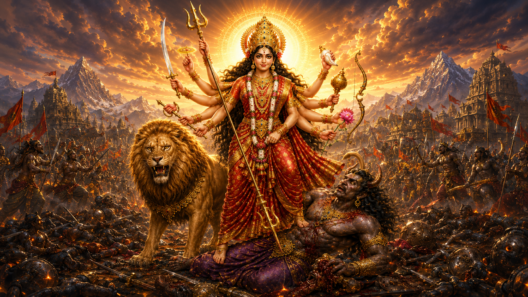
Parvati appears in multiple forms: as the gentle, domesticating Uma; as the fierce Durga when she battles demons; as the terrifying Kali when even Durga is overwhelmed; as Annapurna, the nourishing goddess of food. All these are facets of Shakti, Shiva’s inseparable power.
Ganesha: The Elephant-Headed Son
Ganesha (also called Ganapati, Vinayaka) is the elder son of Shiva and Parvati — the elephant-headed lord of beginnings, remover of obstacles, and patron deity of wisdom, writing, and all new ventures. The most popular narrative of Ganesha’s elephant head tells of Parvati fashioning a boy from her own body while Shiva was absent, stationing him as a guardian at her door. When Shiva returned and the unfamiliar boy refused him entry, Shiva in fury beheaded him — only to discover he had killed Parvati’s son. Distraught, he promised to replace the head with the first living being found facing north, which was an elephant. Ganesha is thus both the son of Shiva and a living symbol of the union of the human and the divine, the small and the cosmic.
Kartikeya / Murugan: The Warrior Son
Kartikeya (also Skanda, Murugan, Subramanya) is the second son of Shiva — the commander of the divine army (Devasena) who was born specifically to destroy the demon Tarakasura, whom only Shiva’s son could kill. Kartikeya’s birth narrative is extraordinary: Shiva’s seed (released during interrupted meditation) was too powerful for any single womb — it was carried by Agni (fire), then by the Ganga, and finally nurtured by the six Krittika star-maidens, giving him six faces (Shanmukha). He wields the Vel (divine spear) and rides a peacock. In South India, the worship of Murugan is ancient, elaborate, and distinct — the Tirumurugattrupadai (one of the Ten Tamil Idylls) is entirely dedicated to him. Kavadi-bearing pilgrims undertaking the Thaipusam festival are among the most visually striking expressions of Shaiva devotion on earth.
Nandi: The Devoted Gatekeeper
Nandi is simultaneously Shiva’s vehicle, his chief gana (attendant), and the prototype of perfect devotion. Nandi is the son of the sage Shilada and a celestial being — he chose Shiva as his eternal master and was rewarded with the post of gatekeeper and chief of Shiva’s celestial retinue. Every Shiva temple has a Nandi image facing the sanctum, and worshippers traditionally whisper their prayers into Nandi’s ear, trusting that the devoted bull will carry the words to his master. Nandi is also credited as the transmitter of the Agamic knowledge — the vast corpus of Shaiva temple science and ritual was transmitted from Shiva through Nandi to the rishis.
Sacred Abodes: Kailash, Kashi, and the Jyotirlingas
Mount Kailash: The Celestial Abode
Mount Kailash (6,638 metres), rising in the Trans-Himalayan range of Tibet, is held in the Shaiva tradition to be Shiva’s earthly abode — Kailasa, the silver mountain where Shiva sits in eternal meditation. The mountain has never been climbed — not because it is technically impossible, but because no serious mountaineer has attempted its summit out of a combination of legal prohibition, local reverence, and the mountain’s own mysterious presence. The Kailash Mansarovar Yatra — circumambulation of the mountain and a dip in the sacred Mansarovar lake — is one of the most arduous and spiritually charged pilgrimages in the world, undertaken by Hindus, Jains, Buddhists, and Bönpo practitioners alike. A single parikrama (circuit, approximately 52 km) is said to cleanse the karma of one lifetime; 108 circuits guarantee liberation.
Kashi / Varanasi: The Eternal City
Kashi (modern Varanasi/Benares) is Shiva’s city on earth — the one place in the universe, it is said, that Shiva never leaves. Kashi exists as a tirtha (crossing-place) between the mortal and divine worlds. The Kashika Khanda of the Skanda Purana devotes thousands of verses to Kashi’s sacred geography, listing 56 Vinayaka shrines, 72 Shiva lingas within the city, 12 Aditya temples, and the supreme Kashi Vishwanath Jyotirlinga at its centre. Every soul that dies within Kashi’s limits — the area enclosed between the Varuna and Assi rivers that give the city its modern name — is said to receive Taraka Diksha (initiation into the liberation mantra) from Shiva himself, guaranteeing moksha. This is why Kashi has been the preferred place to die for millennia, and why its burning ghats, where cremations proceed around the clock, are not places of mourning but of the deepest spiritual celebration.
The Twelve Jyotirlingas
Across the Indian subcontinent, twelve sites are held to be locations where Shiva appeared as the self-luminous column of light (jyotirlinga). These are: Somnath (Gujarat), Mallikarjuna (Andhra Pradesh), Mahakaleshwar (Ujjain), Omkareshwar (Madhya Pradesh), Kedarnath (Uttarakhand), Bhimashankar (Maharashtra), Kashi Vishwanath (Varanasi), Trimbakeshwar (Maharashtra), Vaidyanath (Jharkhand), Nageshwar (Gujarat), Rameshwaram (Tamil Nadu), and Grishneshwar (Maharashtra). Pilgrimage to all twelve is considered supremely meritorious and is undertaken by millions of devotees. Each Jyotirlinga has its own mythological narrative, unique iconography, and associated puranic text.
The Pancha Bhuta Stalas
In South India, five ancient temples in Tamil Nadu and Andhra Pradesh are held to enshrine Shiva as the five great elements (panchabhutas): Chidambaram (Nataraja — akasha/space), Thiruvanaikaval (Jambukeshvara — water), Thiruvannamalai (Arunachala — fire), Kalahasti (Vayu — air), and Kanchipuram (Ekambareshvara — earth). The five temples form a sacred circuit that maps the cosmos onto the South Indian landscape. Pilgrimaging through all five is believed to purify the gross body, subtilise the senses, and prepare the devotee for deeper contemplation.
Key Narratives from the Puranas
The Destruction of Daksha’s Yagna
King Daksha — Shiva’s father-in-law and a lord of creation — held a grand yajna (fire sacrifice) to which he deliberately did not invite Shiva, considering the ash-smeared wanderer unworthy of divine company. Sati, Shiva’s consort and Daksha’s own daughter, was devastated by this insult to her husband. She insisted on attending despite Shiva’s warning, and when she arrived, Daksha publicly and viciously insulted Shiva. Unable to bear the dishonour to her husband, Sati threw herself into the sacrificial fire. When the news reached Shiva, his grief turned to cosmic rage. He tore a matted lock from his hair, creating the terrifying being Virabhadra, who led Shiva’s army to destroy the yagna — decapitating Daksha, routing the assembled gods, and reducing the sacrifice to ashes. Brahma and Vishnu eventually appealed to Shiva’s mercy; Daksha was restored to life with a goat’s head, and the sacrifice was completed. This myth establishes Shiva as a deity who does not accept humiliation silently and whose wrath, while terrible, is ultimately disciplinary rather than vindictive.
The Burning of Kamadeva
After Sati’s death, Shiva withdrew into the Himalayas and entered an inconsolably deep meditation. The gods, alarmed because a great demon (Taraka) could only be destroyed by Shiva’s son, needed Shiva to fall in love with the reborn Sati (now Parvati) and father a divine warrior. They sent Kamadeva (the god of love/desire) to shoot his flower-arrow at the meditating Shiva. The moment the arrow struck, Shiva’s third eye opened — a single beam of fire incinerated Kamadeva on the spot, reducing him to ash. The gods were terrified. Yet the moment of disturbance had been enough: Shiva became aware of Parvati’s presence. After Parvati performed years of intense austerity to prove her worthiness, Shiva accepted her as his consort. Kamadeva was eventually restored to formless existence as Ananga (“the bodiless one”). The story encodes a sophisticated psychology: desire, when it attempts to penetrate the stillness of pure consciousness, is destroyed — yet the love that remains, purified of desire, is the deepest love of all.
Shiva as Kiratarjuna: The Hunter of the Mahabharata
During his forest exile, Arjuna undertook severe penance on the Himalayas to obtain the Pashupatastra — Shiva’s supreme weapon — from the great god himself. Shiva appeared before him in disguise as a mountain hunter (kirata) accompanied by Parvati. A quarrel arose over the kill of a boar (actually the demon Muka sent by Duryodhana) — Arjuna claimed the kill, the hunter disputed it. They fought; Arjuna’s arrows mysteriously disappeared, his bow shattered, his quiver emptied. He attacked with his fists; the hunter absorbed the blows. He fashioned a garland and placed it at the hunter’s feet in surrender — the garland rose to rest on Shiva’s head. The disguise dropped; the full blazing form of Shiva appeared; Arjuna was granted the Pashupatastra — the weapon of absolute dissolution. This episode from the Kiratarjuniya section of the Mahabharata (and Bharavi’s epic poem of the same name) is one of literature’s most celebrated portrayals of the divine test: the guru appears in an unexpected, even hostile form, and it is precisely the devotee’s surrender that earns the supreme gift.
Shaiva Traditions and Philosophical Schools
Shaivism is not a single monolithic tradition but a vast family of related philosophical and devotional streams, each with its own scriptural corpus, ritual tradition, and metaphysical framework.
Shaiva Siddhanta
Shaiva Siddhanta is the predominant theological tradition of Tamil Shaivism and the philosophical foundation of South Indian temple worship. Its canonical texts are the 28 Shaiva Agamas and the 12th-century Tamil theological works of Meykandar and his successors. Shaiva Siddhanta is a pluralistic realism — it holds that God (Shiva), individual souls (pashu), and world (pasha) are three eternally real and distinct entities. Liberation (mukti) is the soul’s release from the bonds of anava (ego), karma, and maya through Shiva’s grace. The Nayanmars — 63 Tamil saint-poets of the 6th–9th centuries — represent the emotional summit of Shaiva Siddhanta, their hymns (collected in the Tirumurai) moving from intense personal longing to the ecstasy of divine merger.
Kashmir Shaivism
Kashmir Shaivism (also known as Trika or Pratyabhijna) is the non-dualistic Shaiva philosophy developed by a succession of brilliant thinkers in medieval Kashmir, most famously Abhinavagupta (950–1020 CE), whose Tantraloka (30 volumes) is the most comprehensive exposition of Tantric Shaiva philosophy ever written. For Kashmir Shaivism, there is only one reality — Shiva-consciousness — and the universe is not an illusion (as in Shankara’s Advaita) but the free play (lila) of Shiva’s consciousness with itself. The individual soul does not need to be released from the world but simply needs to recognise (pratyabhijna = recognition) its own identity with Shiva-consciousness. The path involves practices such as shaktipat (transmission of awakening energy), krama (sequential meditation), and the cultivation of the vibrant recognition that one’s own awareness is Shiva himself.
Veerashaivism / Lingayatism
Veerashaivism, founded by the reformer Basavanna (1131–1167 CE) in Karnataka, represents a socially radical current within Shaivism. Basavanna rejected caste hierarchy, brahminical ritualism, and temple formalism, teaching that Shiva (worshipped as the Ishtalinga — a small linga worn on the body) is accessible to all without mediation of priest or caste. The movement produced the extraordinary vachana literature — hundreds of thousands of prose poems in Kannada, composed by male and female saints across all castes, that are among the most direct, passionate, and socially progressive devotional writings in world literature.
The Nath Sampradaya
The Nath tradition, associated with Gorakshanath (10th–12th century CE) and the nine Nath Siddhas, understands Shiva as Adiyogi — the first yogi who transmitted the knowledge of Hatha Yoga, Kundalini Yoga, and the alchemical practices of rasayana. The Nath tradition is the primary source of classical Hatha Yoga as it spread across South Asia and eventually to the world. Gorakshanath’s texts — the Gorakshashataka, Vivekamartanda — describe the yogic body, its energy channels, the six chakras, and the ascent of kundalini energy toward the sahasrara (crown chakra) where Shiva and Shakti unite in liberation.
Shiva and Adiyogi: The First Yogi
One of the most important identifications of Shiva in the living tradition is as Adiyogi — the first yogi, the originator and transmitter of all yogic science. The Yogic tradition holds that on the day of the summer solstice thousands of years ago, a being appeared in the upper Himalayas who was neither moving nor still, neither alive nor dead — he simply sat. Drops of ecstasy fell from his eyes. After long observation, seven sages (Saptarishis) begged him to share what he had found. He ignored them for 84 years. Finally, on the winter solstice (celebrated as Guru Purnima by some traditions), he agreed to transmit the knowledge — turning south, facing the seven sages, and transmitting the science of yoga in its completeness. This day marks the birth of the transmission of inner science. The seven sages carried this knowledge to every corner of the world. In this tradition, every yoga lineage ultimately traces itself back to Adiyogi — Shiva — as the source.
Shiva in Daily Worship and Practice
Om Namah Shivaya: The Panchakshara Mantra
Om Namah Shivaya — “I bow to Shiva” — is the most widely chanted mantra in Shaivism and one of the most recited in all of Hinduism. It contains the five sacred syllables Na-Ma-Shi-Va-Ya (the panchakshara), which correspond to the five elements (earth, water, fire, air, space), the five actions of Shiva (panchakriya), and the five sense organs. The mantra appears in the Shri Rudram of the Krishna Yajur Veda (8th anuvaka) and has been transmitted continuously for over 3,000 years. Regular chanting of this mantra is held to gradually dissolve the ego, purify the chakras, and open the practitioner to the grace of Shiva.
Rudrabhisheka
Rudrabhisheka — the ceremonial bathing of the Shivalinga — is the central ritual of Shaiva worship. The linga is bathed with milk, curd, honey, ghee, sugarcane juice, rose water, and finally plain water, while the priest chants the Shri Rudram and Chamakam. Each substance offered carries symbolic significance: milk for purity, curd for contentment, honey for sweetness, ghee for knowledge. The ritual re-enacts on a microcosmic scale the cosmic relationship between the devotee and Shiva — the devotee pouring out all that is pure and nourishing onto the image of the infinite, receiving in return the divine vibration of the sacred mantras.
Pradosham
Pradosham is the bi-monthly (twice per lunar month) auspicious period that falls on the Trayodashi (13th lunar day) of both the waxing and waning moon, approximately 1.5 hours before and after sunset. According to the Skanda Purana, during Pradosham all the devas assemble on Mount Meru to witness Shiva’s tandava dance. Worship performed during Pradosham time — particularly the bathing of the linga, circumambulation of the temple, and recitation of Shiva prayers — is considered exponentially more effective than worship at other times. Shani Pradosham (Pradosham falling on Saturday) is especially auspicious for devotees of Shiva who seek relief from karmic difficulties.
Mahashivaratri
Mahashivaratri — “The Great Night of Shiva” — falls on the 14th night of the dark fortnight in the month of Phalguna (February–March). It is the most important festival in the Shaiva calendar. According to one narrative, this is the night Shiva performed his cosmic dance; according to another, it is the night Shiva swallowed the Halahala poison; according to a third, it is the night of the marriage of Shiva and Parvati. Devotees fast through the day and stay awake through the night, bathing the linga at four intervals (corresponding to the four prahars / watch-periods of the night), chanting, and meditating. The night vigil has a yogic rationale: the earth’s magnetic north pole is at its weakest during this period, and human energy is naturally inclined upward — staying awake in meditation at this time facilitates deeper states of consciousness.
Shravan Month
The month of Shravan (July–August) is dedicated to Shiva in the North Indian calendar. Every Monday of Shravan is celebrated as Shravan Somvar, considered supremely auspicious for Shiva worship. During this month, millions of devotees — the Kanwariyas — undertake barefoot pilgrimage to the Ganga, carrying water home in decorated pots (kanwar) to offer at local Shiva temples. The Kanwar Yatra is one of the largest annual human pilgrimages on earth, drawing tens of millions of participants across North India.
Key Takeaways
- Shiva is the Absolute in personal form — in Shaiva philosophy, he is not merely one of three gods but the supreme reality (Brahman) who contains, creates, preserves, and dissolves all existence.
- His iconography is a complete theology — every element of Shiva’s appearance (ash, serpent, moon, Ganga, third eye, lingam) is a precise philosophical statement about the nature of reality and liberation.
- He is simultaneously the most ascetic and the most compassionate — Shiva sits in renunciation yet is the most easily propitiated god (Bholenath). His austerity and accessibility are not contradictory but two faces of the same infinite love.
- The Shivalingam is not a physical idol but a symbol of the infinite — it represents the formless absolute that cannot be contained in any human image, yet graciously manifests as a sign (lingam) for the sake of human worship.
- Shiva is the Adiyogi — the first yogi and the source of all yogic science. Every lineage of yoga, meditation, and inner inquiry traces itself, directly or indirectly, to the transmission of Shiva-consciousness.
- The Panchakriya (five cosmic actions) — creation, preservation, dissolution, concealment, and grace — are Shiva’s continuous activity, and together they constitute a single, compassionate act aimed at the liberation of every soul.
- Shaivism is a living, diverse tradition — from Shaiva Siddhanta to Kashmir Shaivism, from Lingayatism to the Nath Sampradaya, Shiva has inspired some of the world’s most sophisticated philosophical systems and the most personal devotional poetry.
- Om Namah Shivaya is not merely a mantra but a complete spiritual programme: each of its five syllables addresses one of the five sheaths of the human body and one of the five elements of the cosmos.
Frequently Asked Questions
Is Shiva a god of destruction only?
No — this is one of the most common and significant misunderstandings about Lord Shiva. While Shiva is associated with dissolution (samhara) in the Hindu Trinity, destruction in the Shaiva context is never mere annihilation. It is transformation — the necessary end of what is exhausted, so that what is new and more conscious can arise. Shiva destroys ego, ignorance, and what has run its course, not out of hostility but out of cosmic compassion. He is equally the creator of yoga, the teacher of the Vedas, the patron of arts, the most devoted husband, and the most accessible of all deities — called Bholenath (“the innocent Lord”) precisely because he grants liberation to even the simplest sincere devotee.
What is the significance of the Shivalingam?
The Shivalingam is one of the most misunderstood symbols in world religion. Theologically, the lingam represents the formless, infinite nature of Shiva — the absolute that cannot be contained within any human form. The word lingam means “sign” or “mark” in Sanskrit: it is the minimal possible form that marks the presence of the Formless. The story of the infinite column of light (jyotirlinga) that Brahma and Vishnu could not find the beginning or end of establishes the lingam as the symbol of the Infinite. The pitha (base) represents Shakti — the creative energy — and the lingam-pitha unit represents the inseparable union of Shiva and Shakti, consciousness and energy, the transcendent and the immanent.
Who are the Nayanmars and why are they important?
The Nayanmars (also Nayanars) are 63 Tamil poet-saints of the 6th–9th centuries CE who composed deeply personal hymns of devotion to Shiva in classical Tamil. They came from all castes — including hunters, farmers, fishermen, and kings — and their lives and hymns, compiled in the Tirumurai (twelve volumes), transformed Tamil culture and significantly shaped the development of Bhakti (devotional) movements across India. Their most celebrated collections are the Tevaram (hymns of the three great saints Sambandar, Appar, and Sundarar) and the Thiruvasagam of Manikkavacakar — poems of such beauty and intensity that they are still sung in South Indian Shiva temples every morning as living liturgy, over 1,200 years after their composition.
What is the difference between Rudra and Shiva?
Rudra is the Vedic predecessor and one face of what later became the fully elaborated deity Shiva. In the Rig Veda, Rudra is a storm deity — fierce, destructive, associated with wild nature, death, and disease, but also with healing and grace. He is propitiated with prayers precisely because he is feared. Over time, through the Upanishadic period and into the Puranic period, Rudra was increasingly identified with the Absolute itself — developing from a peripheral storm deity into the great god Shiva, who absorbed into himself a vast range of other divine attributes (Shiva the ascetic, Shiva the dancer, Shiva the householder, Shiva the teacher, Shiva the erotic). The name “Shiva” (Auspicious) is itself a propitious euphemism — just as Rudra’s dangerous aspects were softened and transcended by the more complete revelation of the Mahadeva. In temple worship, the Vedic aspect of Shiva is still invoked through the Shri Rudram; the Puranic and Agamic aspects through the Panchakshara mantra and the visual forms.
Why does Shiva live in cremation grounds?
Shiva’s presence in cremation grounds (shmashana) is one of the most intentional and philosophically loaded aspects of his iconography. In most religious cultures, the place of death and cremation is the most ritually impure, the most feared, and the most avoided. Shiva makes it his home, smears its ash on his body, and dances there in the night — the ultimate gesture of absolute fearlessness and the transcendence of all conventional categories of purity and impurity. The message is that no place, no state, no experience is beyond the divine presence. For the yogi who has realised the Self, there is nowhere that is not sacred. Practically, the cremation ground is also the great teacher of detachment: in its fires, all social distinctions — of caste, wealth, beauty, and power — reduce to the same ash. Shiva dwelling there is Shiva in the company of the ultimate truth that the world spends its life avoiding.
What is the Maha Mrityunjaya Mantra and why is it associated with Shiva?
The Maha Mrityunjaya Mantra (Tryambakam yajaamahe sugandhim pushtivarddhanam / Urvaarukamiva bandhanaan mrityor mukshiya maamritaat) — “We worship the three-eyed Shiva, the fragrant nourisher of all. May he free us from the bondage of death as a cucumber is freed from its vine, and grant us immortality” — is one of the oldest and most sacred mantras in the Vedic tradition, appearing in the Rig Veda (7.59.12) and the Krishna Yajur Veda. It is addressed to Shiva as Tryambaka (the three-eyed one) and is traditionally chanted for healing, protection, longevity, and liberation. The mantra does not merely pray for physical survival but for moksha — liberation from the cycle of birth and death. It is recited at the bedside of the dying, at the beginning of surgical procedures in Ayurvedic tradition, and as a daily protective mantra by millions of devotees worldwide.